As an Amazon Associate, I earn from qualifying purchases.
In this article 12 sections
- How Does a Lightning Detector Work?
- Detection Range and Alert Zones
- The 30-30-30 Rule Explained
- Types of Lightning Detectors
- Best Lightning Detectors to Buy
- Lightning Detection in Home Weather Stations
- How Accurate Are Lightning Detectors?
- Lightning Detector vs Smartphone App: Which Is Better?
- How to Install a Lightning Detector
- False Alerts and Limitations
- Lightning Safety Facts
- Frequently Asked Questions

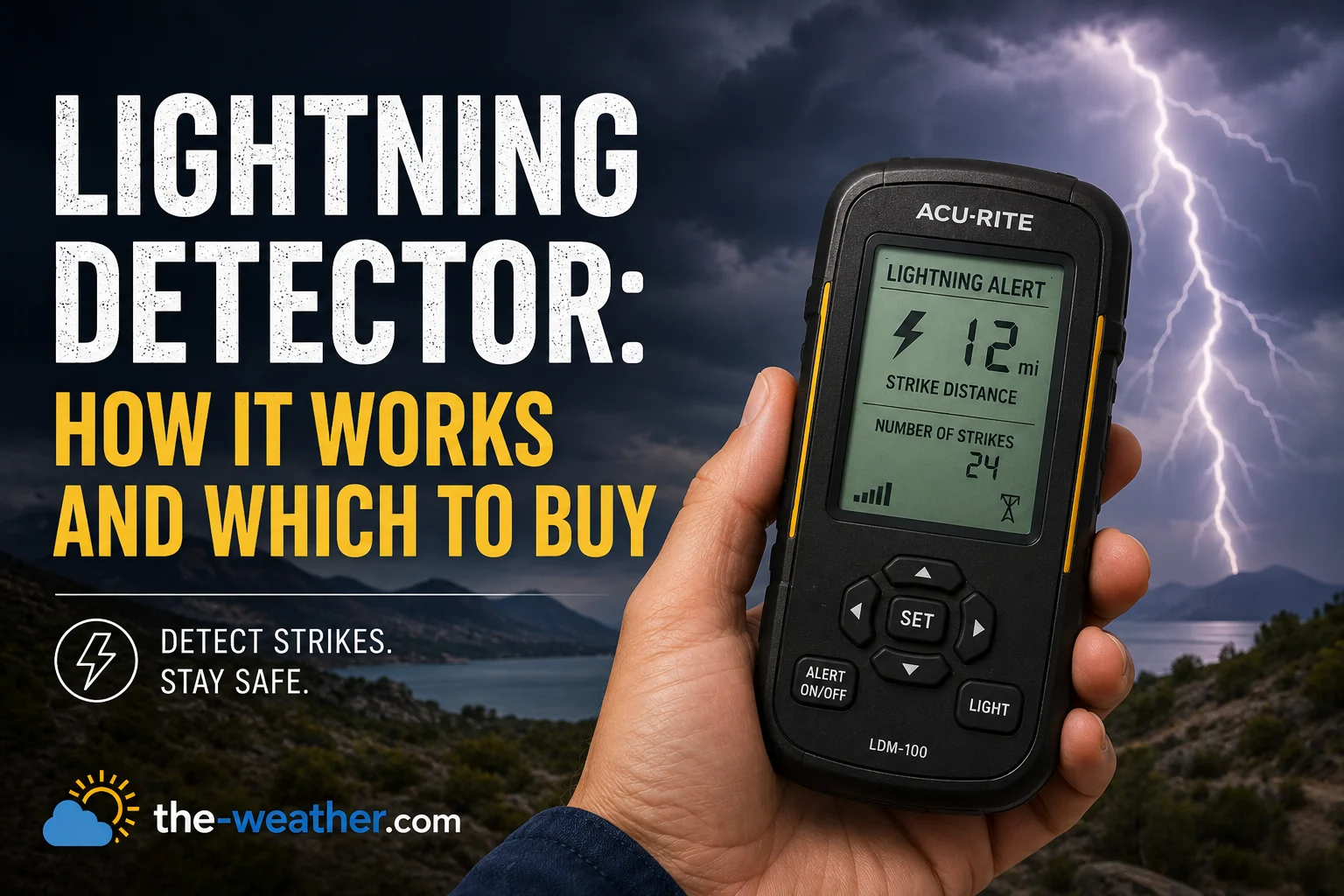
Lightning kills more Americans annually than tornadoes or hurricanes in most years. The problem is not that storms are unpredictable: it is that most people go back outside too soon, or do not seek shelter early enough in the first place. A lightning detector removes the guesswork by detecting the electromagnetic signature of each strike and estimating its distance from your location in real time.
This guide covers how lightning detectors work, what the detection range actually means, the 30-30-30 safety rule, the difference between consumer devices and professional networks, and which options work best for home weather stations, outdoor activities, and pool safety.
A lightning detector senses the radio frequency pulse emitted by each lightning strike and estimates its distance from your location, typically in zones up to 25 miles (40 km). Consumer devices use the AS3935 chip to distinguish lightning from other electrical interference. They work reliably but are not 100% accurate: false alerts from motors and power lines are possible, and false negatives can occur in heavy rain. Always combine detector readings with the 30-30-30 rule.
How Does a Lightning Detector Work?

Every lightning bolt generates a powerful burst of radio frequency (RF) energy called a sferic (short for atmospheric). This electromagnetic pulse travels outward from the strike at the speed of light and can be detected hundreds of miles away. A lightning detector identifies these pulses, filters out interference from other sources, and uses signal strength to estimate how far away the strike occurred.
A discharge between cloud and ground or between clouds releases a burst of radio frequency energy in the 500 kHz range, the characteristic signature of lightning.
The detector's antenna picks up the electromagnetic pulse. The AS3935 chip, used in most consumer devices, is tuned specifically to the frequency range of lightning sferics.
The AS3935 applies a pattern-matching algorithm to distinguish lightning pulses from false sources like electric motors, fluorescent lights, and power line noise. It assigns a confidence level to each detected event.
Signal attenuation over distance allows the chip to estimate how far the strike occurred. Stronger signals indicate closer strikes. The device reports distance in zones (overhead, near, distant) rather than an exact mileage.
The device sounds an alert, displays the estimated distance zone, and logs the strike count. Most home weather station sensors transmit this data wirelessly to a console and phone app in real time.
Did you know: The AS3935 chip was developed by Austria Microsystems and is now used in devices from AcuRite, Ambient Weather, Ecowitt, and Boltek. It detects lightning in the 500 kHz frequency band and can discriminate between cloud-to-ground and intra-cloud discharges in some implementations. The full AS3935 datasheet from ams OSRAM details the chip's detection algorithm and sensitivity settings.
Detection Range and Alert Zones
Consumer lightning detectors report distance in zones rather than precise mileage. This is because signal attenuation varies with terrain, humidity, and storm type, making exact distance estimation unreliable. Most AS3935-based devices report three zones plus a clear status.
Seek shelter immediately. Do not wait. Lightning at this range can strike with no audible warning. Stay indoors away from windows, plumbing, and corded electronics.
Move indoors now. Lightning regularly strikes several miles ahead of a visible storm. At 12 miles, you have roughly 10 minutes before the storm reaches you: less if it is moving fast.
Monitor closely. Be prepared to seek shelter. Begin clearing outdoor activities. A fast-moving storm can close 12 miles in 15 to 20 minutes.
No lightning detected within 25 miles in the last several minutes. Apply the 30-minute rule: wait 30 minutes after the last detected strike before resuming outdoor activities.
The 30-30-30 Rule Explained
The 30-30-30 rule is the National Weather Service guideline for lightning safety. It applies whether or not you have a lightning detector, and should be used alongside any detector reading rather than as a replacement for one.
A lightning detector extends your warning window beyond what the 30-second flash-to-thunder method provides. By detecting strikes at 25 miles, it can alert you 20 to 30 minutes before a storm arrives: giving you time to clear a pool, end an outdoor event, or move equipment under cover before you would otherwise see or hear anything.
Types of Lightning Detectors
| Type | Range | Best For | Price Range |
|---|---|---|---|
| Handheld personal detector | Up to 40 miles | Golf, hiking, outdoor sports, camping | $30 to $150 |
| Home weather station sensor | Up to 25 miles | Fixed home monitoring, pool safety, garden | $30 to $80 (add-on) |
| Weather station with built-in detector | Up to 25 miles | All-in-one home weather monitoring | $150 to $400 |
| Smartphone app (network-based) | Network coverage area | General awareness, mapping nearby strikes | Free to $5/month |
| Professional detector | Up to 300 miles | Aviation, sports facilities, utilities | $500 to $5,000+ |
Best Lightning Detectors to Buy
One of the most popular consumer handheld detectors. Uses the AS3935 chip with three alert zones and a strike count display. Compact enough for a golf bag or hiking pack. Range up to 40 miles. Around $40 to $60.
Widely used at outdoor sports facilities and golf courses. Audible alarm with distance zone display. Popular with pool operators and sports event managers for its loud alert tone. Range up to 40 miles. Around $50 to $80.
Wireless sensor that connects to all Ecowitt consoles and the GW series gateways. Displays strike count, distance zone, and time of last strike. Compact outdoor unit with waterproof housing. Around $30 to $40.
Compatible with Ambient Weather WS-2902 and WS-5000 stations. Adds lightning detection to an existing setup without replacing the station. Same AS3935 chip as the Ecowitt version. Around $35 to $45.
All-in-one station with temperature, humidity, wind, rain, UV, and lightning built in. No separate sensor purchase required. Connects to the Ecowitt app and supports third-party platforms. Around $150 to $200.
PCI-based professional lightning detection system with real-time mapping software. Used by airports, universities, and research stations. Detects strikes up to 300 miles with directional bearings. From $500.
Lightning Detection in Home Weather Stations
Most home weather stations do not include lightning detection as standard: it is typically an optional add-on sensor or a feature of higher-end models. The exception is some Ecowitt all-in-one units which bundle lightning with other sensors. See our home weather stations guide for a full breakdown of which stations support lightning add-ons.
| Station | Lightning included? | Add-on compatible? | Sensor |
|---|---|---|---|
| Ambient WS-2902C | No | Yes (WH57) | AS3935 |
| WeatherFlow Tempest | No | No | Not supported |
| Davis Vantage Pro2 | No | No | Not supported |
| Ecowitt GW2001 | Yes | Yes | AS3935 |
| Ecowitt HP2564 / HP2560 | No | Yes (WH57) | AS3935 |
For pool safety specifically, a fixed outdoor sensor connected to an app with push notifications is more practical than a handheld detector. The Ecowitt WH57 paired with the Ecowitt weather station app allows you to receive lightning alerts on your phone even when you are away from the console: useful for sending family members inside before a storm arrives.
How Accurate Are Lightning Detectors?
Consumer lightning detectors are reliable but not perfect. The AS3935 chip that powers most devices was designed for detection rather than precision mapping. Here is what accuracy looks like in practice:
| Metric | Consumer Device | Professional Network |
|---|---|---|
| Detection rate (nearby strikes) | 85 to 95% within 12 miles | 95 to 99% |
| Distance accuracy | Zone-based (not precise mileage) | Within 0.5 miles |
| False alert rate | 5 to 20% depending on placement | Under 1% |
| Range at high sensitivity | Up to 25 to 40 miles | Up to 300+ miles |
| Intra-cloud detection | Limited (some devices) | Full |
Placement is the biggest controllable factor in accuracy. A device placed next to a pool pump, air conditioning unit, or fluorescent light will produce far more false alerts than the same device placed in an open area away from electrical interference. Most AS3935-based devices include a sensitivity adjustment (high, medium, low): medium is the recommended setting for most home installations as it reduces false alerts without significantly reducing detection range.
Lightning Detector vs Smartphone App: Which Is Better?
One of the most common questions about lightning detectors is whether a dedicated device is actually necessary when lightning apps are available for free. The answer depends on what you need it for.
| Feature | Lightning Detector (Hardware) | Smartphone Lightning App |
|---|---|---|
| Detection method | Local RF pulse detection (AS3935 chip) | Crowdsourced network data (Blitzortung, Vaisala) |
| Internet required | No | Yes |
| Alert speed | Seconds after each strike | 30 seconds to several minutes lag |
| Works without cell signal | Yes | No |
| Shows strike location map | No (distance zone only) | Yes |
| Audible alarm | Yes (dedicated alert tone) | Push notification only |
| Best for safety decisions | Yes | Good as backup only |
| Cost | $30 to $150+ | Free to $5/month |
The key difference is speed and independence. A hardware lightning detector responds to the electromagnetic pulse of each strike within seconds and does not rely on a network connection. A smartphone app shows where lightning has already been reported by other sensors in a network, which introduces a lag of 30 seconds to several minutes, and stops working entirely if you lose cell signal in the field. For pool safety, camping, golf, or any outdoor activity where you need maximum warning time, a hardware detector is the better choice. Apps work well as a secondary reference for mapping storm movement.
How to Install a Lightning Detector
Correct placement makes a significant difference in both detection accuracy and false alert frequency. Whether you are installing a handheld detector, a home weather station add-on sensor, or a fixed outdoor unit, these guidelines apply.
- Place well away from power lines and electrical panels. Power line interference is the most common cause of false alerts. Keep the sensor at least 15 to 20 feet from any overhead power line and away from the electrical service entry to your home.
- Keep away from motors and pumps. Pool pumps, HVAC compressors, refrigerators, and electric motors all emit RF pulses that the AS3935 chip can mistake for lightning. Position outdoor sensors on the opposite side of the property from pool equipment where possible.
- Mount outdoor sensors at manufacturer-recommended height. Most add-on sensors like the Ecowitt WH57 are designed to be mounted at 3 to 6 feet on a post or fence in an open location. Follow the manufacturer's mounting guide exactly for the best results.
- Test before storm season. Once installed, verify the sensor is communicating with your console. Check that push notifications work on your phone. Run a sensitivity test by temporarily raising sensitivity to high to verify the sensor can detect distant events, then return it to medium for daily use.
- Do not install indoors near fluorescent lighting. Fluorescent and older LED ballasts emit RF interference that mimics lightning sferics. Indoor lightning sensors should be positioned away from any fluorescent fixtures and electrical panels.
- Recalibrate if false alerts become frequent. If your device starts triggering repeatedly with no storm present, lower the sensitivity one step. If false alerts persist, recheck all nearby electrical sources and relocate the sensor if necessary.
False Alerts and Limitations
No consumer lightning detector is 100% accurate. Understanding the limitations helps you use the device more effectively and avoid both unnecessary false alarms and dangerous false confidence.
| Issue | Cause | How to reduce it |
|---|---|---|
| False alerts (no lightning) | Electric motors, pool pumps, fluorescent lights, power tools, nearby power lines | Position sensor away from electrical equipment. Adjust sensitivity setting to medium rather than maximum. |
| Missed strikes (false negatives) | Heavy rain attenuating the RF signal, terrain blocking the signal path | Never rely solely on a detector. Always apply the 30-30-30 rule regardless of what the device shows. |
| Inaccurate distance estimate | Signal strength varies with storm type, storm height, and humidity | Treat distance zones as approximate guidance, not precise measurements. |
| Delayed alert | Processing time and wireless transmission lag in station-based sensors | Handheld detectors respond faster than station add-on sensors for time-critical safety decisions. |
Lightning Safety Facts
- Lightning kills an average of 20 Americans per year, with hundreds more injured (NOAA).
- Florida receives more lightning strikes than any other US state due to converging sea breezes from both coasts.
- 90% of lightning strike victims survive, but many suffer long-term neurological effects.
- Lightning can strike up to 10 miles ahead of a visible storm, in apparently clear sky (known as a "bolt from the blue").
- The smell of ozone before a strike is produced by the ionization of nitrogen and oxygen molecules in the discharge channel.
- Most US lightning fatalities occur in open fields, under trees, near water, and on golf courses.
- A typical lightning bolt carries 300 million volts and 30,000 amperes of current.
- The 30-minute rule after the last thunder is the single most important behavioral guideline for lightning safety.
Frequently Asked Questions
Do lightning detectors work?
Yes, lightning detectors work reliably for detecting nearby lightning strikes within their rated range of up to 25 to 40 miles. Consumer devices using the AS3935 chip can estimate distance in real time. They are not 100% accurate and can produce false alerts from electric motors and power lines. Positioning the device away from electrical interference and setting sensitivity to medium improves reliability significantly.
What is the 30-30-30 rule for lightning?
The 30-30-30 rule states: if the time between seeing lightning and hearing thunder is 30 seconds or less, seek shelter immediately (the storm is within 6 miles). Stay sheltered until 30 minutes after the last thunder is heard. The third 30 is to crouch low if caught in the open with no shelter available. The National Weather Service recommends the 30-minute rule consistently, as lightning can strike several miles ahead of a visible storm.
What device can be used to detect lightning?
Handheld personal lightning detectors (AcuRite, Skyscan), home weather station add-on sensors (Ecowitt WH57, Ambient WH57), and smartphone apps using crowdsourced lightning networks can all detect lightning. For home use, a weather station with a built-in lightning sensor or a dedicated add-on sensor is the most practical option. Smartphone apps show historical strike data, not real-time detection.
How far away do lightning detectors work?
Most consumer lightning detectors detect strikes within a 25-mile (40 km) radius. Some handheld models claim up to 40 miles. The device reports estimated distance in zones: 0-3 miles (overhead/imminent), 3-12 miles (near), and 12-25 miles (distant). Detection range can be reduced by terrain, buildings, heavy rain, and electrical interference from nearby appliances.
How much does a lightning detector cost?
Handheld personal lightning detectors cost $30 to $150. Home weather station lightning sensor add-ons cost $30 to $80. Weather stations with built-in lightning detection cost $150 to $400. Professional lightning detection systems cost $500 to several thousand dollars.
What state in the US gets the most lightning?
Florida receives more lightning strikes than any other US state, earning it the nickname the Lightning Capital of the United States. The combination of sea breezes from both the Atlantic and Gulf coasts converging over the Florida peninsula creates ideal thunderstorm conditions virtually every summer afternoon. Texas and Oklahoma rank second and third for total annual lightning strike counts.
What do you smell before lightning strikes?
The smell before lightning is ozone, produced when lightning ionizes nitrogen and oxygen molecules in the air. It has a clean, sharp, slightly metallic smell similar to chlorine or fresh rain. A strong ozone smell outdoors during a storm indicates nearby lightning activity and is a signal to seek shelter immediately.
Can I use my phone as a lightning detector?
Smartphones do not have hardware lightning sensors. Lightning apps use crowdsourced strike data from networks like Blitzortung to show where lightning has already struck on a map. A dedicated hardware detector responds to each strike's electromagnetic pulse within seconds, making it faster and more reliable for safety decisions than any app-based approach.
What attracts lightning to a house?
Lightning is attracted to the highest point in a given area. Tall trees near a house, metal roofing, antennas, satellite dishes, and ungrounded metal structures on a roof all increase strike risk relative to neighboring lower structures. Properly installed lightning rods and whole-home surge protection systems significantly reduce the risk of lightning damage to a home and its electronics.
Where do most people get struck by lightning?
According to NOAA data, most lightning fatalities in the US occur outdoors: in open fields, under trees, near water (fishing, boating, swimming), on golf courses, and during outdoor sports. The majority of strikes happen when people either fail to seek shelter early enough or go back outside too soon after a storm. The 30-minute rule after the last thunder is the most important safety guideline.
Sources
Lightning safety guidelines from the National Weather Service and CDC Lightning Safety. Lightning strike fatality data from NOAA. AS3935 chip specifications from Austria Microsystems official documentation. Product specifications from AcuRite, Ecowitt, Ambient Weather, Skyscan, and Boltek official documentation. No manufacturer compensation was received.
Lena Thornton
Weather Station Analyst & CWOP Contributor. Lena has researched, reviewed and analysed weather stations and instruments for over a decade. She contributes observation data to the Citizen Weather Observer Program (CWOP) and writes exclusively for the-weather.com.