We may earn a commission when you buy through links on this page, at no extra cost to you. Learn more
In this article 8 sections
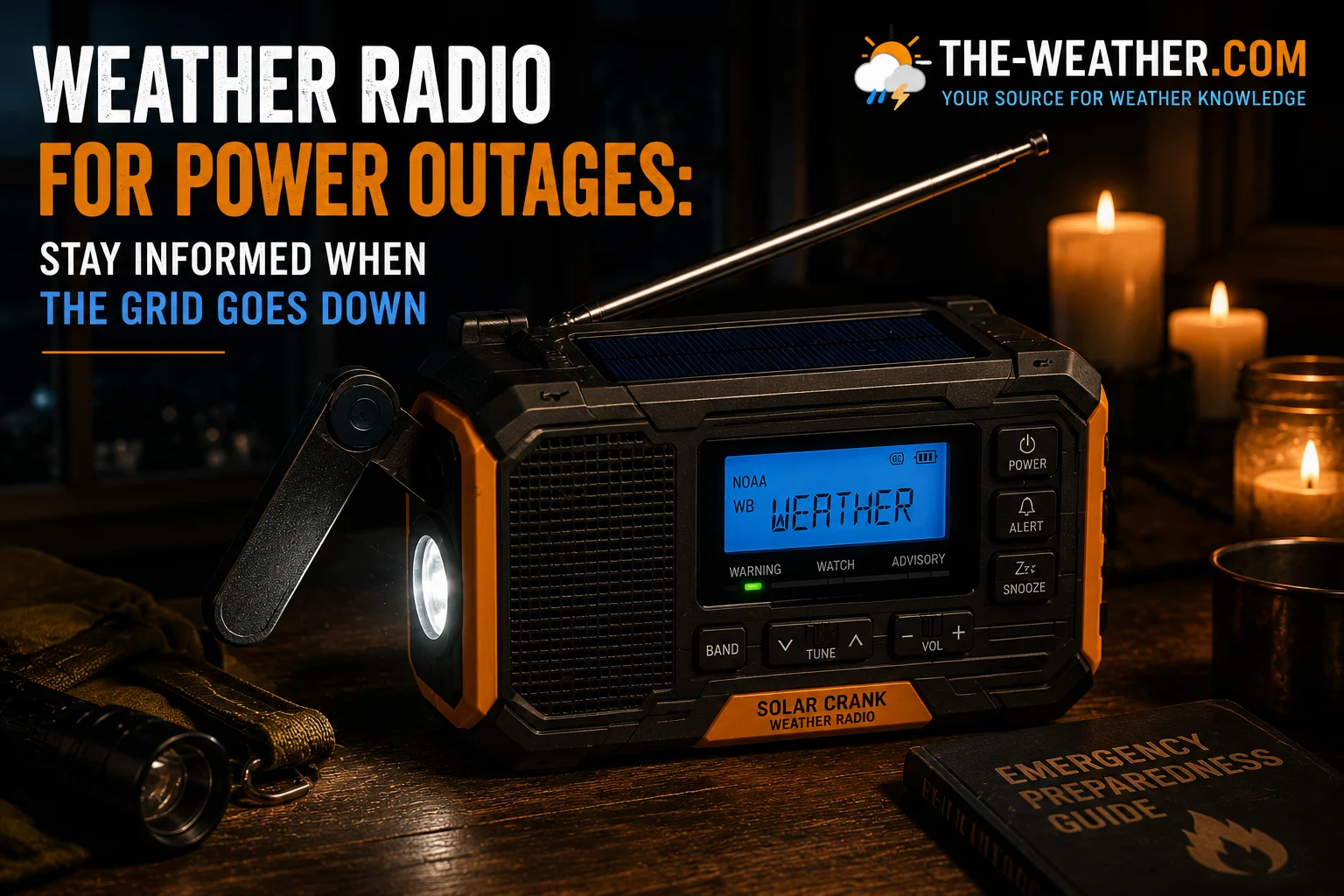
A power outage is the one scenario that simultaneously removes your most-used information sources, internet, phone charger, television, and smart home devices, while increasing your need for emergency information. A weather radio built for power outages solves this problem directly. It runs without the grid, receives NOAA alerts 24 hours a day, and keeps you informed through any outage, from a brief blackout to a multi-day weather event.
The key difference between a standard weather radio and one suited for power outages is power independence. A desktop radio that plugs into the wall is useless the moment the circuit breaker trips. A properly equipped emergency weather radio has at least three independent power sources, batteries, hand crank, and solar, so it works regardless of what the grid is doing.

Lena Thornton: Weather Station Analyst & CWOP Contributor
Specifications verified against official documentation
At a Glance
Why Your Phone Fails During Power Outages
Smartphones are the first thing people reach for during a power outage. They are also the least reliable information source in a major one. Three things happen simultaneously when a serious storm or grid failure hits:
Cell towers lose power. While carriers maintain backup generators, many sites rely on backup generators with finite fuel supplies, requiring refueling during prolonged outages. In the immediate aftermath of a major storm, towers also sustain physical damage from wind, flooding, and falling trees.
Networks become overloaded. Even when towers stay online, the volume of simultaneous calls and data requests from everyone in an affected area overwhelms network capacity. Texts go through; calls and data often do not.
Your phone battery dies. Without a functioning outlet and with the battery draining faster from constant background searches for signal, most phones are dead within 12–18 hours of normal use. A weather radio running on AA batteries keeps working for 40–80 hours with no outlet required.
NOAA's Weather Radio All Hazards network operates on 162–163 MHz and transmits from over 1,000 stations across the US. Most NOAA Weather Radio transmitters are designed with backup power to continue broadcasting during many outages, although service can still be interrupted by severe damage or prolonged failures.
Power Source Types for Outage Use
The most critical feature of any weather radio for power outages is how it generates power when the grid is gone. A single power source is a single point of failure.
AA / AAA Batteries
Most reliableFresh alkaline batteries provide 40–80 hours of continuous use. Stockpile fresh cells: they last 5–10 years in storage. Replace annually. This is your primary outage power source.
Built-in Rechargeable
Charge before storms10–20 hours of runtime when fully charged. Most comfortable listening experience. Charge to 100% when a storm is forecast. Also charged by hand crank and solar.
Solar Panel
Daylight dependentCharges the internal battery in direct sunlight. Set the radio in a window or outside during daylight hours. Useless at night or in prolonged cloud cover, never rely on it as a primary source.
Hand Crank
Last resort1 minute of cranking yields approximately 5–10 minutes of listening. Physically tiring for extended use. Essential as a final backup when all other power is exhausted, but not a primary strategy.
Power Source Runtime Comparison
Estimated Listening Time by Power Source
The Minimum Rule
NOAA weather band + hand crank + AA battery backup
This combination covers any outage scenario, from a 2-hour blackout to a week-long grid failure. Everything else is a useful addition, not a requirement.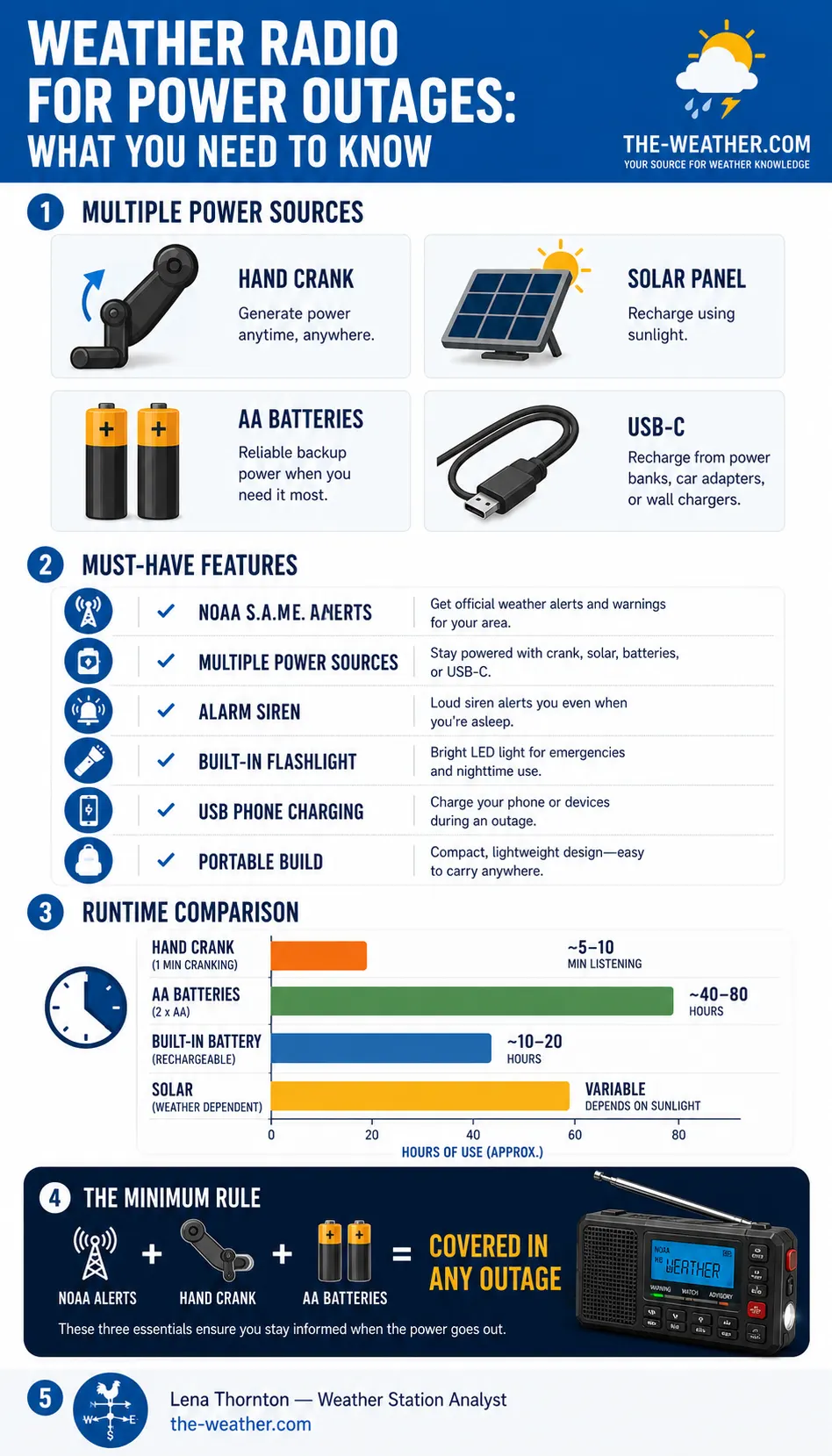
Features That Matter for Outage Use
What to Look For
Choosing by Outage Type
Storm-caused outage
Most common scenario. Outages last hours to days depending on damage. NOAA alerts are essential during the storm itself. AM/FM becomes important after for restoration updates. Large internal battery and USB charging extend usefulness into the recovery period.
Hurricane / Extended outage
Outages lasting days to weeks. Solar charging becomes useful for daily battery top-ups. AA battery stockpile is critical. USB phone charging is essential for maintaining communication when cell networks restore. Plan for minimum 5 days of independent power.
Tornado event
Short warning time: the alarm siren is the most critical feature. Keep the radio near your bed with S.A.M.E. programmed and the alarm enabled. Power outage may precede or follow the tornado. AA batteries as primary power ensures it works regardless of internal battery charge state.
Winter storm / Ice event
Cold reduces battery capacity: lithium AA batteries outperform alkaline below freezing. Keep the radio indoors and warm. Extended outages in winter present genuine safety risks; NOAA alerts and AM/FM for local shelter information are both essential.
Top Weather Radios for Power Outages
Midland ER310PRO
Top PickThe most complete emergency weather radio for power outage use. The 10,000mAh battery delivers up to 200 hours of runtime and charges phones via USB. NOAA S.A.M.E. alerts, hand crank, solar panel, and an ultrasonic dog whistle for locating pets.
- 10,000mAh battery: up to 200hr runtime
- NOAA + S.A.M.E. + AM/FM
- Hand crank + solar + USB-C
- USB phone charging output
- Typical price: ~$90–$100
Midland ER40
Best ValueCompact and affordable alternative to the ER310PRO. Smaller battery but lighter build: better suited for bug-out bags and portability. Covers all the essential outage features at a lower price point.
- Compact, portable build
- NOAA + S.A.M.E. + AM/FM
- Hand crank + solar
- USB phone charging output
- Typical price: ~$50–$65
Midland WR120B
Best DesktopDedicated desktop NOAA weather radio, not a multi-purpose survival unit. Plugs into the wall with AAA battery backup for outages. Best for bedside or kitchen counter placement where AC power is normally available and you want the alarm always active.
- AC power with AAA battery backup
- NOAA + S.A.M.E. + alarm siren
- Continuous NOAA alert monitoring while powered
- No crank or solar: pair with a portable unit
- Typical price: ~$30–$45
S.A.M.E. Alerts: Why County Filtering Matters During Outages
S.A.M.E. (Specific Area Message Encoding) is the feature that makes a NOAA weather radio genuinely useful rather than a nuisance. Without it, a radio in coastal Florida receives alerts for every county within broadcast range, which can mean alarm tones at 3 a.m. for storms 150 miles away.
With S.A.M.E. programmed to your county code, the alarm only sounds for alerts affecting your specific area. This means when it goes off during an outage at night, it is always relevant. You do not train yourself to ignore it.
Find your S.A.M.E. county code at nws.noaa.gov/nwr/counties. Program it into your radio before the next storm season. See our step-by-step walkthrough at how to program a Midland weather radio.
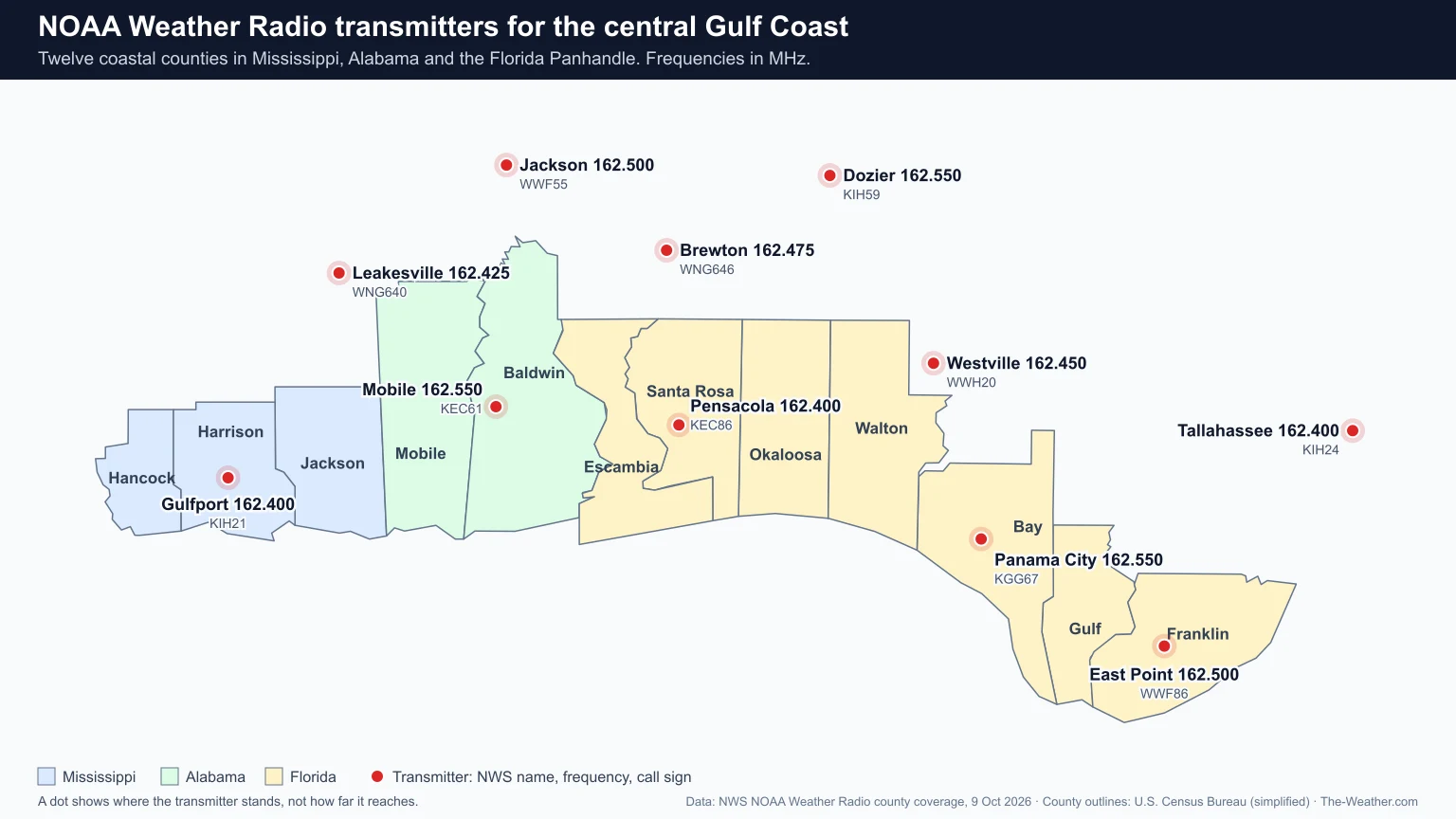
For the coast from Mississippi to the Florida Panhandle, our Gulf Coast county lookup shows the SAME code of each county and the transmitters listed for it.
S.A.M.E. also lets you select which alert types trigger the alarm. You can choose to receive tornado warnings and hurricane watches while filtering out lower-urgency advisory messages. This level of control is what separates a quality outage radio from a basic one, and it is the reason to prioritize S.A.M.E. capability above almost every other feature.
Frequently Asked Questions
Can a weather radio work during a power outage?
Yes, that is precisely what a weather radio is designed for. A quality emergency weather radio runs on AA batteries, a built-in rechargeable battery, a hand crank, and a solar panel. None of these require grid electricity. The NOAA transmitter network also runs on backup generators, so alerts continue broadcasting through most power outages.
What is the best emergency weather radio?
The Midland ER310PRO is consistently ranked among the best emergency weather radios. It features a 10,000mAh battery with up to 200 hours of runtime, hand crank charging, a solar panel, NOAA weather alerts with S.A.M.E. filtering, an alarm siren, and USB phone charging output. The Midland ER40 is a more compact and affordable alternative.
How long will a hand crank radio play?
Typically, one minute of hand cranking provides approximately 5 to 10 minutes of radio listening time. Hand cranking is tiring for extended use and is best treated as a last-resort power source when batteries are exhausted. Many emergency radios can operate for roughly 30–80 hours on a fresh set of AA batteries, depending on the model and usage.
What is the best radio for when the grid goes down?
For grid-down scenarios, the best radio combines NOAA weather alerts, AM/FM reception, multiple power sources (hand crank, solar, battery), and USB phone charging. The Midland ER310PRO covers all of these. For longer outages requiring shortwave reception, the Kaito KA500 is the standard recommendation.
Do weather radios need Wi-Fi or cell service?
No. NOAA weather radios receive broadcasts directly from transmitters on 162–163 MHz frequencies and require no internet connection, Wi-Fi, or cell service. This is the key advantage over smartphone weather apps during major outages when cell infrastructure fails.
What radio would survive an EMP?
Simple analog radios with minimal digital circuitry may be more resistant to electromagnetic pulse, though EMP effects depend on many variables. Storing a basic AM/FM radio in a metal container when not in use adds protection. For everyday preparedness, the risk of EMP is far lower than the near-certainty of needing a working battery-powered radio during a storm or outage.