Our picks in this guide
Compare the models in this guide
See today’s price, delivery options and customer reviews on Amazon.
As an Amazon Associate we earn from qualifying purchases, at no extra cost to you. Learn moreWe may earn a commission when you buy through links on this page, at no extra cost to you. Learn more
In this article 14 sections
- Temperature Differences: Quick Glance Cheat Sheet
- Why Indoor and Outdoor Temps Never Match
- The Three Pillars of Temperature Variance
- How to Accurately Compare Your Temps
- Indoor vs. Outdoor vs. "Feels Like"
- The Daily Temperature Cycle
- Common Measurement Mistakes
- Is Your Home Weather-Proof?
- Safety First: Extreme Temperature Gaps
- Frequently Asked Questions
- Watch: What Causes the Temperature Gap?
- Related Weather Education
- Reliable Meteorological Sources
- Updates & Revisions
Have you ever stepped outside on a summer morning, expecting a crisp breeze, only to find it’s already sweltering? Or maybe your weather app says it’s a perfect 72 degrees, but you’re shivering in your living room? Honey, you aren't crazy! The difference between indoor and outdoor temperatures is a fascinating dance of physics, insulation, and local microclimates. Today, we’re diving deep into why your home feels like a different planet compared to your backyard.
In a heat wave right now? Why your yard can read hotter than the forecast: backyard temperature in a heat wave. Keeping rooms safe: track indoor temperature and humidity during a heat wave.
Temperature Differences: Quick Glance Cheat Sheet
Walls hold heat long after sunset.
Windows act like mini-greenhouses.
Moving air makes outside feel colder.
Moist air traps heat better than dry air.
Apps use airport data, not your yard.
Cheap sensors can be off by 3-5 degrees.
Why Indoor and Outdoor Temps Never Match
| Factor | Indoor Impact | Outdoor Impact |
|---|---|---|
| Sunlight | Trapped by glass (Greenhouse effect). | Direct radiation vs. shade. |
| Air Movement | Stagnant air feels warmer. | Wind removes heat from surfaces. |
| Insulation | Slows down temperature equalization. | N/A (Open system). |
| Heat Sources | Appliances, lights, and humans. | Asphalt, concrete, and soil. |
Let's be real, sugar: your house is essentially a big, insulated box. Its whole job is to resist the weather outside. When we talk about what temperature really is, we're measuring the kinetic energy of air molecules. Inside, those molecules are trapped. Outside, they’re free to roam. This fundamental difference is why your thermostat and your backyard sensor are always in a bit of a spat.
One of the biggest culprits is "Thermal Mass." Materials like brick, concrete, and even the heavy timber in your walls act like a thermal battery. During a hot day, they soak up heat. When the sun goes down and the outdoor air cools off, those walls are still radiating heat back into your rooms. It’s why your upstairs bedroom feels like a sauna at 10 PM even if it’s a lovely 65 degrees outside. Bless its heart, your house just doesn't know when to let go!
Then we have the "App Problem." Most people rely on their smartphones for the "official" temperature. But those apps usually pull data from the nearest major airport. If you live ten miles away in a wooded valley or a concrete jungle, that airport data is about as useful as a screen door on a submarine. To get the truth, you really need to look into home weather stations that measure exactly where you stand.
The Three Pillars of Temperature Variance
The Greenhouse Effect
Short-wave radiation from the sun passes through your windows, hits your carpet, and turns into long-wave infrared heat. That heat can't get back out through the glass. Your living room is literally a solar heater.
Internal Heat Loads
Every time you run the dishwasher, binge-watch your favorite show, or even just breathe, you're adding heat. A single human body at rest puts out about as much heat as a 100-watt old-fashioned light bulb.
Microclimates
Your backyard might have more shade, different soil moisture, or better wind protection than the "official" station. These tiny variations can cause a 5-to-10 degree difference within just a few blocks.

Visualizing the Heat Gap
This infographic breaks down the "Lag Time" between indoor and outdoor environments. Notice how the outdoor temperature peaks around 3 PM, but the indoor temperature often doesn't hit its max until 6 or 7 PM? That's the insulation doing its job, for better or worse!
- Conduction: Heat moving through walls and windows.
- Infiltration: Hot or cold air leaking through cracks.
- Radiation: The sun's rays heating up surfaces directly.
- Convection: Air currents moving heat around your rooms.
If you're seeing wild swings in your indoor humidity along with these temp changes, you might want to check out our guide on how to perform a hygrometer salt test. Accurate data is the first step to a comfortable home!
How to Accurately Compare Your Temps
- Placement is Key: Place your outdoor sensor in a "Stevenson Screen" or a shaded, well-ventilated area. Never put it in direct sunlight, or it will read 20 degrees too high. I love the sensor array on the AcuRite Optimus for this: it's built for accuracy.
- Indoor Neutrality: Keep your indoor console away from air vents, kitchens, and direct sunlight. A hallway wall is usually the most "honest" spot in the house.
- The 24-Hour Test: Don't just look at one moment. Track the highs and lows for a full day. You'll see the "lag effect" where your house stays warm long after the sun sets.
- Check the App: Compare your backyard reading to your favorite weather app. Note the difference: this is your "Local Offset."
- Sync Your Gear: If you're using a high-tech system like the one in my EnvyBox WiFi review, make sure both sensors are calibrated to the same baseline.
Indoor vs. Outdoor vs. "Feels Like"
Controlled by HVAC and insulation. It’s stable but can be influenced by humidity and "stuffy" air. It rarely matches the outside because of the barrier of your home's envelope.
The raw data of the air in the shade. It changes rapidly with wind gusts and cloud cover. This is the "true" meteorological state of your local environment.
This is the big one! Wind chill in winter and the Heat Index in summer. Your body doesn't care what the thermometer says; it cares how fast it can shed heat. Humidity makes it feel hotter; wind makes it feel colder.
The Daily Temperature Cycle
This is usually when indoor and outdoor temps are closest. The house has had all night to cool down, and the sun hasn't started its mischief yet.
Outside air is heating up fast. Inside, your insulation is fighting the good fight, keeping things significantly cooler... for now.
Outside is at its hottest. Inside is starting to climb as the "thermal battery" of your walls begins to saturate with heat.
Outside air drops quickly. Inside, the house is "bleeding" heat from the day's solar gain. This is when you're most likely to say, "Why is it so hot in here?!"
Common Measurement Mistakes
- Direct Sun: Putting a thermometer in the sun measures the temperature of the *thermometer*, not the air.
- Near the Roof: Heat rises. If your sensor is too close to your shingles, you're measuring your roof's fever, not the weather.
- Kitchen Placement: Putting your indoor sensor near the oven or fridge (which exhausts heat) will give you a false reading.
- Ignoring Humidity: High indoor humidity can make 75 degrees feel like 80. Always track both!
Is Your Home Weather-Proof?
Lena's Tip: If you want to save on your energy bill, use your outdoor sensor to know exactly when to open the windows in the evening!
Safety First: Extreme Temperature Gaps
Honey, while it's fun to track these differences, extreme gaps can be dangerous. If it's 100 degrees outside and your AC fails, your home can become a "heat trap" very quickly. Always have a backup plan. I highly recommend keeping one of our top weather alert radios ready. If the power goes out during a heatwave or a blizzard, that radio will be your lifeline for official safety instructions.
Lena’s Backyard Wisdom
I remember one winter when my app said it was 30 degrees, just a bit of frost, right? But my backyard sensor, tucked away in my low-lying garden, was screaming 24 degrees. If I hadn't checked my own station, I would have lost all my prize-winning hydrangeas! The "official" temp is a suggestion; your backyard temp is the reality. Trust your gear, not the cloud!
Frequently Asked Questions
Why is it colder outside than my weather app says?
Your app likely uses data from an airport or a station in a different elevation. Cold air settles in low spots (valleys), so if your house is at the bottom of a hill, you'll always be colder than the "official" report.
Can I use an indoor thermometer outside?
Bless your heart, usually no. Indoor thermometers aren't weather-sealed. Humidity and rain will fry the electronics faster than a funnel cake at the state fair. Always use a dedicated outdoor sensor.
How much of a difference is "normal"?
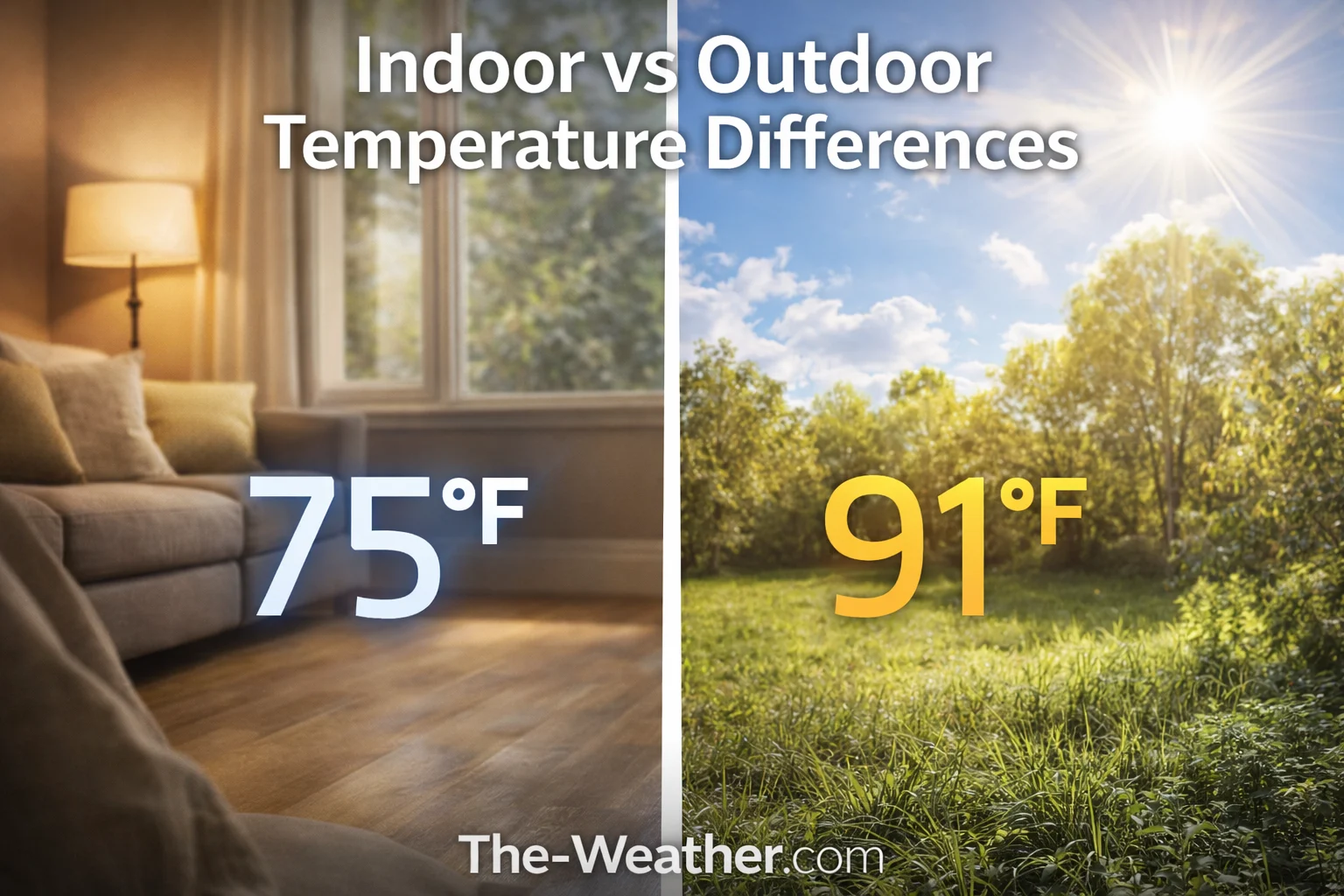
In a well-insulated home, a 15-to-20 degree difference is common during the heat of the day. If your indoor temp is within 5 degrees of the outside without HVAC, your insulation might need an upgrade!
Does humidity affect the thermometer reading?
Strictly speaking, no. A thermometer measures dry-bulb temperature. However, humidity affects how *you* feel and how your home holds onto heat.
Watch: What Causes the Temperature Gap?
Related Weather Education
Reliable Meteorological Sources
Updates & Revisions
Last Updated: January 13, 2026. This educational guide was reviewed for scientific accuracy regarding thermodynamics and home insulation standards. Updated to include the latest microclimate research data.

Lead Reviewer at The-Weather.com
I've spent over a decade tracking storms and researching weather gear. When I'm not analyzing barometric pressure trends, you can find me in my garden or teaching my grandkids how to stay safe during a storm. I believe that local data is the best data! Learn more about Lena.
Ready to decide?
Find your pick on Amazon
Prices and stock change daily. Check the current price, delivery options and what owners say in their reviews.
Our top picksCompare our picks on AmazonToday's price, delivery & owner reviews on Amazon
Check on Amazon →