
As an Amazon Associate, I earn from qualifying purchases.
In this article 7 sections
The forecast said 94°F. Your patio thermometer says 103°F. Is your thermometer broken, or is the forecast wrong? Usually neither. In a Southern California heat wave, the temperature can really differ from street to street, and a thermometer in the wrong spot can add a few "fake" degrees on top. Here is how to tell the two apart, and how to get a reading you can trust.
Short answer: your yard can be hotter than the forecast for two reasons. Real reasons: the forecast covers a whole area or an official station that may be miles away, and Southern California has strong microclimates (coast versus inland valleys, pavement versus lawn). Measuring reasons: a sensor in the sun, against a wall or above paving reads too high. Put a shielded sensor in the shade, about 4 to 6.5 feet above grass, and compare it with the nearest official station. For current alerts, check the National Weather Service offices for Los Angeles and San Diego.
Editorial Research & Review
- Written by
- Lena Thornton, Weather Station Analyst & CWOP Contributor
- Based on
- National Weather Service guidance, WMO siting standards, and our existing weather station and thermometer research
- Hands-on testing
- Not performed by The-Weather.com for the products on this page
- Research last verified
- October 2, 2026
Real Reasons Your Yard Is Hotter
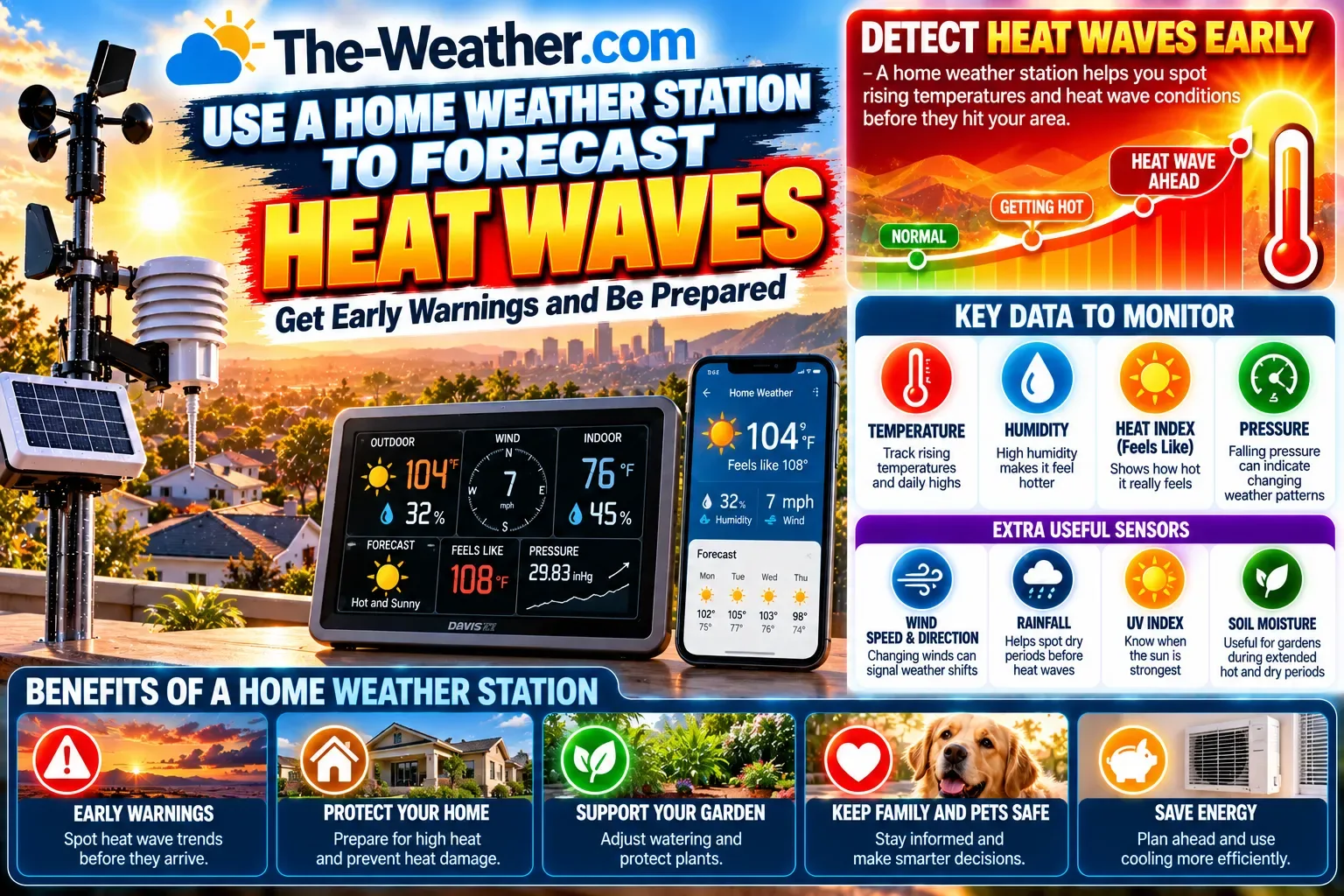
Sometimes your thermometer is simply right, and your home really is hotter than the number on the forecast.
The forecast covers an area, not your street. Forecasts and "current temperature" in many apps come from an official station or a model grid, often at an airport or in a nearby town. In Southern California, a few miles can mean a very different day.
Coast versus inland. Near the ocean, cooler sea air and the marine layer often keep temperatures down. A few valleys inland, that cooling fades, and heat builds up through the afternoon. In a heat wave the gap between the beach and the inland valleys can be large.
Your surroundings add heat. Concrete, asphalt, block walls and roofs soak up sun all day and give the heat back for hours, also after sunset. A paved backyard in the valley can feel very different from a shaded lawn a block away. That warmth at night matters too: warm nights give your body less chance to recover, which is one reason the NWS HeatRisk scale looks at night temperatures as well (see our Heat Advisory vs Extreme Heat Warning page).
Measuring Reasons Your Thermometer Reads Too High
This is the part you can fix. Air temperature is supposed to be measured in the shade, with air flowing freely around the sensor. A sensor that sees the sun is measuring a hot piece of plastic, not the air.
Our AcuRite Iris review describes how solar heating on a sensor casing can make readings run 5°F to 15°F high in direct sun. That is why better stations put the temperature sensor inside a radiation shield (the white, stacked plates), and some add a small fan that pulls air through it.
How to Get a Reading You Can Trust
- Shade and airflow: mount the sensor on the north side, or under a shield, with open air around it.
- Height: about 1.25 to 2 meters (4 to 6.5 feet) above the ground, which is the international standard height (WMO).
- Over grass if you can: soil and plants stay cooler than paving.
- Compare at night: when solar heating is gone, compare your reading with the nearest official station. A large difference can help reveal a siting or sensor-placement problem.
- Check official data: the observations on your NWS office page, or nearby stations on the Weather Underground map.
More detail with photos in our articles how to install a home weather station and why your weather app can be inaccurate.
Tools for an Accurate Backyard Temperature
Find your match in 10 seconds
Strong fit for the full picture
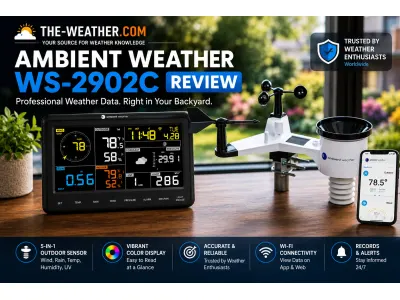
Ambient Weather WS-2902C
Why it fits: the outdoor array has a built-in radiation shield and measures temperature, humidity, solar radiation and UV, so you see both the heat and how strong the sun is. Data goes to the app and Weather Underground.
Research basis: our WS-2902C review, Ambient Weather's documentation.
Good fit if
- You want to compare your yard with official stations
- You want sun and UV data in a heat wave
- You also want rain and wind
Skip it if
- You have no open spot for the array
- Your Wi-Fi is 5 GHz only
- You only need one temperature number
Heat tip: our review notes that passive shields can still read a little high on calm, sunny afternoons; placement over grass and away from walls matters most.
Check current price on Amazon
Check current price on AmazonWS-2902C · opens in a new tabNot sure yet? Read our WS-2902C review
Strong fit for hot, sunny yards
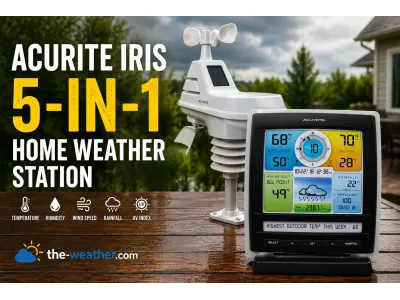
AcuRite Iris 5-in-1
Why it fits: a complete one-pole station with a colour display and app. In hot, sunny locations, the optional PRO+ sensor upgrade adds solar-powered fan aspiration if daytime temperature accuracy is important to you.
Research basis: our AcuRite Iris review and Iris PRO+ upgrade review.
Good fit if
- You want a simple complete station
- You like a local forecast on the display
- You may add the PRO+ upgrade later
Skip it if
- You want UV or solar radiation
- Your Wi-Fi is 5 GHz only
- You want Alexa or Google Home
Check current price on Amazon
Check current price on AmazonAcuRite Iris · opens in a new tabNot sure yet? Read our AcuRite Iris review
Strong fit for a simple outdoor reading
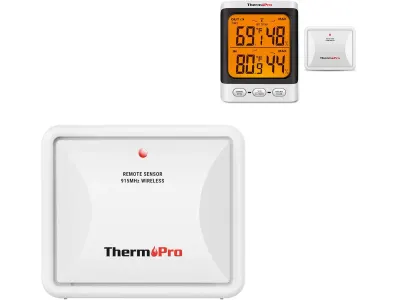
ThermoPro TP62
Why it fits: an affordable indoor/outdoor thermometer and hygrometer with up to 3 wireless sensors. Put one sensor in a shady spot outside and you have a real backyard number, no Wi-Fi needed.
Research basis: our ThermoPro TP62 review, ThermoPro's specifications.
Good fit if
- You only want temperature and humidity
- You want inside and outside on one display
- You want something affordable
Skip it if
- You want phone alerts
- You want a radiation shield included
- You want wind, rain or UV
Heat tip: the outdoor sensor has no radiation shield, so shade is essential. A covered spot on the north side works well.
Check current price on Amazon
Check current price on AmazonThermoPro TP62 · opens in a new tabNot sure yet? Read our ThermoPro TP62 review
Southern California Heat FAQ
Why is my backyard hotter than the forecast?
The forecast covers an area or an official station that may be miles away, and Southern California has strong differences between the coast and inland valleys. Paving, walls and roofs add heat too. And a thermometer in the sun or against a wall reads higher than the real air temperature.
Where should I put an outdoor thermometer?
In the shade with open airflow, about 4 to 6.5 feet above the ground, ideally over grass and away from walls, paving, roofs and air conditioning units. A radiation shield helps a lot.
How do I know if my thermometer is reading too high?
Compare it with the nearest official station at night, when solar heating is gone. If your reading is close at night but much higher in the afternoon, sunlight on the sensor is a likely cause.
Why does it stay hot at night during a heat wave?
Paving, walls and roofs store heat during the day and release it at night, and inland areas lose the cooling sea air. Warm nights matter for health because the body gets less chance to recover.
Update Log
- October 2, 2026: Page published during the early October 2026 Southern California heat. Siting guidance checked against WMO standards and our station reviews.
Sources
- National Weather Service Los Angeles and National Weather Service San Diego: current alerts and observations
- World Meteorological Organization, WMO-No. 8 on meteorological instruments and methods of observation: temperature sensor height and exposure
- Our reviews: Ambient WS-2902C, AcuRite Iris, ThermoPro TP62
See also: Heat Advisory vs Extreme Heat Warning · Track Indoor Temperature and Humidity During a Heat Wave · Best Outdoor Thermometers