
As an Amazon Associate, I earn from qualifying purchases.
In this article 4 sections

The tools that matter during hurricane season are not the ones that show you the national forecast: they are the ones that tell you what is happening in your specific backyard, right now.
Lena Thornton here, Weather Station Analyst at The-Weather.com. Every June when hurricane season opens, I get the same question from readers: what should I actually buy? Not what looks impressive on a shelf. Not what has the most features. What genuinely helps when a tropical system is bearing down on your home.
The answer is simpler than most preparedness articles suggest. Two tools matter above everything else: something that tells you what is happening at your exact location, and something that wakes you up when conditions change overnight. Everything else is supplementary.
October 2026 update: NOAA's August update lowered the outlook to 2 to 6 hurricanes, and the Atlantic had no hurricane until October 7, when Isaias became the first of the season. Read how the 2026 Atlantic hurricane season went without a hurricane until October. The season runs until November 30.
Why Your Own Weather Data Matters During a Tropical Storm
Official forecasts tell you what is happening in a broad area. Your own weather station tells you what is happening on your street. That distinction matters more than it sounds.
In a tropical storm, rainfall can differ enormously over a few miles. When Tropical Storm Arthur reached the Texas and Louisiana coast in June 2026, the forecast called for rainfall totals of 5 to 20 inches depending on location (National Hurricane Center and ABC News, June 17, 2026). A neighbourhood flooding event can begin hours before an official flood warning is issued for your county. A homeowner with a rain gauge watching their hourly rainfall rate climb from 0.3 inches per hour to 1.2 inches per hour has meaningful advance warning that a neighbour without one does not.
The same applies to barometric pressure. A rapid pressure drop at your specific location, measurable on any home weather station with a barometer, is one of the earliest physical signs of a strengthening or approaching system. You are not replacing the National Hurricane Center. You are adding a layer of local situational awareness that official forecasts, by their nature, cannot provide for every address.
Reading Barometric Pressure During a Tropical Storm
All home weather stations with a barometer display pressure in inches of mercury (inHg) or millibars (mb). Here is what the readings mean during hurricane season:
The eye of Hurricane Dorian measured 910 mb (26.87 inHg) at its most intense: one of the lowest pressures ever recorded at landfall in the Atlantic basin. Pressure values should be interpreted alongside official forecasts and warnings: storm impacts vary significantly by storm size, speed, and location.
A Home Weather Station With Wind, Rain, and Pressure
The single most valuable tool for monitoring tropical storm conditions at your specific location
During a tropical system, the three measurements that matter most are wind speed, hourly rainfall rate, and barometric pressure. A home weather station that captures all three gives you a real-time picture of what is happening in your yard, not a county-wide average, not a forecast model, but actual current conditions at your address.
For hurricane season specifically, look for a station with a self-emptying rain gauge (so it continues measuring through a multi-day rain event without overflowing), a solid wind cup anemometer (cheap cups can fail at higher wind speeds), and Wi-Fi connectivity so you can monitor readings from inside the house during the storm rather than going outside to check a display.
If you want the professional-grade option
The Davis Vantage Vue is built with a stronger emphasis on long-term durability and weather resistance than consumer-grade stations. The sensor housing is built with a stronger emphasis on long-term durability and weather resistance, the anemometer is designed for sustained high-wind accuracy, and the build quality reflects decades of professional weather station manufacturing. If you live in a coastal area where a direct hurricane hit is a realistic annual risk rather than a once-in-a-decade event, the Vantage Vue is worth the additional investment. See our Davis Vantage Vue vs Pro2 comparison to understand where the Vantage Vue fits in the Davis lineup.
Check Davis Vantage Vue Price As an Amazon Associate, we earn from qualifying purchases at no extra cost to you.A NOAA Weather Alert Radio With Battery Backup
The tool that works when everything else has failed: no internet, no cellular, no mains power required
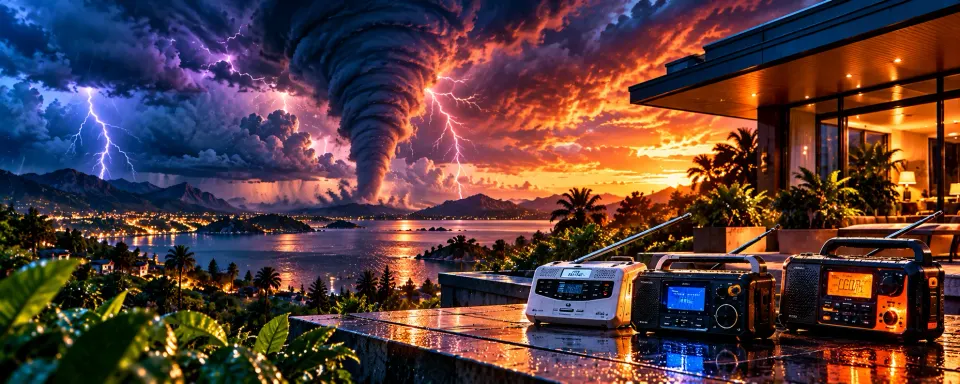
This is the tool most people underestimate until a storm cuts their power at 2am. A smartphone depends on cellular networks staying operational and your phone battery holding charge. Both are unreliable during sustained tropical storm conditions. A NOAA weather alert radio receives National Weather Service broadcasts directly via radio frequency: independent of the internet, your cellular carrier, and mains power.
The specific alerts that matter most during hurricane season, Tornado Warnings, Flash Flood Emergencies, Storm Surge Warnings, are broadcast immediately on NOAA weather radio. Many of these are issued with very short lead times, often under 30 minutes. A radio that wakes you from sleep with an 85dB alarm when a Tornado Warning is issued for your county can be the difference between adequate response time and none.
S.A.M.E. (Specific Area Message Encoding) is non-negotiable. Without it, the radio sounds for every alert in your entire state. With it, you program your county codes and only hear alerts that affect your area. Every radio we recommend below includes S.A.M.E.
Hurricane Season Preparedness: What You Actually Need
This video covers the practical side of hurricane preparedness: what tools matter, how to use them, and the mistakes most homeowners make when setting up weather monitoring for storm season.
Worth watching before hurricane season gets active: the section on sensor placement is particularly relevant. A wind sensor mounted near a building or in a sheltered location will read significantly lower than actual conditions during a tropical storm, which is exactly when you need accurate data most.
A Portable Power Bank (20,000mAh or Larger)
Keeps your phone, tablet, and alert radio charged when grid power fails
Your weather station and alert radio both have battery backup. Your phone does not. During a sustained power outage, Hurricane Ida left over a million Louisiana customers without power for weeks in 2021, your phone becomes your primary communication tool, weather app, flashlight, and emergency contact device simultaneously.
A 20,000mAh power bank charges most smartphones five to six times from full. This is the minimum useful capacity for a multi-day outage scenario. Features to look for: USB-C input for fast recharging between storms, two or more output ports so you can charge a phone and a tablet simultaneously, and a LED indicator showing remaining charge.
A Self-Emptying Rain Gauge (If Your Station Doesn't Include One)
Hourly rainfall rate is the most actionable local flood metric available to homeowners
Flood warnings are issued by county. Your flood risk depends on your specific drainage situation, your elevation, and what has already fallen in the previous 24 hours at your address. A rain gauge that logs hourly totals gives you that data. When the hourly rainfall rate at your house climbs above 1 inch per hour and your yard drainage is already saturated, you have actionable information to move your vehicle, check your sump pump, or make an earlier evacuation decision.
The AcuRite Atlas and Ambient WS-2902C both include self-emptying rain gauges. If your current weather station does not include rainfall measurement, a standalone tipping bucket rain gauge paired with a display console is a worthwhile addition before a season that forecasters expect to be above normal.
A Dedicated NWS-Linked Weather App
Not the default phone weather app: a direct feed from your local National Weather Service office
The default weather app on your phone pulls from aggregated forecast data that may be hours old. During a fast-moving tropical system, conditions can change significantly within a single hour. Two apps worth having for hurricane season:
- Weather.gov: Direct feed from your local NWS office. Text-based but authoritative and updated continuously during active warnings. The "Local Storm Reports" page for your area shows reports from trained storm spotters and CWOP stations.
- RadarScope: Professional-grade radar visualization showing storm cell intensity, rotation, and precipitation rates. The dual-polarization data available at the subscription tier shows the difference between rain and debris: useful for post-landfall tornado risk assessment.
Both of these are tools used by professional meteorologists and trained storm spotters. They are not casual weather apps: they require some learning to use effectively. But during an active tropical system, they provide information that no consumer weather app matches.
Critical: Where You Mount Your Sensor Changes Everything
A weather station mounted in a sheltered or obstructed location gives misleading data precisely when accurate data matters most. During a tropical storm, a sensor in the wrong position might show 22 mph winds while your exposed rooftop is experiencing 38 mph gusts.
- Height matters for wind: Mount the anemometer at least 10 feet above the ground and above surrounding obstructions. The NWS standard for official wind measurement is 10 metres (33 feet): consumer stations mounted lower will read lower than official values, which is worth knowing when comparing your readings to official reports.
- Clearance matters for rain: The rain gauge funnel must be unobstructed above. Overhanging branches deflect or add to rainfall measurements. Mount the gauge away from any overhead obstruction with a clear vertical view of the sky.
- Shade matters for temperature: A sensor in direct sun reads air temperature plus radiant heat from the housing, typically 5–15°F higher than actual ambient air temperature. A north-facing, shaded, aspirated position gives the most accurate reading.
- Before the storm, verify your setup: Check that all sensor mounting hardware is secure. At 40 mph sustained winds, the strength of a low-end tropical storm, improperly secured equipment can be damaged or displaced.
Hurricane Season Readiness Checklist
- Weather station installed and transmitting: wind, rain, and pressure all showing on console
- NOAA weather alert radio programmed with your county S.A.M.E. codes
- Alert radio battery backup tested: batteries fresh or rechargeable charged
- Power bank charged and stored with emergency supplies
- Rain gauge funnel clear of debris
- Sensor mounting hardware checked and secure
- Local NWS office bookmarked on your phone
- Know your evacuation zone and route before the season starts
Frequently Asked Questions
What weather tools do I need for hurricane season?
The two highest-priority tools are a home weather station measuring wind, rain, and pressure, and a NOAA weather alert radio with battery backup. These give you local real-time data and reliable overnight alerts independent of power and internet. A portable power bank, standalone rain gauge, and NWS-linked weather app round out the essential kit.
Why does barometric pressure matter during a hurricane?
A rapid pressure drop is one of the earliest measurable local signs of an approaching storm. Most home weather stations with a barometer display pressure trend arrows: falling rapidly means a significant low-pressure system is near. The eye of a hurricane is characterized by extremely low pressure: Dorian measured 910 mb at peak intensity.
Do I need a weather alert radio if I have a smartphone?
Yes. Smartphones depend on cellular networks and battery charge: both fail during prolonged power outages. A NOAA alert radio with battery backup receives NWS broadcasts via radio frequency, independent of internet or power. It is the most reliable way to receive tornado and flood warnings overnight during a storm.
What is the best weather station for hurricane monitoring?
The AcuRite Atlas and Ambient WS-2902C are the strongest mid-range options: both include wind, rain, temperature, humidity, and pressure with Wi-Fi alerts. The Davis Vantage Vue is the professional-grade choice for coastal properties where hurricane conditions are a realistic annual risk.
Our full emergency weather radio roundup covers the Midland WR400, Sangean CL-100, and other S.A.M.E.-capable models with detailed feature comparisons. Want a small crank radio for the go-bag? See our Midland ER40 review.
Sources
Tropical Storm Arthur data from National Hurricane Center official advisories and reporting by ABC News and Fox Weather, June 17, 2026. Barometric pressure values and hurricane pressure data from NOAA educational resources. Product specifications from official manufacturer pages. Performance observations from owner reviews and our own published product reviews. No manufacturer compensation was received.

Lena Thornton
Weather Station Analyst & CWOP Contributor. Lena has researched, reviewed and analysed weather stations and environmental sensors from AcuRite, Ambient Weather, Davis Instruments, La Crosse Technology, and Midland. Published June 17, 2026.