
As an Amazon Associate, I earn from qualifying purchases.
In this article 8 sections
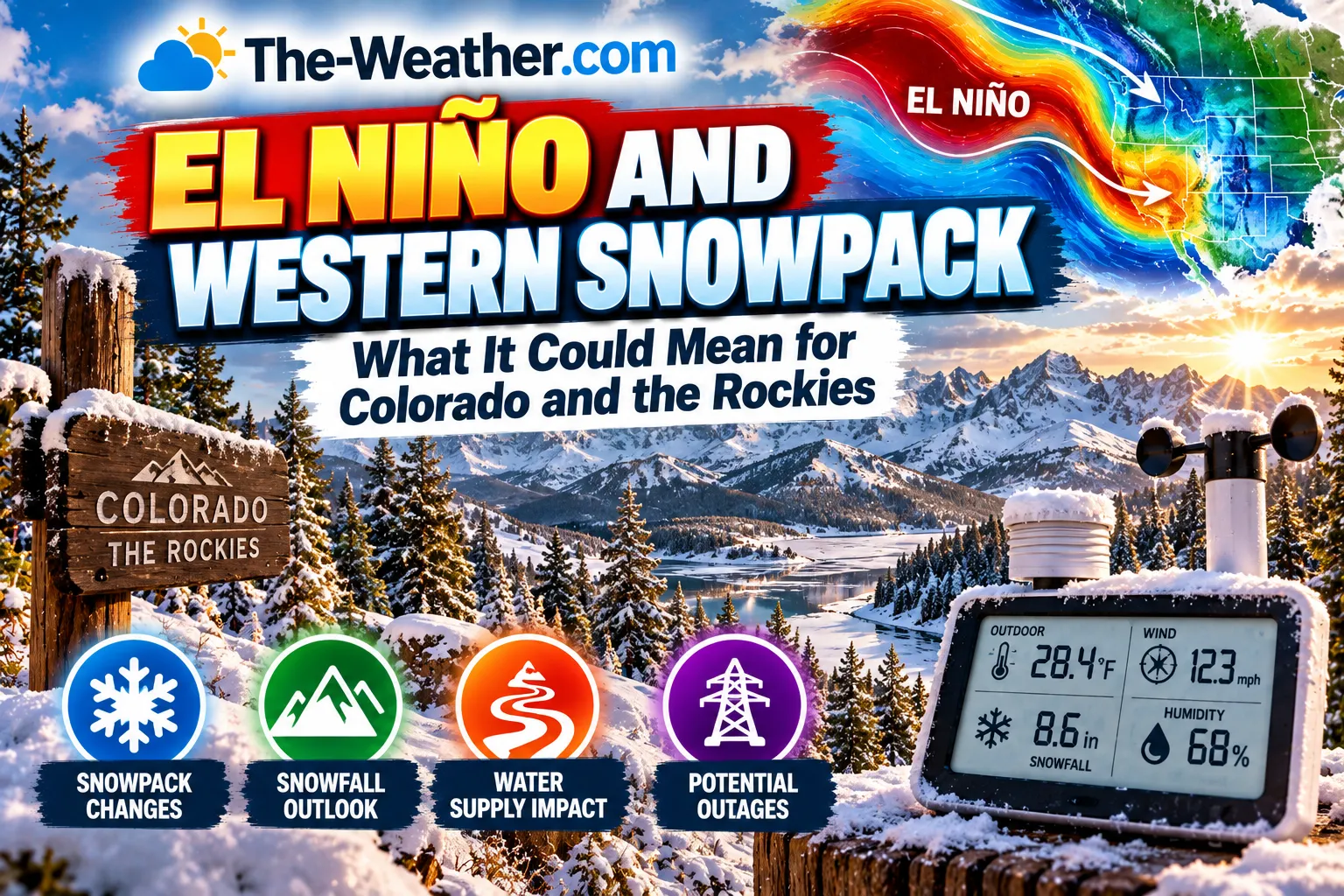
Skiers want powder, farmers and cities want water, and everyone in Colorado wants to know the same thing: does a big El Niño mean a big snow year? The answer is more interesting than yes or no. In Colorado, El Niño tends to pick favorites: some mountains and seasons do well, others come up short. Here is what past strong El Niños did, what NOAA expects this winter, and how to keep an eye on the snow yourself.
Short answer: a strong El Niño does not mean a big snow winter everywhere in Colorado. In the 10 strongest fall El Niños since 1915, Colorado often got a wet fall and spring, but the north-central mountains had a drier than normal mid-winter in 9 of 10 cases. The Front Range leaned wetter in all seasons, with a higher chance of big spring snowstorms, and spring snowpack and runoff were often above normal in the end (Western Water Assessment and NOAA). Farther north, Montana, Idaho and the interior Northwest lean drier and milder this winter (NOAA CPC).
Editorial Research & Review
- Written by
- Lena Thornton, Weather Station Analyst & CWOP Contributor
- Based on
- Western Water Assessment and NOAA analysis of past strong El Niños in Colorado, NOAA Climate Prediction Center outlooks (September 2026), Colorado Climate Center data
- Hands-on testing
- Not performed by The-Weather.com for the products on this page
- Research last verified
- October 2, 2026
El Niño and the Western Snowpack: The Big Picture
During El Niño the Pacific storm track tends to run across the southern U.S., while the northern jet stream stays farther north. That splits the West roughly in two:
NOAA's September 2026 outlook keeps "two relatively modest signals for below normal precipitation" over the interior Northwest and the Great Lakes, and shows equal chances for temperature from the southern Rockies eastward (NOAA CPC). For the national picture, see how strong the 2026 El Niño could become.
What Past Strong El Niños Did in Colorado
The best look at this comes from a 2015 briefing by the Western Water Assessment, NOAA and partners. They studied the 10 strongest fall El Niños since 1915. Here is what they found, region by region (WWA and NOAA briefing):
| Region | Fall | Winter (Dec to Feb) | Spring |
|---|---|---|---|
| North-central mountains (Colorado, Yampa, South Platte headwaters) | More often wet | Drier than normal in 9 of 10 cases | Split evenly |
| Front Range | Wetter | Wetter | Wetter, big snowstorms more likely |
| Arkansas Basin | Wet, strongest in fall | Leans wetter | Leans wetter |
| Southwestern Colorado (San Juans, Rio Grande) | Consistently wetter | Split between wet and dry | Slightly wetter |
Based on the 10 strongest fall El Niño conditions since 1915. The briefing also notes "a wide range of outcomes in all seasons".
The spring pattern is different. Because wet falls and springs often made up for the dry mid-winter, the briefing found that in most of the strongest El Niños, May 1 snowpack and the year's river runoff were above normal in Colorado's major river basins. Runoff was above normal in 7 of 10 events for the Colorado River at Lees Ferry and in 8 of 10 for the South Platte.
Front Range: Watch Out for Spring
If you live in Denver, Boulder or Fort Collins, El Niño's signature is often a big spring storm. Colorado State Climatologist Russ Schumacher put it this way in 2023: being in El Niño "doesn't guarantee a big Front Range snowstorm, but it definitely increases the chances." Fort Collins, which averages 51.4 inches of snow, got 68 inches in 1982-83, 89.5 in 1987-88, 55.3 in 1997-98 and 72.8 in 2015-16 (Fort Collins Coloradoan).
Spring snow on the Front Range is usually heavy and wet. That is great for the soil and terrible for tree branches, which is how a pretty April morning turns into a power outage. Late-season snow can still affect roads, trees and power lines well into spring.
How to Track Snow Where You Live
The official snowpack numbers come from NRCS SNOTEL sites in the mountains, which measure snow water equivalent: how much water the snow would make if it melted (NRCS SNOTEL interactive map). At home you can do your own version:
New snow
Measure fresh snow on a flat white board, then wipe it clean. That stops wind and melting from fooling you.
Melt it
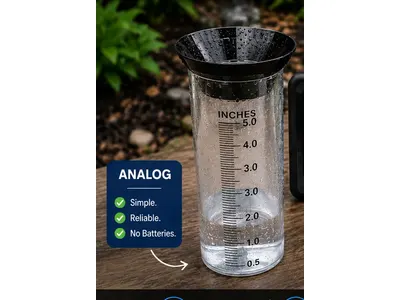
Bring a manual 4-inch rain gauge inside after the storm, let the snow melt and read the water. That is your own snow water equivalent.
One honest tip: most home weather stations use an unheated tipping-bucket rain gauge. It does not measure snow while it is falling, and it may report the water later when the snow melts. More in our article how rainfall and snow are measured.
Weather Tools for a Rocky Mountain El Niño Winter
Find your match in 10 seconds
Strong fit for measuring snow water
Stratus RG200 Manual Rain Gauge
Why it fits snow country: The classic 4-inch manual gauge. In winter you remove the funnel, let the snow fall in, melt it indoors and read the water to 0.01 inch. No batteries, nothing to freeze up electronically.
Research basis: our rain gauge article, the manufacturer's specifications and CoCoRaHS requirements.
Good fit if
- You want a simple manual gauge with 0.01-inch resolution
- You may report to CoCoRaHS
- You want something that works without power
Skip it if
- You do not want to go outside to read it
- You want automatic logging
- You want alerts
Check current price on Amazon
Check current price on AmazonStratus RG200 · opens in a new tabNot sure yet? Read our rain gauge article
Strong fit for winter storm warnings
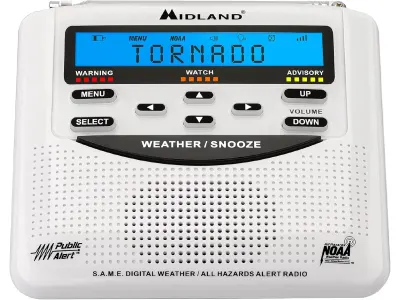
Midland WR120B NOAA Weather Alert Radio
Why it fits snow country: A S.A.M.E. alert radio that sounds a siren for warnings in your programmed counties, including Winter Storm and Blizzard Warnings, with battery backup when the power fails.
Research basis: our Midland WR120B review, Midland's specifications.
Good fit if
- You want night-time alerts for your county
- You want simple setup
- You want battery backup when the power fails
Skip it if
- You want AM/FM radio too
- You want the warning read out
- You need a portable radio
Check current price on Amazon
Check current price on AmazonMidland WR120B · opens in a new tabNot sure yet? Read our Midland WR120B review
Strong fit for heavy-snow outages
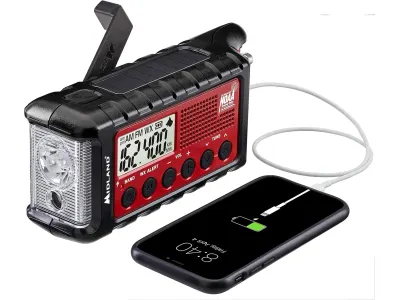
Midland ER310 Emergency Crank Weather Radio
Why it fits snow country: Heavy spring snow brings down branches and lines. The ER310 charges by hand crank, sun or USB, takes AA batteries, scans the NOAA weather channels and adds a flashlight with SOS.
Research basis: our Midland ER310 review, Midland's specifications and the ER310 user manual.
Good fit if
- You want a radio for the emergency kit or car
- You live where outages can last days
- You want to charge a phone
Skip it if
- It would be your only night-time alert radio (no S.A.M.E.)
- You want something pocket-sized
- You only need home alerts
Check current price on Amazon
Check current price on AmazonMidland ER310 · opens in a new tabNot sure yet? Read our Midland ER310 review
El Niño and Snowpack FAQ
Does El Niño mean more snow in Colorado?
Not everywhere and not all winter. In past strong El Niños, Colorado often had wet falls and springs, while the north-central mountains were drier than normal in mid-winter in 9 of 10 cases. The Front Range and southern mountains tended to do better. Spring snowpack often ended above normal.
Is El Niño good for skiing in Colorado?
It depends on where and when you ski. Southern areas and the Front Range tend to benefit more, and spring storms can be big. North-central resorts have historically seen more variable mid-winter snow during strong El Niños.
What does El Niño mean for the northern Rockies?
NOAA's 2026-27 outlook leans drier and milder than normal for the interior Northwest, including Montana and Idaho. That often means a weaker snowpack, though single big storms can still happen.
What is snow water equivalent?
The amount of water in the snowpack if it all melted, usually in inches. It matters more for water supply than snow depth, because fluffy and heavy snow hold very different amounts of water.
Update Log
- October 2, 2026: Page published. Historical patterns checked against the Western Water Assessment and NOAA El Niño briefing for Colorado; outlook checked against the NOAA Climate Prediction Center outlook of September 17, 2026.
Sources
- Western Water Assessment and NOAA: El Niño impacts for Colorado (briefing, 2015)
- NOAA Climate Prediction Center: seasonal outlook discussion (September 17, 2026)
- NOAA Climate Prediction Center: ENSO Diagnostic Discussion
- Fort Collins Coloradoan: Fort Collins snow in past strong El Niño winters (2023)
- NRCS National Water and Climate Center: SNOTEL interactive map
- CoCoRaHS: Community Collaborative Rain, Hail and Snow Network
- Our articles: how rainfall and snow are measured, what is a snowstorm, winter storm alerts during outages
See also: How Strong Could the 2026 El Niño Become? · El Niño Winter in California · El Niño in the Midwest