
As an Amazon Associate, I earn from qualifying purchases.
In this article 8 sections
Ask "where is the hottest place on Earth?" and you can get two honest answers: a valley in California, or a desert in Iran. Both are right, because they measure two different things. Here is the record, the catch, and what "hot" means on a thermometer versus a satellite.
Short answer: the highest air temperature on record is 134°F (56.7°C), measured on July 10, 1913 at Furnace Creek in Death Valley, California, according to the World Meteorological Organization's extremes archive. The hottest ground surface found by satellite is in Iran's Lut Desert, where NASA's MODIS instrument recorded 159.3°F (70.7°C) in 2005. A thermometer in the shade and the ground in full sun are very different things.
Editorial Research
- Written by
- Lena Thornton, Weather Station Analyst & CWOP Contributor
- Based on
- The WMO Weather and Climate Extremes Archive, NASA Earth Observatory's analysis of land surface temperatures, and NOAA NCEI 1991-2020 climate normals for the Death Valley station
- Research last verified
- October 24, 2026
The Official Record: Death Valley, 134°F
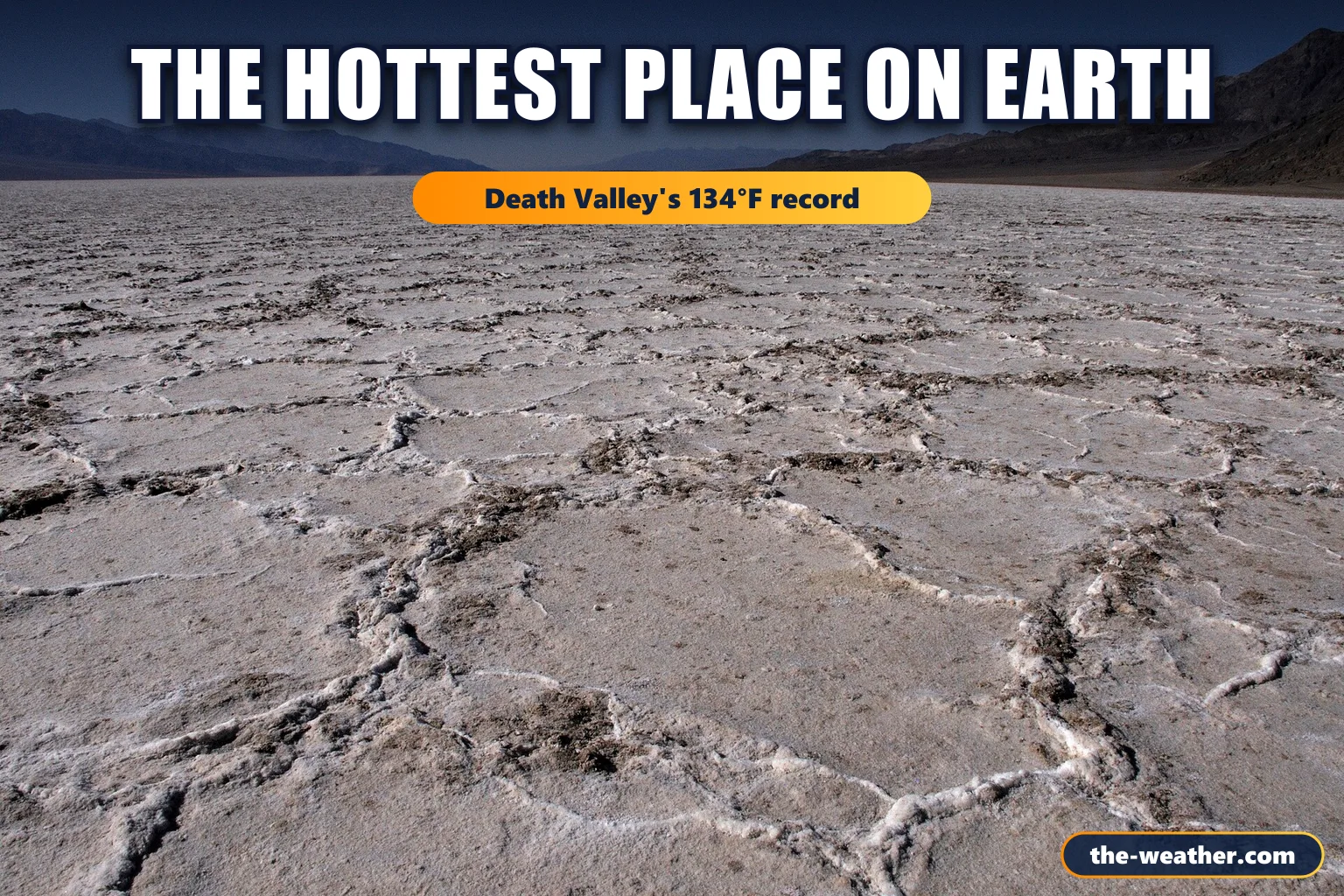
The World Meteorological Organization (WMO) keeps the official list of weather extremes. Its record for the highest air temperature is 56.7°C (134°F), measured on July 10, 1913 at Furnace Creek (then called Greenland Ranch) in Death Valley, California.
For 90 years the record belonged to El Azizia in Libya, with 58°C (136.4°F) from 1922. On September 13, 2012 a WMO evaluation panel declared that reading invalid. According to the UN news report on the decision, the panel pointed to problematic instruments, a probably inexperienced observer, an observing site over asphalt-like material that did not represent the desert, and poor agreement with nearby and later readings. The title went back to Death Valley.
The 1913 reading is questioned by some researchers too, but the WMO has not changed it, so 134°F remains the official record.
How Hot Is Death Valley in a Normal Summer?
The record is one day. The normal summer is impressive on its own. These are NOAA's official 1991-2020 normals for the Death Valley station:
| Month | Normal daily high | Normal average (day and night) |
|---|---|---|
| May | 100.7°F | 87.8°F |
| June | 111.1°F | 97.5°F |
| July | 117.4°F | 104.2°F |
| August | 115.9°F | 102.3°F |
| September | 107.7°F | 93.4°F |
NOAA NCEI 1991-2020 U.S. Climate Normals, station USC00042319 (Death Valley, CA).
A normal July day averages over 104°F, including the night. And the whole year brings only about 2.2 inches of precipitation, according to the same normals. Dry air, a deep basin below sea level and steep walls that trap the heat make it a natural oven.
The Hottest Ground: Iran's Lut Desert
Satellites measure something else: how hot the ground itself gets. NASA's Earth Observatory (in an article from April 2012, written before the WMO decision on Libya) looked at seven years of land surface temperatures (2003 to 2009) from the MODIS instrument on NASA's Terra and Aqua satellites. The Lut Desert in Iran was the hottest place in five of those seven years, and it produced the single highest reading: 70.7°C (159.3°F) in 2005.
Other hot spots in that analysis:
- Queensland, Australia (shrublands): 69.3°C (156.7°F) in 2003
- Turpan Basin near the Flaming Mountain, China: 66.8°C (152.2°F) in 2008
NASA explains that the hottest surfaces have clear skies, dry soil and light winds, and ground that soaks up sunlight instead of reflecting it. A photo caption in the article points to the dark pebbles of the Lut Desert.
Air Temperature vs Ground Temperature
This is why the two answers are so far apart. NASA notes that official air temperature is measured by a thermometer shielded from direct sunlight, 1.2 to 2 meters above the ground. Land surface temperature is how hot the ground itself gets, and "it is often significantly hotter than air temperature".
NASA gives an old example: in 1915 near Tucson, Arizona, the soil just below the surface was about 29°C (52°F) hotter than the air four feet up. Anyone who has walked barefoot on a beach in July knows the feeling.
The same rule applies to your backyard weather station. A temperature sensor in the sun, or close to a dark wall or a driveway, reads far too hot. The official method is shade, airflow and the right height. Our page on checking the outside temperature accurately explains good placement.
Hot Places Closer to Home
Death Valley is the extreme, but other U.S. desert cities are hot too. Phoenix, Arizona, for example, has a normal July average of 95.5°F in NOAA's 1991-2020 normals, about 9°F cooler than Death Valley's. Hot, humid places feel even worse than the thermometer says. Try our heat index calculator to see how humidity changes the number.
Hottest Place on Earth FAQ
What is the hottest temperature ever recorded on Earth?
134°F (56.7°C) at Furnace Creek, Death Valley, California, on July 10, 1913. That is the official air temperature record of the World Meteorological Organization.
Is Death Valley the hottest place on Earth?
For air temperature, yes: it holds the official record. For ground temperature measured by satellite, Iran's Lut Desert has been hotter, with 70.7°C (159.3°F) in 2005 in NASA's analysis.
Why was the Libya record removed?
On September 13, 2012 a WMO evaluation panel declared the 1922 El Azizia reading of 58°C invalid, because of problems with the instruments, the observer and the measuring site.
Why is the ground hotter than the air?
The ground absorbs sunlight directly, while official air temperature is measured in the shade, 1.2 to 2 meters up. NASA notes land surface temperature is often significantly hotter than air temperature.
How hot is Death Valley in July?
NOAA's 1991-2020 normals give a normal daily high of 117.4°F and a normal average (day and night) of 104.2°F.
Update Log
- October 24, 2026: First version, with WMO, NASA and NOAA information.
Sources
- WMO: World Weather and Climate Extremes Archive
- UN News: Ninety-year-old world temperature record is invalid, WMO (September 2012)
- NASA Earth Observatory: Where Is the Hottest Place on Earth?
- NOAA NCEI: U.S. Climate Normals (1991-2020 monthly normals, stations USC00042319 Death Valley and USW00023183 Phoenix, retrieved October 24, 2026)
- Photo: National Park Service: salt flats in Death Valley National Park, public domain, via Wikimedia Commons
More weather basics: How latitude affects climate · Weather vs climate · Why does hot air rise?