We may earn a commission when you buy through links on this page, at no extra cost to you. Learn more
In this article 9 sections
- S.A.M.E. Programming: Why It Matters and How It Works on the WR120B
- Three Alert Modes and Color-Coded LED Indicators
- WR120B vs WR400 vs ER310: Choosing the Right Midland Radio
- Pros & Cons
- Who Should Buy the WR120B: And Who Should Upgrade
- WR120B Feature Overview: Visual Summary
- Midland WR120B Setup and Feature Walkthrough
- Frequently Asked Questions
- Final Verdict
Midland WR120B Review (2026): Best Budget NOAA Weather Radio for Home Alerts?
Reviewed product
Midland WR120B
See today’s price, delivery options and customer reviews on Amazon.
As an Amazon Associate we earn from qualifying purchases, at no extra cost to you. Learn moreIs the Midland WR120B worth buying? Yes, for a reliable, budget-friendly desktop NOAA weather radio with S.A.M.E. county filtering under $40, it is one of the most trusted options available. Its 90dB siren, color-coded LED indicators, 25-county memory, and alarm clock make it a practical bedside emergency radio. The main trade-offs vs the WR400: no AM/FM radio, no USB device charging, fewer alert types (60+ vs 80+), and 3 AAA battery backup instead of 4 AA.
I'm Lena Thornton, a weather station analyst and CWOP contributor. This review is based on verified specifications from Midland's official WR120 product page, official support documentation, Amazon listing data, and detailed comparison against the WR400 and WR300 using published manufacturer specifications. The WR120B is Midland's most popular NOAA alert radio, and understanding exactly what it does and does not include is the most useful thing this review can tell you.
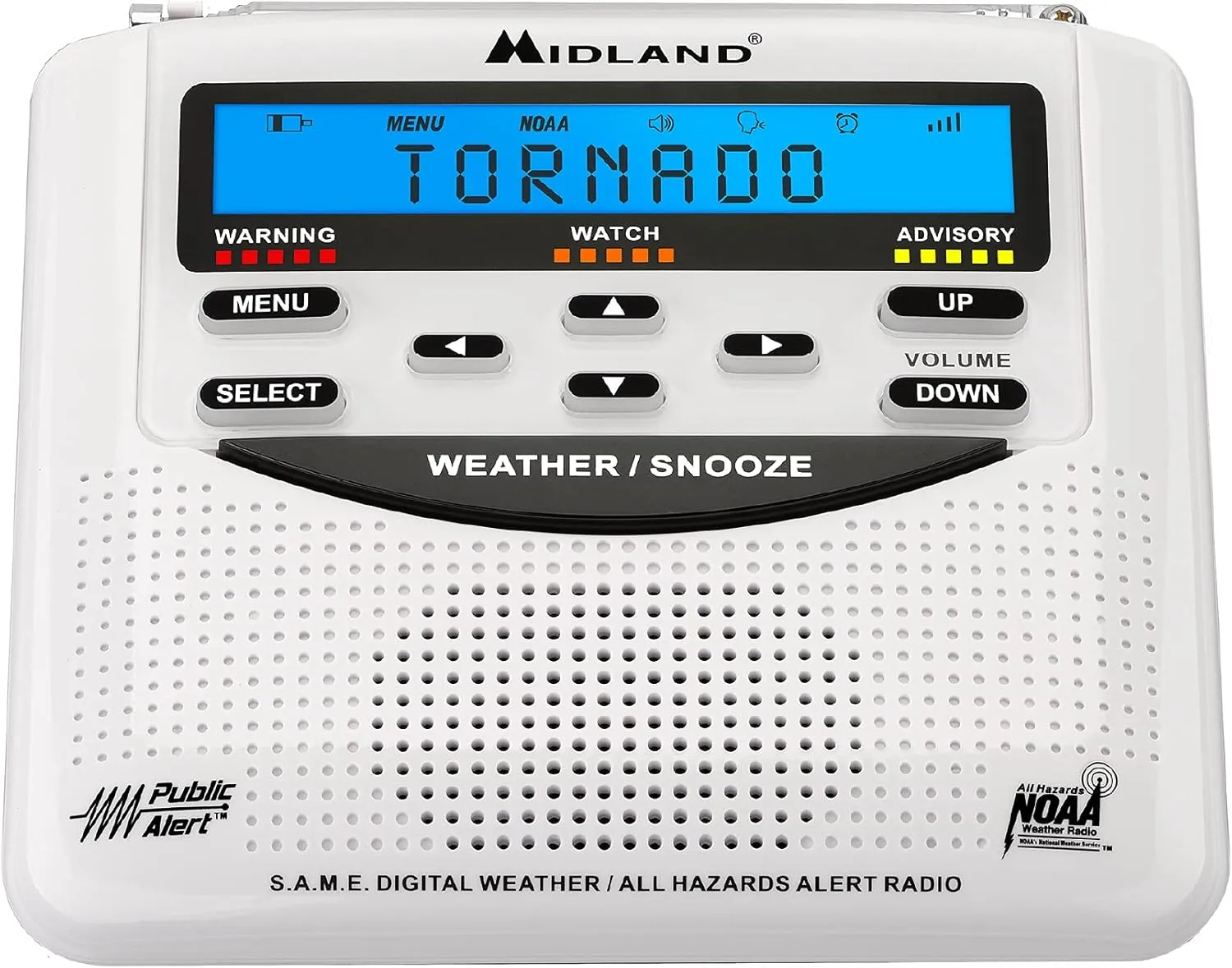
Midland WR120B: compact desktop NOAA weather radio with S.A.M.E. county programming, 90dB siren, and color-coded LED indicators.
Key Specifications at a Glance
Shopping during Black Friday? See which NOAA weather alert radios are worth buying at a sale price, and how to tell a real deal from a dressed-up one: Black Friday Weather Radio Deals 2026.
S.A.M.E. Programming: Why It Matters and How It Works on the WR120B
S.A.M.E. Specific Area Message Encoding, is the National Weather Service system that directs alerts to specific geographic areas. Without it, a weather radio alerts for every NWS broadcast within reception range, which can include counties 100 miles away. With S.A.M.E. programmed, the WR120B only sounds when an alert is issued for your selected counties.
The WR120B supports up to 25 programmed counties: useful if you live near a county border or want to monitor a second property. A distinctive advantage of the WR120B over some competing radios: setup does not require manual FIPS code lookup. You navigate to your country, state, and county directly through the menu, and the radio handles the code automatically.
The alert override function automatically interrupts whatever is playing to notify you of a warning: you do not need to be listening or monitoring manually. The radio stays silent in standby and activates only when a relevant alert fires.
Three Alert Modes and Color-Coded LED Indicators
The WR120B offers three selectable alert modes so you can match the notification to your living situation, and the color-coded LEDs give you an immediate visual read on threat severity before you even hear the alert description.
Adjustable to High, Medium, or Low. At full volume, rated at 90dB: loud enough to wake most sleepers. The most commonly selected mode for overnight use.
The radio speaks the warning type in your selected language: English, Spanish, or French. Useful for immediately identifying the nature of the alert.
Flashing LED for deaf or hard-of-hearing users, or where audible alerts are disruptive. Works alongside the color-coded severity indicators.
Color-Coded LED Severity Indicators
The WR120B's three-color LED system gives you an instant visual read on how serious the alert is: before the voice description has finished. This is useful when the radio fires at night and you need to assess quickly whether to shelter immediately.
Imminent threat. Tornado warning, severe thunderstorm warning, flash flood warning. Take shelter now.
Conditions are favorable for severe weather. Monitor closely and prepare to act.
Minor hazard. Wind advisory, frost advisory, dense fog. Awareness warranted, action optional.
WR120B vs WR400 vs ER310: Choosing the Right Midland Radio
The WR120B is the budget-friendly alert-only option. The WR400 is the full-featured home radio. The ER310 is the portable crank option. Here is exactly what separates them.
| Feature | WR120B ~$35 |
WR400 ~$49 |
ER310 ~$60 |
|---|---|---|---|
| S.A.M.E. Counties | Up to 25 | Up to 25 | None, all-channel |
| Alert Types | 60+ | 80+ More |
All-channel NOAA |
| Siren | 90dB · 3 levels | 85dB · 3 levels | Audible siren |
| Color LED Indicators | Yes, Red/Orange/Green WR120B ✓ |
Yes | No |
| AM/FM Radio | No Alert only |
Yes, 4 presets/band WR400 only |
Yes, AM/FM/WX |
| USB Device Charging | No | Yes, USB-A 5V/1A WR400 only |
Yes, USB-A |
| Battery Backup | 3 AAA alkaline Less capacity |
4 AA alkaline More capacity |
6 AA + Li-ion Most |
| Alarm Clock | Yes, alarm + snooze | Dual alarm + AM/FM wake | No |
| Portable | No, desktop only | No, desktop only | Yes, crank/solar |
| Best For | Budget home alerting | Full-featured home setup | Go-bag · outdoor use |
Pros & Cons
In short: buy the WR120B for reliable S.A.M.E. county alerts, 90dB siren, and color LED indicators at the lowest price in the Midland lineup. Upgrade to the WR400 if you want AM/FM radio or USB device charging.
The Pros
- S.A.M.E. for up to 25 counties: Filters out alerts from distant counties: the most important feature for avoiding alert fatigue. Setup does not require manual FIPS code lookup.
- 90dB siren with three volume levels: Rated louder than the WR400's 85dB. High/Medium/Low settings give flexibility for light sleepers or different room sizes.
- Color-coded LED indicators: Red/Orange/Green severity system gives an instant visual read before you hear the alert description: a practical advantage at night.
- Three alert modes: Siren, voice alert, and LED flash: covers households with deaf or hard-of-hearing members.
- Alarm clock with snooze: Makes it a natural bedside device that earns its place in daily life rather than sitting unused on a shelf.
- Budget price: Under $40 makes this the most accessible entry point in the Midland S.A.M.E. radio lineup. Public Alert Certified and DHS recommended.
- Trilingual display: English, Spanish, and French: selected on first power-up.
The Cons
- No AM/FM radio: Weather channels only. If you want a bedside radio that also plays music or talk, you need the WR400.
- No USB device charging: The WR400 includes a USB-A port for charging phones during outages. The WR120B does not.
- 3 AAA battery backup: less capacity: AAA cells hold less energy than the AA batteries used in the WR400 and ER310. For extended multi-day outages, pre-season battery replacement is essential.
- 60+ alert types vs 80+ on WR400: The WR120B covers the core weather and hazard alerts but misses some newer categories added to the WR400's expanded list.
- S.A.M.E. programming requires patience: Though simpler than some radios (no manual FIPS code required), the menu navigation takes 5–10 minutes on first setup and clears can be unintuitive: a trait shared across the Midland lineup.
Who Should Buy the WR120B: And Who Should Upgrade
Buy the WR120B if you...
- Want county-specific NOAA alerts at the lowest price point in the Midland lineup
- Need a bedside alarm clock that doubles as an emergency alert radio
- Have deaf or hard-of-hearing household members who need the visual LED flash mode
- Want a simple setup: no FIPS codes to look up, just select your state and county
- Are on a budget and don't need AM/FM or USB charging
Upgrade to the WR400 if you...
- Want AM/FM radio for daily listening alongside emergency alerts
- Need USB device charging during power outages
- Want 80+ alert types including newer NWS alert categories
- Want 4 AA battery backup for longer outage runtime vs 3 AAA
- Need a dual alarm clock that wakes to weather, AM/FM, or buzzer
WR120B Feature Overview: Visual Summary
Midland WR120B: S.A.M.E. county filtering, 90dB siren, color-coded LED severity indicators, and alarm clock for reliable home emergency preparedness.
This image helps visualise how the WR120B's core features work together during an emergency. The S.A.M.E. system filters which alerts reach you, only those matching your programmed counties fire the alarm. The three-color LED system tells you the severity level at a glance before the voice description finishes.
The 90dB siren at High volume is the loudest rating in the Midland desktop lineup: louder than the WR400's 85dB. For a bedside radio in a typical home, this is sufficient to wake most sleepers through a closed door. The Low and Medium volume settings let you dial it back for lighter sleepers or a shared bedroom.
The 3 AAA battery backup kicks in automatically when AC power is lost, maintaining the clock, S.A.M.E. county programming, and alert monitoring with no action required. AAA cells have less total capacity than the AA batteries in the WR400: replace them before storm season for best results.
The alarm clock function is what makes the WR120B practical as a daily-use device rather than a dedicated emergency tool that gets forgotten. It sits on your nightstand, wakes you up in the morning, and is already monitoring NOAA channels in standby the entire time.
Midland WR120B Setup and Feature Walkthrough
This walkthrough covers the WR120B's S.A.M.E. county setup process, alert tone selection, alarm clock programming, and a live alert demonstration: the fastest way to understand the setup experience before buying.
The S.A.M.E. county selection sequence is worth watching closely. The WR120B's state-and-county navigation (no manual FIPS lookup required) is one of the simpler setup processes in the category, but understanding the menu flow before you sit down with the radio makes it significantly faster.
The alert demo section shows the color LED system in action: seeing Red, Orange, and Green fire in context is more useful than any written description of the severity levels.
Ready to add the WR120B to your home kit?
Order on AmazonFrequently Asked Questions
Is the Midland WR120B worth buying in 2026?
Yes, for a reliable, budget-friendly desktop NOAA weather radio with S.A.M.E. county filtering under $40, the WR120B is one of the most trusted options available. Its 90dB siren, color-coded LED indicators, 25-county memory, and alarm clock make it a practical bedside emergency radio. If you want AM/FM radio or USB device charging, step up to the WR400.
What is S.A.M.E. programming and how does the WR120B handle it?
S.A.M.E. (Specific Area Message Encoding) lets you program the radio to only alert for your selected counties. The WR120B supports up to 25 counties and does not require manual FIPS code lookup: you navigate to your country, state, and county through the menu. This is simpler than some competing radios that require entering 6-digit codes manually. Setup takes approximately 5–10 minutes on first attempt.
How loud is the WR120B alert siren?
The WR120B's siren is rated at 90dB: louder than the WR400's 85dB. Three volume levels (High, Medium, Low) let you adjust for your environment. At High, it is loud enough to wake most sleepers. The siren can be replaced with a voice alert or LED flash mode for deaf or hard-of-hearing users.
Does the WR120B work during a power outage?
Yes. It runs on AC power normally and switches automatically to 3 AAA alkaline batteries (not included) when power is lost. The backup maintains the clock, county programming, and alert monitoring. AAA cells have less capacity than the AA batteries in the WR400: install fresh batteries before storm season for best backup performance.
What is the difference between the WR120B and WR400?
The WR400 adds: AM/FM radio with 4 presets per band, a dual alarm clock (wake to weather/AM-FM/buzzer), USB-A device charging, 80+ alert types (vs 60+ on the WR120B), storage for the last 10 alerts, and 4 AA battery backup (more capacity than 3 AAA). The WR120B is the better choice if you just need S.A.M.E. alert monitoring at the lowest price. See our full WR400 vs WR300 comparison for more context.
What languages does the WR120B support?
English, Spanish, and French: selected on first power-up. All alerts, menus, and clock display in the chosen language. This trilingual feature is confirmed across all WR120 variants per Midland's official specifications.
Final Verdict
The Midland WR120B is the right radio for buyers who want S.A.M.E. county-filtered NOAA alerts at home without paying for AM/FM radio or USB charging they don't need. At under $40 it is the most accessible entry point in Midland's S.A.M.E. lineup, and it covers the core emergency alert function reliably: 90dB siren, color-coded LED severity indicators, voice alert, 25-county memory, and an alarm clock that keeps the device in daily use.
The 3 AAA battery backup is the main functional limitation vs the WR400's 4 AA, and the absence of AM/FM radio means it serves one role rather than two. For buyers who want the full-featured home setup, AM/FM, USB charging, dual alarm, 80+ alerts, the WR400 is the upgrade. For buyers who want a dependable, simple S.A.M.E. alert radio at the best price, the WR120B is the answer.
Review Methodology
This review is based on verified specifications from Midland's official WR120 product page, Midland's official WR120 user guide, Amazon product listing documentation, and the Weather Radio Wiki WR120 entry (updated 2026). The NWS Weather Radio All Hazards programme documentation was consulted for S.A.M.E. system accuracy. Comparison specifications for the WR400 and ER310 are drawn from their respective Midland product pages. No manufacturer compensation was received.
Which NOAA Weather Radio Is Right for Your Home in 2026?
We compared five NOAA weather alert radios on alert reliability, S.A.M.E. programming, battery backup, and real-world emergency performance. See which one we recommend for most homes.

Lena Thornton
Weather Tech Specialist & CWOP Contributor. Lena covers emergency preparedness technology, NOAA weather communication systems, and desktop weather radio reviews at The-Weather.com. Every review is grounded in verified manufacturer specifications and published independent data. Last updated April 2026.
Ready to decide?
Get the Midland WR120B
Prices and stock change daily. Check the current price, delivery options and what owners say in their reviews.