We may earn a commission when you buy through links on this page, at no extra cost to you. Learn more
In this article 9 sections
- What Shortwave Radio Actually Is
- Frequency Bands Explained
- Why Shortwave Matters for Emergencies
- Key Shortwave Stations to Know
- Top Emergency Shortwave Radios
- What to Look For in an Emergency Shortwave Radio
- Shortwave vs NOAA Radio: Not Either/Or
- Emergency Shortwave Radio Checklist
- Frequently Asked Questions
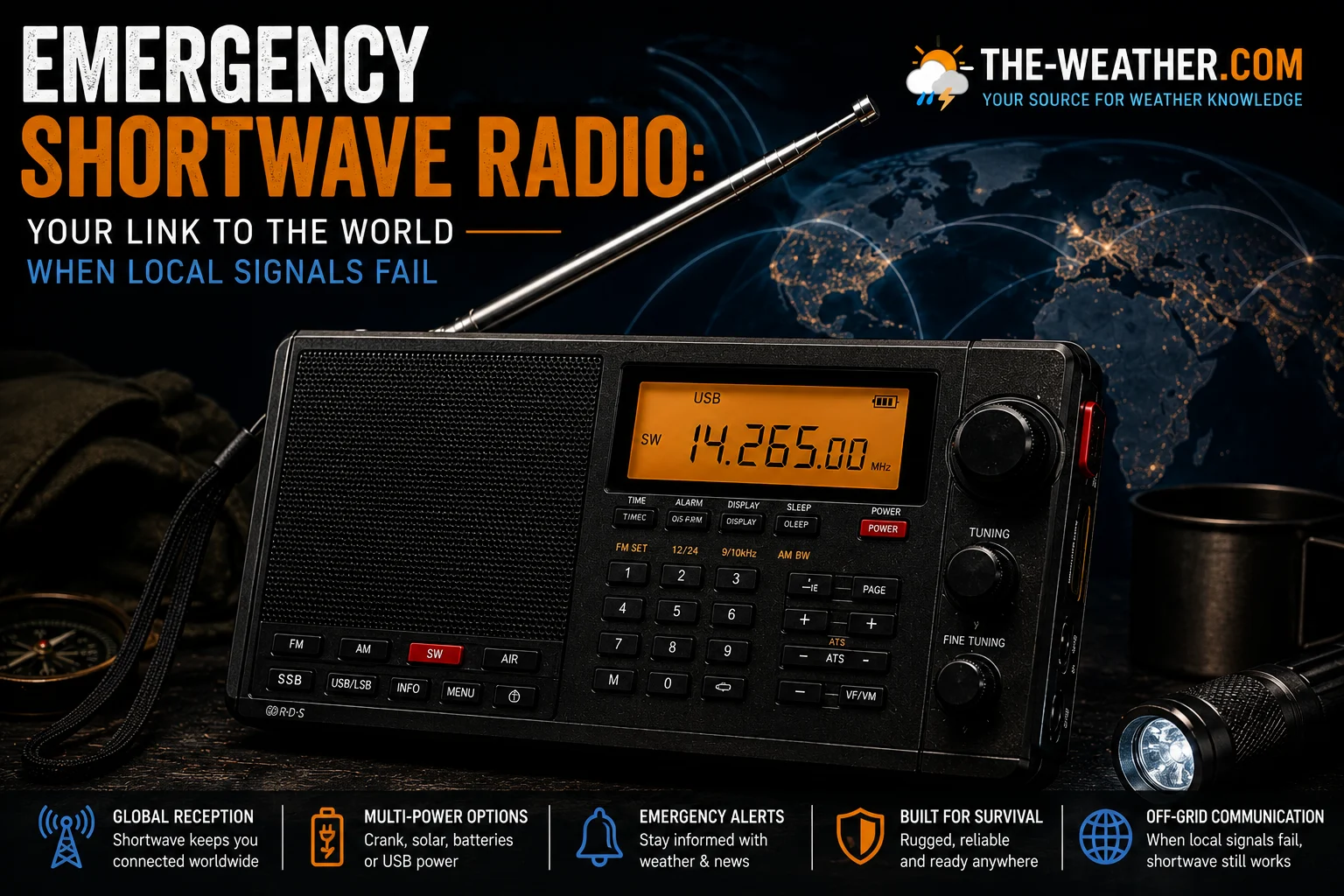
When a major disaster knocks out local AM/FM stations, cuts internet access, and overwhelms cell towers, most radios go silent. A shortwave emergency radio does not. Shortwave signals travel thousands of miles by bouncing off the ionosphere, reaching receivers far outside the affected area, which means you can still hear international broadcasters like the BBC World Service, Voice of America, and Radio Japan when everything local has failed.
This is the specific advantage shortwave brings to emergency preparedness that no other radio type replicates. A standard NOAA weather radio or AM/FM unit covers local and regional alerts. Shortwave extends your reach to global broadcasts, off-grid news, and amateur radio emergency nets that operate independently of any local infrastructure.

Lena Thornton: Weather Station Analyst & CWOP Contributor
Specifications verified against official documentation
At a Glance
What Shortwave Radio Actually Is
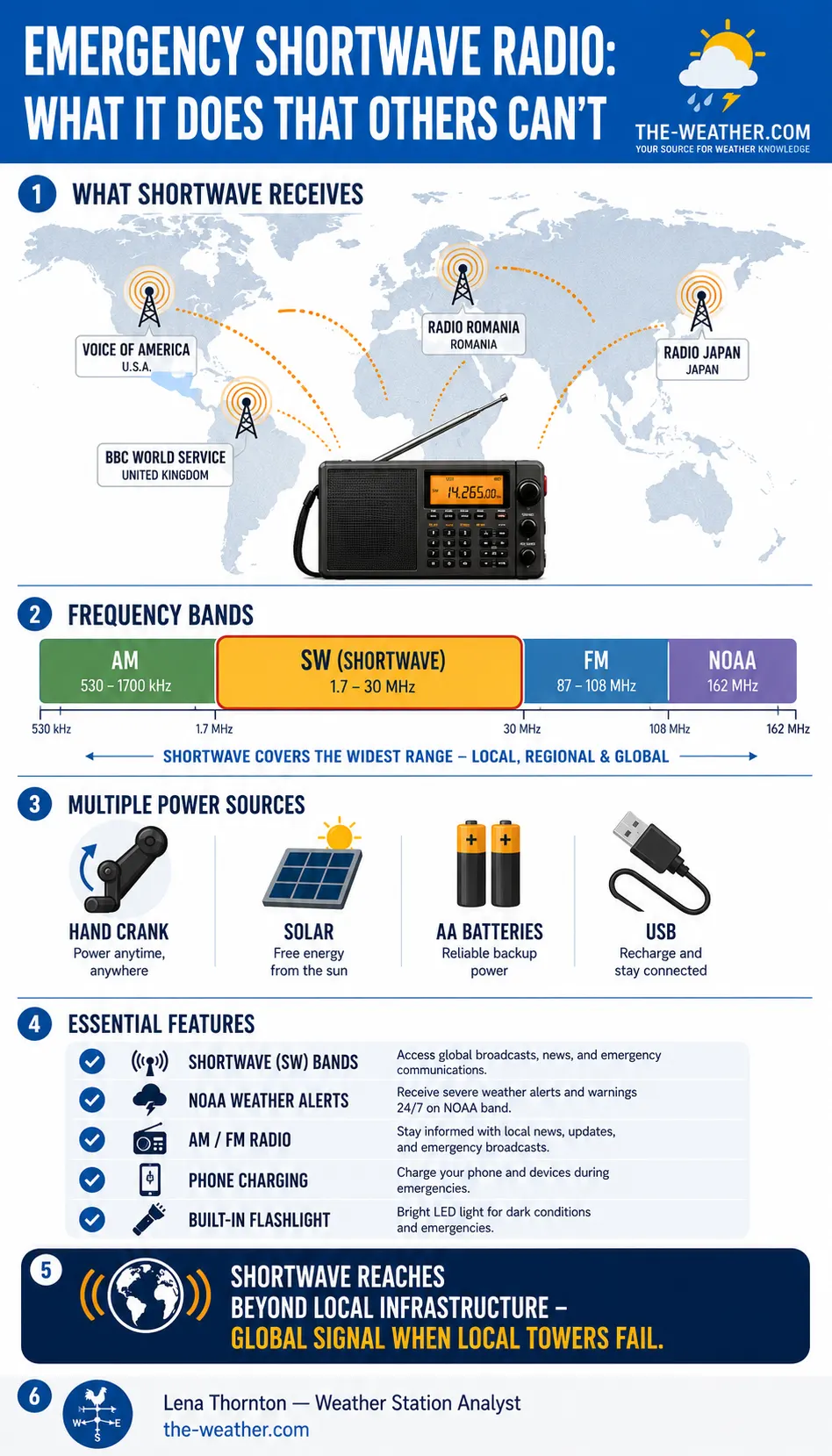
Shortwave refers to radio frequencies between approximately 1.7 and 30 MHz. At these frequencies, radio waves behave differently from AM and FM: instead of traveling in straight lines from tower to receiver, shortwave signals bounce off the ionosphere (a layer of charged particles in the upper atmosphere) and return to earth hundreds or thousands of miles from the transmitter. A single shortwave station in London can reach listeners in North America, Africa, and Asia simultaneously.
This propagation characteristic is what makes shortwave uniquely valuable for emergency use. It does not depend on local tower networks, fiber cables, internet routing, or any infrastructure that a disaster might damage. The transmitter is elsewhere. The ionosphere continues to enable long-distance propagation under suitable conditions, though signal quality varies with time of day, season, and the solar cycle, as the article explains below.
You do not need a license to listen to shortwave. Any civilian can receive shortwave broadcasts without registration or authorization. A license is only required if you want to transmit, which requires a ham radio license from the FCC.
Frequency Bands Explained
Most emergency shortwave radios cover several distinct bands. Understanding what each covers helps you tune to the right place when you need information.
Radio Spectrum: Emergency Use Bands
The sweet spot for emergency preparedness is a radio that covers all five bands above. NOAA handles local weather alerts. AM and FM cover local and regional news. Shortwave low bands carry ham radio emergency nets active during disasters. Shortwave high bands receive the major international broadcasters that stay on air when local infrastructure collapses.
Why Shortwave Matters for Emergencies
Three scenarios make shortwave specifically valuable that a standard NOAA or AM/FM radio cannot cover.
When local stations go off-air
AM and FM transmitters in a disaster zone may lose power, sustain physical damage, or be forced to evacuate staff. During major hurricanes and earthquakes, local stations routinely go dark for hours or days. At that point your standard emergency radio has nothing to receive. A shortwave radio continues picking up broadcasts from outside the affected region: BBC World Service, Voice of America, and Radio Canada International all broadcast in English on shortwave around the clock.
When you need information from outside the affected area
Local broadcasts, when they resume, naturally focus on local conditions. Shortwave gives you access to a broader picture: regional government statements, international news, and perspective on how outside resources are being mobilized. This matters most during events like widespread power grid failures where the disaster zone covers hundreds of miles.
Ham radio emergency nets
Amateur radio operators activate emergency nets on shortwave-adjacent HF frequencies during major disasters. The ARRL National Traffic System and local ARES (Amateur Radio Emergency Service) nets carry health and welfare traffic, resource coordination, and situational updates commonly on the 40-meter amateur band. A shortwave-capable radio that covers these bands lets you monitor this traffic even without a ham license.
Shortwave signal quality varies by time of day and season. High-frequency bands (10–30 MHz) propagate better during daylight hours. Low-frequency shortwave bands (3–10 MHz) work better at night. This is not a flaw: it is physics. Plan your listening accordingly and be familiar with which frequencies your target stations use at different times.
Key Shortwave Stations to Know
| Station | Country | Typical Frequencies (kHz) | Language |
|---|---|---|---|
| BBC World Service | UK | Varies seasonally, typically 5–15 MHz range | English + 40 others |
| Voice of America | USA | Varies seasonally, typically 5–17 MHz range | English + 47 others |
| Radio Japan (NHK World) | Japan | Varies seasonally, typically 9–15 MHz range | English + 18 others |
| Radio Romania International | Romania | Varies seasonally, typically 7–11 MHz range | English + 10 others |
| ARRL / Ham Emergency Nets | USA | Commonly on the 40-meter amateur band | English, disaster traffic |
Shortwave frequencies change seasonally and by time of day: what works at noon may not work at midnight. Keep a printed shortwave frequency schedule in your emergency kit. Most active broadcasters publish current seasonal schedules on their websites, and resources like the WRTH (World Radio TV Handbook) list them comprehensively.
Top Emergency Shortwave Radios
The best emergency shortwave radios combine multiple power sources with broad band coverage. These three are the most referenced in the preparedness community based on published specifications and user reports.
Kaito KA500
Top PickThe most widely recommended combination emergency and shortwave radio. Five power sources, seven NOAA weather bands, and broad shortwave coverage make it the standard recommendation for preparedness kits.
- Bands: AM / FM / SW (13 bands) / NOAA (7)
- Power: hand crank, solar, USB, AC, AA batteries
- Phone charging via USB output
- LED flashlight + SOS beacon
- Typical price: ~$70–$90
Eton Elite Traveler
Best ReceptionEton's premium travel receiver with exceptional shortwave sensitivity and an SSB (single sideband) mode for receiving ham radio and utility stations. Better audio and tuning precision than most emergency combos.
- Bands: AM / FM / SW / LW + SSB mode
- Power: AC adapter + AA batteries
- Clock / alarm / sleep timer
- No crank or solar: pair with a survival radio
- Typical price: ~$100–$130
C. Crane CC Skywave 2
Most PortableCompact pocket-sized receiver with aviation band, NOAA weather, shortwave, and FM. The aviation band lets you monitor air traffic: useful during large-scale evacuations. Excellent audio quality for its size.
- Bands: AM / FM / SW / NOAA / Aviation
- Power: 2 AA batteries (long runtime)
- Pocket size: fits in a bug-out bag
- No crank or solar: AA backup is the power plan
- Typical price: ~$80–$100
What to Look For in an Emergency Shortwave Radio
Feature Checklist
Shortwave vs NOAA Radio: Not Either/Or
A common question is whether a shortwave radio replaces a dedicated NOAA weather radio. The answer is no: they serve different functions and the best emergency kit includes both capabilities, ideally in one unit.
| Feature | NOAA Weather Radio | Shortwave Radio | Combined Emergency Radio |
|---|---|---|---|
| Weather alerts | Yes, S.A.M.E. alerts | No | Yes |
| County-specific filtering | Yes | No | Yes (most models) |
| International reception | No | Yes, worldwide | Yes |
| Works when local towers fail | Partly, NOAA transmitters are hardened | Yes, receives from outside area | Yes |
| Hand crank / solar power | Some models | Some models | Yes (most models) |
| Ham radio net monitoring | No | Yes, HF bands | Yes |
| Typical price | $30–$70 | $50–$200+ | $70–$150 |
The practical recommendation: Buy a combination radio that covers NOAA, AM/FM, and shortwave in one unit, such as the Kaito KA500, with hand crank and solar power. This covers every scenario with one device and removes the need to manage two separate units in your emergency kit.
Emergency Shortwave Radio Checklist
Use this before buying a radio and before storing it in your emergency kit. Print it and keep a copy with your kit.
Frequently Asked Questions
What is the best radio for emergencies?
For most households the best emergency radio combines NOAA weather alerts, AM/FM, shortwave reception, and multiple power sources including hand crank, solar panel, and AA batteries. The Kaito KA500 and Midland ER310PRO are consistently ranked at the top of this category.
Is it worth buying a shortwave radio?
For emergency preparedness, yes. Shortwave reaches beyond local infrastructure and receives international broadcasts when local AM/FM stations go off-air. Stations like BBC World Service and Voice of America broadcast 24 hours a day on shortwave frequencies accessible anywhere in the world.
Is shortwave radio going away?
Shortwave has declined for everyday use but remains active for emergency and international broadcasting. BBC World Service, Voice of America, Radio Japan, and dozens of others continue shortwave transmissions specifically because the signal reaches areas where internet and local infrastructure have failed.
What is the most powerful shortwave radio station?
Several stations transmit at 500 kilowatts or more, including Radio Romania International and various US government-funded stations. The strongest signals in any given location depend on frequency, time of day, and atmospheric conditions rather than transmitter power alone.
Who makes the best shortwave radio?
For emergency use, Kaito and Eton are the most recommended brands. Kaito's KA500 is widely regarded as the best combination emergency and shortwave radio. For dedicated shortwave listening quality, C. Crane and Tecsun produce well-regarded receivers.
What shortwave frequencies should I know for emergencies?
Key stations to know include BBC World Service, Voice of America, and Radio Japan: all of which broadcast in English around the clock on shortwave. Frequencies change seasonally and by time of day; check each broadcaster's published schedule for current listings. The 40-meter amateur band is commonly used for emergency traffic during disasters via nets like the ARRL National Traffic System.