
As an Amazon Associate, I earn from qualifying purchases.
In this article 8 sections
An automatic weather station measures the weather and sends or stores the readings without a person reading the instruments. The National Weather Service says most of its official weather observations are taken at airports by automated weather stations, and the weather station in many backyards works on the same principle. Here is the official definition, how such a station is built, the main U.S. networks, and how a home station fits in.
Short answer: the World Meteorological Organization (WMO) defines an automatic weather station (AWS) as a "meteorological station at which observations are made and transmitted automatically". Sensors measure temperature, humidity, wind, pressure and rain; a data unit collects and processes the readings; and the station sends them out or stores them on site. In the U.S., the best-known example is the Automated Surface Observing System (ASOS) at airports.
Editorial Research
- Written by
- Lena Thornton, Weather Station Analyst & CWOP Contributor
- Based on
- WMO Guide to Meteorological Instruments and Methods of Observation (WMO-No. 8), National Weather Service, NOAA NCEI and the National Interagency Fire Center
- Research last verified
- October 29, 2026
The Official Definition
The WMO's Guide to Meteorological Instruments and Methods of Observation (WMO-No. 8, 2008 edition) defines an automatic weather station as a "meteorological station at which observations are made and transmitted automatically". At such a station, the instrument readings are read out or received by a central data-acquisition unit, and the data can be processed at the station itself or elsewhere, for example at the central computer of the network.
The same WMO publication notes that a combined system of sensors, processing and transmission is often called an automated weather observing system (AWOS) or automated surface observing system (ASOS), and that people commonly call such a system an AWS too, although, as the WMO notes, it is not a "station" fully in line with the definition. In plain words: if a machine reads the instruments and passes the numbers on, it is an automatic weather station (our summary).
Two Kinds: Real-Time and Off-Line
| Type | What the WMO says it does | Typical use |
|---|---|---|
| Real-time AWS | Provides data to users in real time, usually at programmed times, but also in emergencies or on request | Weather reports for forecasting; monitoring storms and river or tide levels |
| Off-line AWS | Records data on site on storage devices, possibly with a display; an observer is needed to send the stored data on | Climate stations and simple stations that help an observer |
Source: WMO-No. 8, Part II, Chapter 1 (2008 edition). The WMO adds that one station often does both.
What Is Inside an Automatic Weather Station
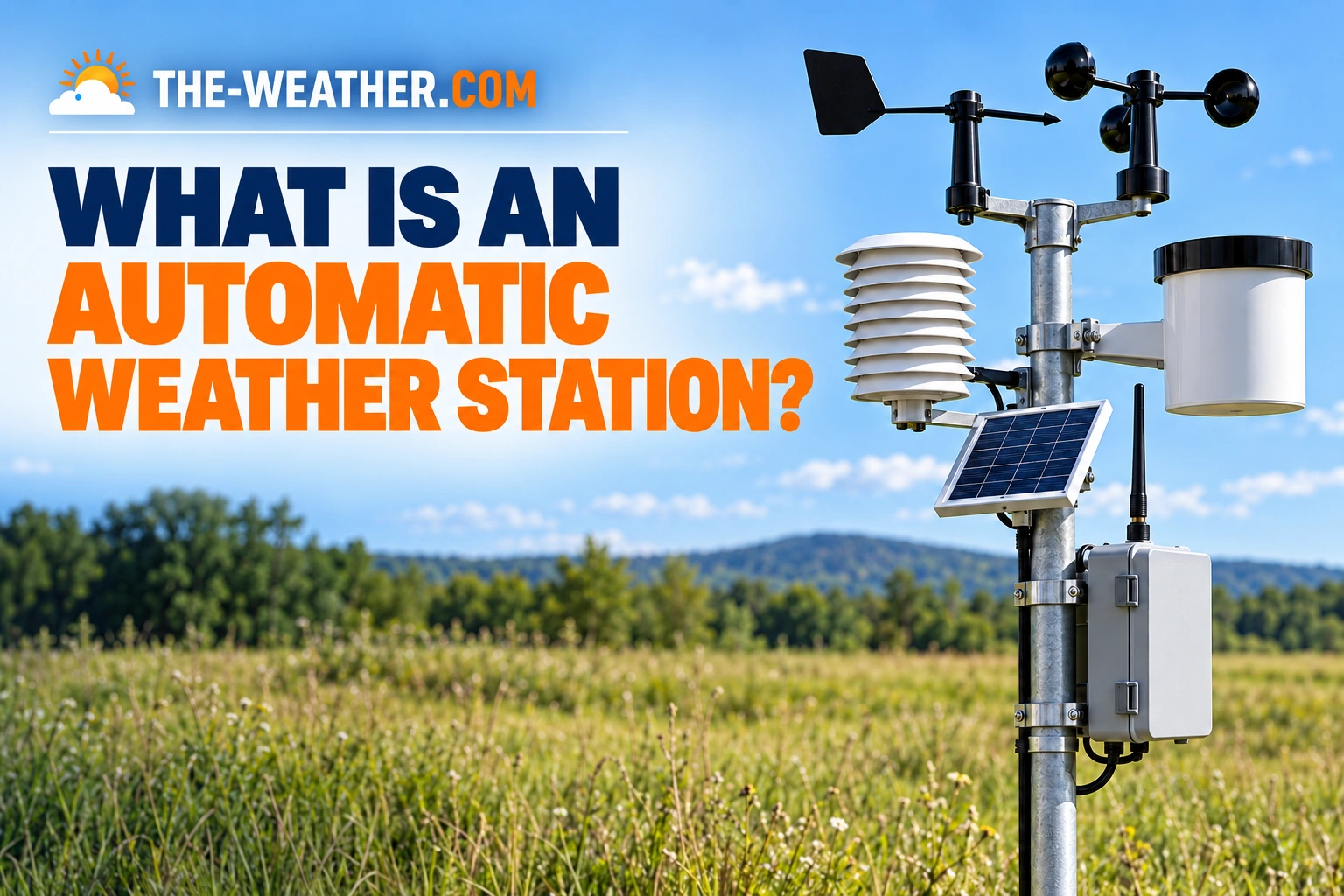
According to WMO-No. 8, a typical AWS has three parts:
- Sensors on a standard observing site, connected to a data collection unit by cables, fibre or radio.
- A processing unit that collects the sensor data, turns it into computer-readable form, processes it, stores it for a while and sends it to users.
- Support equipment: a stabilized power supply, a real-time clock and built-in tests that monitor the station's vital parts.
A home weather station follows the same pattern on a small scale: a sensor array outside, a console or hub inside that collects the readings, and often an internet upload (our comparison).
Why Weather Services Automate
The WMO lists eight purposes. Automatic stations help to:
- add stations, including in remote and hard-to-reach places;
- supply data outside an observer's working hours;
- make measurements more reliable with modern digital techniques;
- keep networks consistent by standardizing how things are measured;
- meet new observing needs;
- reduce human errors;
- lower operating costs by needing fewer observers;
- measure and report often, or continuously.
The trade-off: some observations are still hard to automate. The WMO mentions present weather and costly measurements such as cloud height and visibility, which some stations still allow an observer to add by hand.
Automatic Weather Stations in the U.S.
| Network | Who runs it | What it is for |
|---|---|---|
| ASOS (Automated Surface Observing System) | NWS, FAA and Department of Defense | Around 950 sites, mostly at airports; hourly and special weather reports. More: how U.S. airports measure weather |
| AWOS (Automated Weather Observing System) | FAA | Airport weather at many smaller airports; NCEI describes it as typically reporting at about 20-minute intervals |
| RAWS (Remote Automatic Weather Stations) | About 2,800 units; the National Interagency Fire Center's RAWS group manages and services about 1,700 of them | Remote stations whose data mainly support wildland fire management, and also climate, flood warning and air quality work |
| Personal weather stations | Private owners | Backyard data; through the Citizen Weather Observer Program (CWOP), quality-checked data reach NOAA |
Sources: NWS ASOS program page, NOAA NCEI (ASOS/AWOS), National Interagency Fire Center (RAWS), CWOP. The last column is our summary.
Is a Home Weather Station an Automatic Weather Station?
By the WMO's basic definition, yes: it makes observations and transmits or stores them automatically (our reading). What separates it from an official station is everything around the definition: certified calibration, scheduled maintenance and strict siting rules. Our page professional vs home weather stations compares the two with official figures, and installing a home weather station covers the siting part you can control yourself.
So the station on your fence post is an AWS, just one that never had to pass an inspection. Treat its numbers with a little humility and it will serve you well.
Automatic Weather Station FAQ
What is an automatic weather station?
The WMO defines it as a "meteorological station at which observations are made and transmitted automatically". Sensors measure the weather, a data unit collects and processes the readings, and the station sends them out or stores them.
What does an automatic weather station measure?
Usually air temperature, humidity, wind speed and direction, pressure and precipitation. Larger stations, such as ASOS at airports, also measure visibility and cloud height.
What is the difference between ASOS and AWOS?
Both are automatic airport weather systems. ASOS is run jointly by the NWS, FAA and Department of Defense; AWOS is operated by the FAA. NCEI describes AWOS as typically reporting about every 20 minutes and without ASOS-style special reports.
Why are weather stations automated?
According to the WMO: to add stations in remote places, report around the clock, measure more consistently, reduce human error, lower costs and report more often.
Is a home weather station an automatic weather station?
By the basic WMO definition, yes (our reading). It differs from an official station in calibration, maintenance and siting rather than in how it works.
Sources
- WMO: Guide to Meteorological Instruments and Methods of Observation (WMO-No. 8), seventh edition 2008, Part II Chapter 1 (copy hosted by NWS El Paso)
- National Weather Service: ASOS National Program
- NOAA NCEI: Automated Surface/Weather Observing Systems
- National Interagency Fire Center: Remote Automatic Weather Stations
- NOAA MADIS: Citizen Weather Observer Program
- National Weather Service Chicago: Weather Observations FAQ