
As an Amazon Associate, I earn from qualifying purchases.
In this article 10 sections
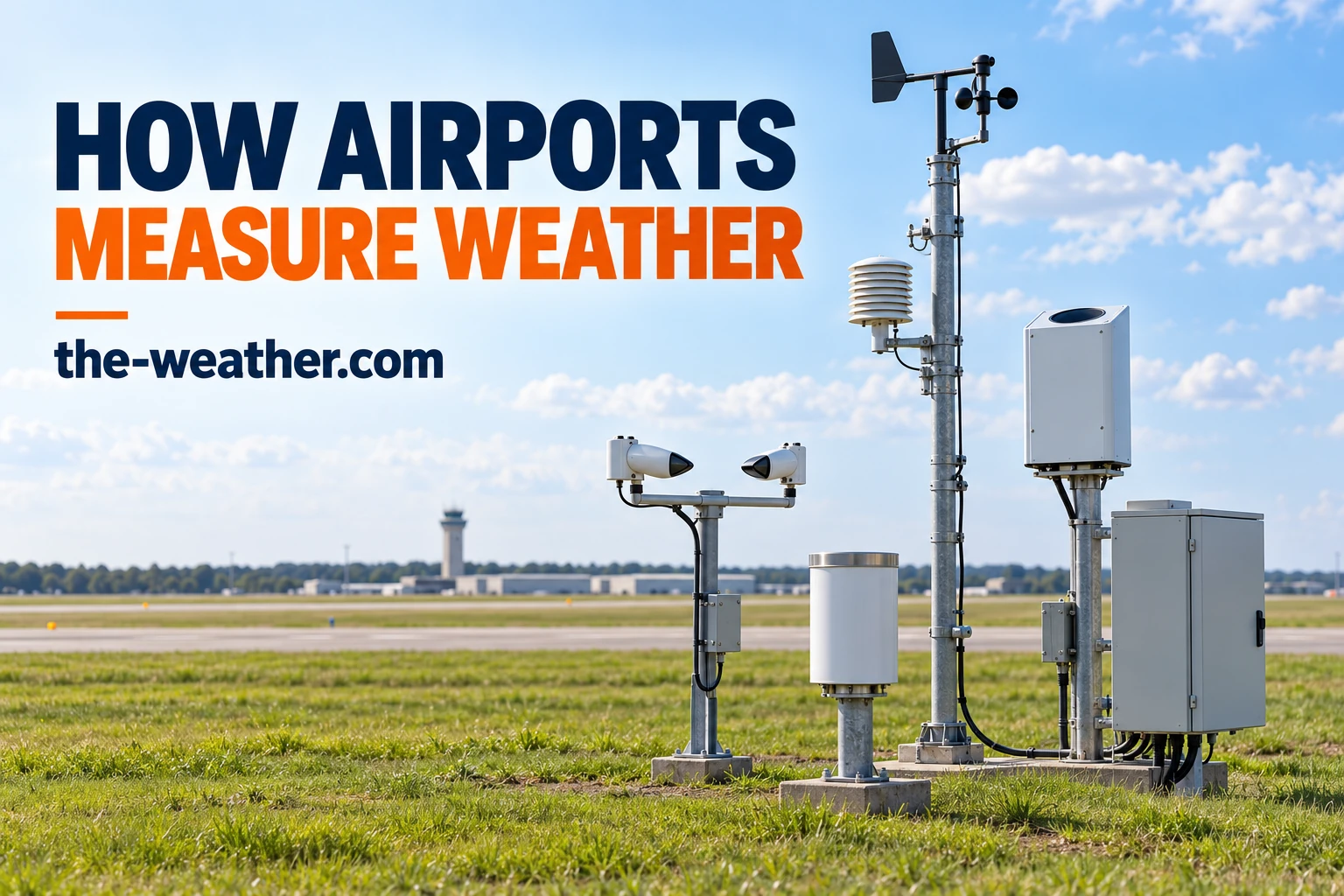
In the United States, most official weather observations come from automated stations at airports. The National Weather Service (NWS) says the type used at most major airports is the Automated Surface Observing System (ASOS). This page explains what an ASOS measures, how each sensor works, how its reports are built, and how you can look up one station yourself, step by step.
Short answer: most major U.S. airports measure weather with ASOS, a network of around 950 automated stations run jointly by the NWS, the Federal Aviation Administration (FAA) and the Department of Defense. Each station measures wind, temperature, dew point, pressure, visibility, cloud height and precipitation, works 24/7 and sends a full report (a METAR) once an hour. Most stations also send shortened reports every 5 minutes, and a special report (a SPECI) when the weather changes quickly.
Editorial Research
- Written by
- Lena Thornton, Weather Station Analyst & CWOP Contributor
- Based on
- NWS ASOS program and sensor pages, the NWS ASOS equipment inventory, the NWS Chicago observations FAQ, the ASOS User's Guide (1998) and NOAA's National Centers for Environmental Information (NCEI)
- Research last verified
- October 29, 2026
What ASOS Is
The NWS ASOS program page describes ASOS as a collaborative effort of the NWS, the FAA and the Department of Defense, with around 950 sites in the United States. The stations work 24/7. According to the NWS Chicago observations FAQ, many major airports also staff FAA-contracted weather observers, whose main role is to augment the ASOS observations and make sure they are accurate.
Not every airport has ASOS. Many smaller airports use AWOS. NCEI describes AWOS in general as operated and controlled by the FAA, older than ASOS, typically reporting at about 20-minute intervals and without the special reports ASOS sends when conditions change. AWOS setups vary from airport to airport, so check the individual station.
The Sensors, One by One
Equipment differs per station: the NWS ASOS equipment inventory lists, by site, which temperature, wind and precipitation sensor types are installed. The table shows what each sensor type does.
| What it measures | ASOS sensor | How it works | Source |
|---|---|---|---|
| Temperature and dew point | Older: DTS-1 and HO-83/1088. Newer: Vaisala HMP-155E | The older design uses a platinum resistance thermometer and a chilled mirror (cooled until dew forms; its temperature then is the dew point). The NWS planned to deploy HMP-155E replacement probes at all sites throughout 2025; the inventory lists all three types, so check your station. | NWS sensor page |
| Pressure | Redundant digital pressure transducers | Three independent sensors at towered airports, two elsewhere. ASOS issues a pressure report only when at least two agree. | NWS sensor page |
| Wind | Ice-free wind sensor: WMT-702 or the older NWS-425 | The NWS replaced the obsolete 425NWS with the WMT-702, which has heated transducers. ASOS reports wind as a 2-minute average of 5-second samples, once a minute; 2 knots or less is reported as calm. | NWS News Archive, wind page |
| Cloud height | Laser beam ceilometer | A vertical laser times the echo from the cloud base, much like radar. Measuring range 12,600 feet, reporting range 12,000 feet. | NWS sensor page |
| Visibility | Forward scatter visibility sensor | A xenon flash lamp sends light twice a second; the detector measures how much the air scatters it. A sample is taken every 30 seconds. | NWS sensor page |
| Precipitation amount | Heated tipping bucket or All Weather Precipitation Accumulation Gauge (AWPAG) | The tipping bucket tips at a set amount, typically 0.01 inch, and is heated to melt snow. The AWPAG weighs the precipitation, which handles snow and mixed precipitation better. The inventory lists both types across the network. | tipping bucket, AWPAG |
| Freezing rain | Freezing rain sensor | A small probe vibrates at 40 kHz. Ice on the probe adds mass and lowers the frequency. It detects ice build-up as low as 0.01 inch per hour. | NWS sensor page |
| Thunderstorms | ASOS Lightning Sensor (ALS), only at selected sites | Installed at selected sites that do not have the FAA's ALDARS, which takes its lightning data from the National Lightning Detection Network. The ALS needs an optical flash and a radio signal within milliseconds of each other and reports distance in bins of 0 to 5, 5 to 10 and 10 to 30 miles. | NWS sensor page |
The table is our summary of the linked NWS pages, checked October 29, 2026.
Pressure gets the most backup for a reason: the NWS calls it the most crucial surface weather element for aircraft, because it is how a plane establishes its height above the ground. Nobody wants the altimeter setting to depend on a single sensor having a good day.
Where the Sensors Stand
The ASOS User's Guide (1998) says the sensors are typically placed near the touchdown zone of the primary instrument runway, with center field as the usual alternative. The federal siting standard puts the wind sensor at 10 meters (32.8 feet); typical ASOS wind sensor heights are 33 or 27 feet. An ASOS is sited for aviation, so its readings describe conditions at the airfield and can differ from a reading in your backyard (our explanation). More on that difference: professional vs home weather stations.
How ASOS Reports
| Report | How often | What it is |
|---|---|---|
| METAR | Once an hour, a few minutes before the top of the hour | The full coded weather report used by pilots and meteorologists |
| Shortened METAR | Every 5 minutes, at most ASOS stations | Less information and less precision than the hourly METAR |
| SPECI | When the weather changes notably or quickly | A special METAR with the same full detail as the hourly one |
| One-minute observation | Every minute | A separate data product, for example for the current wind |
Sources: NWS Chicago observations FAQ (METAR, 5-minute reports, SPECI); NWS wind sensor page and ASOS User's Guide (one-minute observation).
Quality control. According to the ASOS User's Guide, ASOS checks its own sensor data. When it detects system degradation, a component failure or a data error, the affected data are left out of the report and a maintenance check indicator ($) is added to the end of the METAR. The $ means maintenance may be needed; it does not necessarily mean the data are wrong. If there is not enough raw data for an element, that element is left out of the report.
Reading a Real Report
This is a real report from Chicago O'Hare (KORD), as published by the NOAA Aviation Weather Center on October 29, 2026:
SPECI KORD 291911Z 32009KT 10SM BKN025 OVC038 19/12 A3010 RMK AO2 T01890122
- SPECI: a special report, issued because the weather changed between the hourly reports.
- KORD: Chicago O'Hare International Airport.
- 291911Z: the 29th of the month at 19:11 UTC.
- 32009KT: wind from 320 degrees (northwest) at 9 knots.
- 10SM: visibility 10 statute miles.
- BKN025 OVC038: broken clouds at 2,500 feet and overcast at 3,800 feet above ground.
- 19/12: temperature 19 °C, dew point 12 °C.
- A3010: altimeter setting 30.10 inches of mercury.
- RMK AO2: remarks follow; AO2 marks an automated system with a precipitation discriminator, a sensor that identifies the type of precipitation (ASOS User's Guide).
- T01890122: the same temperature and dew point to a tenth of a degree: 18.9 °C and 12.2 °C.
The decoding is ours, following the METAR format.
Look Up One Station in Four Steps
- Find the station code. U.S. airport stations use a four-letter code starting with K (Chicago O'Hare is KORD). Your local NWS forecast page names the station it uses for current conditions (our tip).
- Get the latest report. Enter the code in the Aviation Weather Center METAR lookup. Check the time group (for example 291911Z) to see how old the report is.
- Check the equipment. Open the NWS ASOS equipment inventory spreadsheet and filter by the station code to see which temperature, wind and precipitation sensors are installed.
- Know what it does not report. An ASOS reports the weather at the airfield. Snow depth and severe weather reports such as tornado sightings come from other networks, not from ASOS (ASOS User's Guide).
For pressure there is a shortcut: our free barometric pressure today tool reads the nearest NWS station for a U.S. ZIP code.
Accuracy: Historical Specifications
The ASOS User's Guide (1998) lists the accuracy specifications of the sensors in use at the time, for example air temperature to a root-mean-square error of 0.9 °F, wind speed to ±2 knots or 5% (whichever is greater) and pressure to ±0.02 inHg. These are historical specifications for older equipment. They do not describe the newer sensors, for which we did not find a published network-wide figure on the NWS pages.
Where to Find Historical Data
NCEI archives ASOS and AWOS data. It names the Local Climatological Data product, the Integrated Surface Dataset and 1-minute and 5-minute station datasets, and links to its data access tools from that page.
Airport Weather Station FAQ
How do airports measure weather?
Most major U.S. airports use the Automated Surface Observing System (ASOS), a set of automated sensors for wind, temperature, dew point, pressure, visibility, cloud height and precipitation. Many smaller airports use AWOS.
How many ASOS stations are there?
The National Weather Service says there are around 950 ASOS sites in the United States.
What is the difference between ASOS and AWOS?
ASOS is run jointly by the NWS, FAA and Department of Defense. NCEI describes AWOS in general as FAA-operated, older, typically reporting about every 20 minutes and without ASOS-style special reports. AWOS setups vary by airport.
How often does an airport weather station report?
An ASOS sends a full METAR once an hour. Most ASOS stations also send shortened reports every 5 minutes, and a SPECI when the weather changes notably or quickly.
What does the $ at the end of a METAR mean?
It is the ASOS maintenance check indicator. It means maintenance may be needed, not necessarily that the data are wrong.
Sources
- National Weather Service: ASOS National Program
- National Weather Service: ASOS Sensor Suite Design and the sensor pages linked in the table
- National Weather Service: ASOS Equipment Sites (inventory by station)
- National Weather Service: ASOS News Archive (sensor replacements)
- National Weather Service Chicago: Weather Observations FAQ
- National Weather Service: ASOS User's Guide (March 1998)
- NOAA NCEI: Automated Surface/Weather Observing Systems (ASOS/AWOS)
- NOAA Aviation Weather Center: METAR data