
In this article 9 sections
- What Counts as a Professional and a Home Weather Station
- Accuracy Side by Side
- Why Professional Stations Are More Accurate
- Siting: Where the Station Stands Matters as Much as the Sensor
- Where Home Stations Are Useful
- Narrowing the Gap With a Home Station
- Which Is Right for You?
- Professional vs Home Weather Station FAQ
- Sources
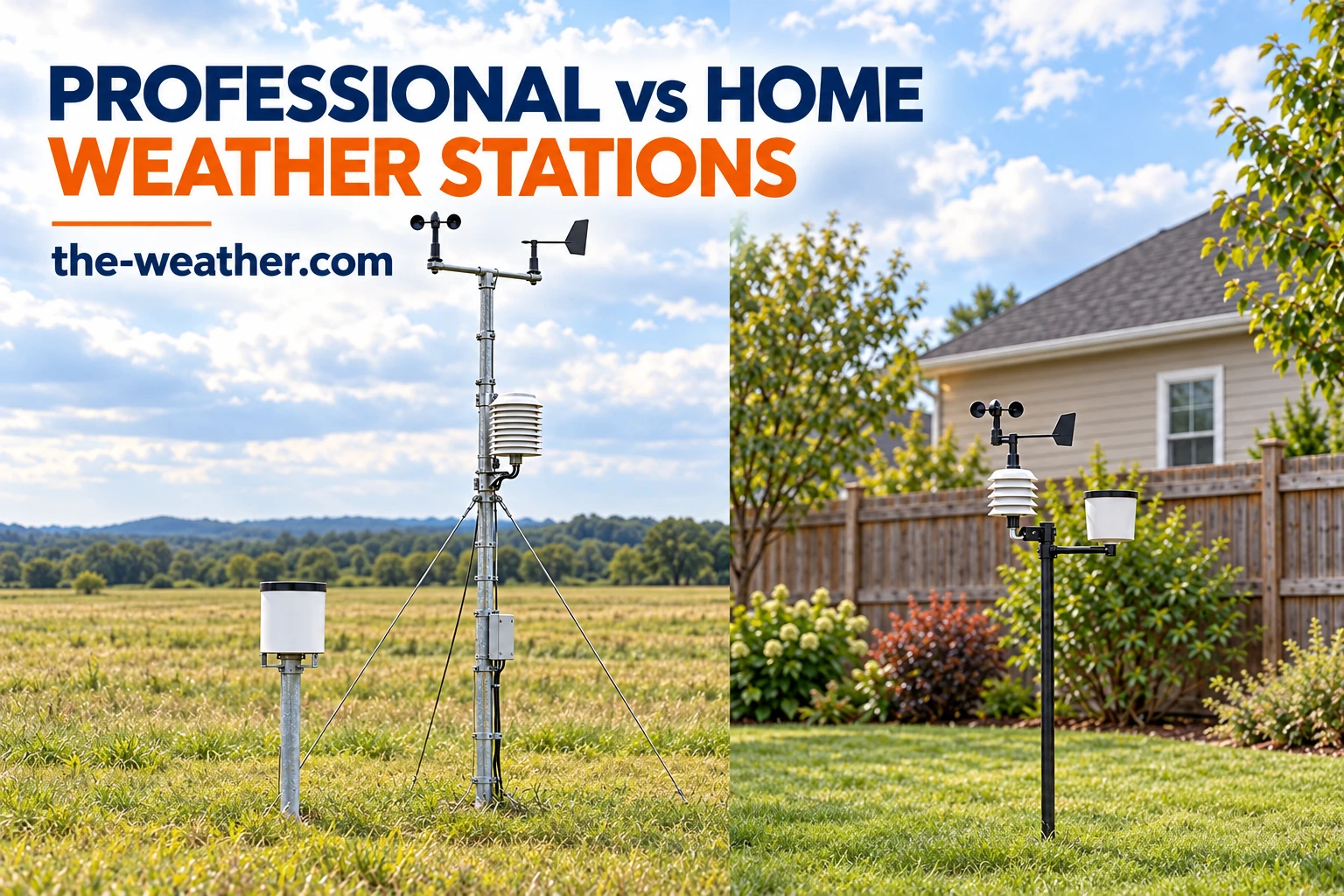
A professional weather station and a backyard weather station both measure temperature, humidity, wind, rain and pressure. The difference is in how closely they hit the true value, how they are calibrated and maintained, and where they are placed. This page compares the two with published numbers from the National Weather Service and a typical home station's own specifications, so you can see where the gap is and whether it matters for what you want to measure.
Short answer: professional stations achieve tighter error margins through certified calibration, higher-grade sensors, scheduled maintenance and strict siting rules. For example, the National Weather Service's airport stations (ASOS) specify air temperature to a root-mean-square error of 0.9 °F (maximum ±1.8 °F) between −58 and +122 °F, while a typical consumer station such as the Ambient Weather WS-2902D specifies ±2 °F. A home station is the right choice for local, everyday weather at your own house; a professional or research-grade station is needed when the data must meet an official standard.
Editorial Research
- Written by
- Lena Thornton, Weather Station Analyst & CWOP Contributor
- Based on
- NWS ASOS User's Guide, NWS Instruction 10-1302, the CWOP siting and quality guides, and manufacturer specifications
- Research last verified
- October 29, 2026
What Counts as a Professional and a Home Weather Station
Professional stations are operated by government agencies, airports, universities and research networks to a written standard. The best-known U.S. example is the Automated Surface Observing System (ASOS), run jointly by the National Weather Service (NWS), the Federal Aviation Administration and the Department of Defense; the ASOS User's Guide (1998) expected more than 900 airports to have ASOS by the turn of the century. The NWS also sets standards for climate observations, including those of its Cooperative Observer Program, in NWS Instruction 10-1302.
Home weather stations (also called personal weather stations) are consumer systems with an outdoor sensor suite and a display or app. Many owners share their data with networks such as the Citizen Weather Observer Program (CWOP), whose data are quality controlled through NOAA's MADIS system and forwarded to some National Weather Service forecast offices.
Accuracy Side by Side
The table compares the published specifications of the NWS ASOS sensors with those of a common consumer station, the Ambient Weather WS-2902D, and with the performance standard CWOP asks volunteer stations to meet.
| Measurement | Professional: NWS ASOS | Home: Ambient Weather WS-2902D | CWOP standard for volunteers |
|---|---|---|---|
| Air temperature | RMSE 0.9 °F, max error ±1.8 °F (−58 to +122 °F) | ±2 °F | ±0.9 °F (−58 to +122 °F) |
| Humidity / dew point | Dew point RMSE 1.1 to 4.7 °F at +32 to +86 °F, depending on dew point depression | Relative humidity ±5% | Dew point ±2.0 °F (+32 to +86 °F) |
| Wind speed | ±2 knots or 5%, whichever is greater | ±2.2 mph or 10%, whichever is greater | ±1 mph up to 10 mph, ±10% above |
| Wind direction | ±5° (above 5 knots) | ±10° | ±5° |
| Rainfall | ±0.02 inch or 4% of the hourly total, whichever is greater | ±5% | ±0.02 inch or 4% of the hourly amount, whichever is greater |
| Pressure | ±0.02 inHg | ±0.08 inHg | Altimeter ±0.03 inHg |
Sources: ASOS User's Guide (temperature, dew point, wind, rain, pressure), Ambient Weather WS-2902D User Manual version 1.29 (specification table), CWOP Official Guide (Tables 1a, 3, 4 and 6). The ASOS figures are from the 1998 edition of the User's Guide and the CWOP figures from the 2005 edition of its guide. The three columns are specifications, not side-by-side measurements.
Why Professional Stations Are More Accurate
Certified calibration. NWS Instruction 10-1302 says temperature instruments for climate observations should be issued with a certificate confirming the required accuracy, or a calibration certificate with the corrections to apply, and that initial testing should be done by an accredited calibration laboratory or a national testing institution. Its performance requirement for air temperature is ±1.0 °F at 95% confidence between −20 and +115 °F. The same instruction notes that the World Meteorological Organization suggests a maximum error of less than 0.4 °F, and that meeting that goal is not always economical. Consumer stations are generally sold with a stated tolerance rather than an individual calibration certificate (our reading of typical manufacturer documentation).
Higher-grade sensors. The original ASOS design, as described in the 1998 User's Guide, measured dew point with a chilled-mirror hygrometer: a mirror cooled until dew forms on it and heated once a day to recalibrate its reference. The same guide notes that work to replace that sensor was under way. The rain gauge was a heated tipping bucket, and the wind sensors belonged to an instrument series that had been the U.S. standard since the mid-1940s. Typical home stations use small electronic sensors instead; Ambient Weather's manual notes that humidity is "a difficult parameter to measure electronically" and drifts over time.
Scheduled maintenance. According to the ASOS User's Guide, a maintenance technician is notified when an ASOS detects a problem, and the network has an aggressive preventive maintenance program. Ambient Weather's manual states that official stations recalibrate or replace humidity sensors on a yearly basis. A home station is maintained by its owner.
Strict siting. The best sensor still gives poor data in the wrong place. Professional networks follow written siting rules, covered in the next section.
Siting: Where the Station Stands Matters as Much as the Sensor
| Rule | NWS climate standard (10-1302) | CWOP guidance for home stations |
|---|---|---|
| Temperature sensor height | 4 to 6 feet above the surface | 4 ft 1 in to 6 ft 7 in (1.25 to 2.0 m) |
| Shielding | Radiation shelter or thermoscreen | Ventilated radiation shield |
| Distance from obstructions | At least four times the height of the obstruction | Siting sheet (NWS El Paso): two times the height of the nearest object; CWOP Official Guide: if possible, at least four times the height of any nearby obstruction |
| Ground surface | Level ground typical of the area, at least 100 feet from extensive concrete or paved surfaces | Level ground representative of the area; avoid rock, concrete, dark surfaces, roofs and irrigated lawns |
| Rooftops | Instruments are not to be sited on rooftops | Avoid roofs for the temperature and humidity sensor |
| Wind sensor | ASOS: federal standard of 10 meters (32.8 feet); typical ASOS heights are 33 or 27 feet | Ideally 10 meters (32.8 feet), ten times the height of the nearest obstruction away |
Sources: NWS Instruction 10-1302 (November 9, 2023), ASOS User's Guide, CWOP siting guide (NWS El Paso).
A home station mounted on a deck rail or near a wall can read too warm on a sunny afternoon, whatever its sensor specification says (our explanation). Siting is often the biggest single difference between a professional and a home measurement (our reading).
Where Home Stations Are Useful
A professional station measures the weather at its own site, often an airport that can be miles from your house. A home station measures your yard: the rain that actually fell on your garden, the wind on your roof line, the frost in your low corner (our explanation). More on that difference: why your weather app can differ from your backyard.
Well-sited home stations also add to the public record. CWOP stations send their data to the NOAA MADIS system, which runs automated validity, temporal consistency and "buddy" checks against nearby stations, and the CWOP Official Guide says the data are forwarded to some NWS Weather Forecast Offices. The CWOP guide also notes a limit: real-time quality feedback does not exist for rainfall.
Narrowing the Gap With a Home Station
- Site it by the rules. Follow the CWOP heights and distances above (our advice).
- Use a ventilated radiation shield. The CWOP siting sheet asks for one; it keeps direct and reflected sunlight off the temperature sensor (our explanation).
- Check humidity against a reference. Ambient Weather recommends calibrating humidity against an accurate source such as a sling psychrometer.
- Compare with neighbours. If you share data with CWOP, its quality statistics show how your station compares with nearby stations.
- Maintain it. Clean the rain gauge funnel, check the cups and vane, and expect the humidity sensor to drift over time (our advice). Step by step: how to upgrade the accuracy of your home weather station.
Which Is Right for You?
| You need | Better fit | Why |
|---|---|---|
| Official climate records, aviation or legal evidence | Professional | Requires certified calibration and siting to a written standard |
| Research, agriculture or engineering data | Research-grade or professional | Known, documented error margins and calibration certificates |
| Weather at your own house, gardening, a pool or home safety alerts | Home station | Measures your exact location; a tolerance of about 2 °F rarely changes a decision at home |
| Contributing to public weather data | Well-sited home station | CWOP accepts home stations and checks their data against neighbours |
The table is our own summary of the sources on this page.
Professional vs Home Weather Station FAQ
Are professional weather stations more accurate than home weather stations?
Yes, by specification. The NWS ASOS specifies air temperature to an RMSE of 0.9 °F (maximum ±1.8 °F) between −58 and +122 °F; a typical home station such as the Ambient Weather WS-2902D specifies ±2 °F. Calibration, maintenance and siting widen the gap in practice.
What makes a professional weather station professional?
Certified calibration (NWS Instruction 10-1302 says instruments should come with a certificate, with initial testing by an accredited laboratory or national testing institution), higher-grade sensors, scheduled maintenance by technicians and siting to a written standard.
Can a home weather station contribute to official weather data?
Yes, through the Citizen Weather Observer Program. CWOP data pass through NOAA MADIS quality control, including checks against nearby stations, and some NWS forecast offices receive the data.
How high should a home weather station be mounted?
CWOP recommends the temperature and humidity sensor at 1.25 to 2.0 meters (4 ft 1 in to 6 ft 7 in) above level ground and the anemometer ideally at 10 meters (32.8 feet).
Why does my home station differ from the airport reading?
The airport station measures conditions at the airport, often miles away, with different surroundings. Siting, sensor tolerance and local weather all contribute to the difference.
Sources
- National Weather Service: Automated Surface Observing System (ASOS) User's Guide (March 1998)
- National Weather Service Instruction 10-1302: Requirements and Standards for NWS Climate Observations (November 9, 2023)
- Citizen Weather Observer Program (CWOP) Official Guide (Version 1.0, March 2005)
- Personal Weather Station Siting (CWOP, NWS El Paso)
- NOAA MADIS: Citizen Weather Observer Program data
- Ambient Weather WS-2902D User Manual, version 1.29 (specification table)