In this article 6 sections
Ambient WS-2902C vs WS-5000 (2026): One Clear Winner?
Our picks in this guide
Compare the models in this guide
See today’s price, delivery options and customer reviews on Amazon.
As an Amazon Associate, I earn from qualifying purchases.
Ambient Weather WS-2902C vs WS-5000: compare sensors, accuracy, update speed, and value to find which station fits your setup.
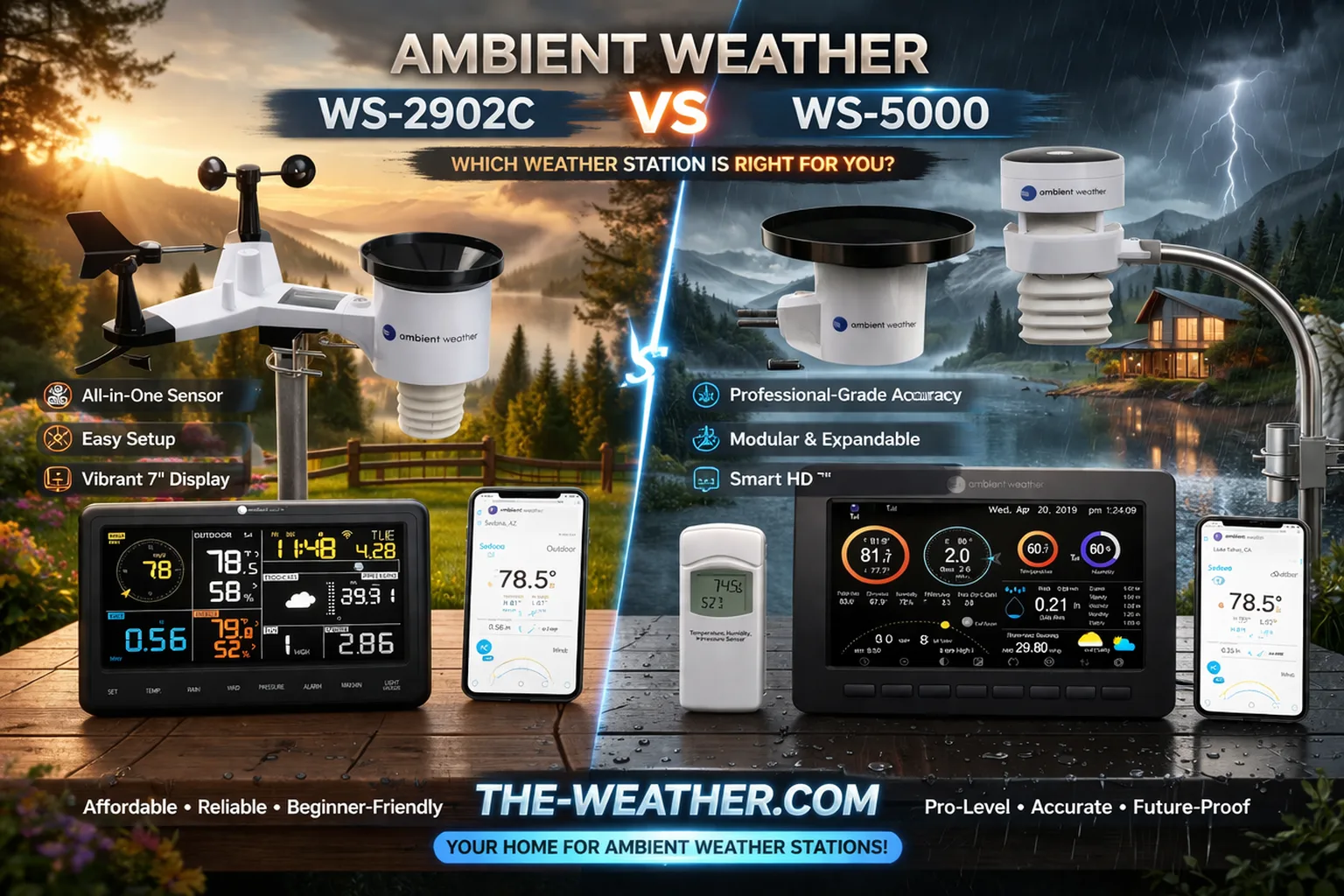
WS-2902C vs WS-5000: quick answer: The WS-5000 wins on wind accuracy, update speed, and freeze resistance. The WS-2902C wins on price, simplicity, and value. In mild climates the WS-2902C delivers ~90% of the WS-5000's data for ~40% of the cost. In cold climates with ice storms, the WS-5000's ultrasonic anemometer is the clear choice: mechanical cups freeze solid.
- Budget is a priority: best value under $200
- You live in a mild or moderate climate
- You want a simple all-in-one setup
- You are a first-time weather station owner
- One mounting location is all you have
- Wind accuracy matters and you want ultrasonic
- You live somewhere that freezes in winter
- You want 4.9-second updates vs 16 seconds
- You want add-on sensor data on the console
- You want a station built for long-term durability
As an Amazon Associate, we earn from qualifying purchases at no extra cost to you. Specifications based on Ambient Weather's official documentation. Features may vary by firmware version and production batch.
Ambient Weather WS-2902C
Best value · mild climates · ~$170–$200
Check WS-2902C price All-in-one complete stationAmbient Weather WS-5000
Ultrasonic · freeze resistant · ~$420–$500
Check WS-5000 price Complete system: Wi-Fi includedHead-to-Head Spec Comparison
Every meaningful spec side by side. The winner in each category is highlighted. Both stations share Wi-Fi, Alexa, Google Home, and IFTTT: the differences that actually matter are below.
| Feature | WS-2902C ~$170–$200 |
WS-5000 ~$420–$500 |
|---|---|---|
| Wind Sensor | Mechanical cups Can freeze |
Ultrasonic, no moving parts Freeze resistant |
| Update Rate | Every 16 seconds | Every 4.9 seconds 3× faster |
| Rain Gauge | Built into sensor array | Separate wireless unit Better placement |
| Console Display | Colour LCD | Full-colour TFT LCD Better display |
| Add-on Sensors on Console | App only, not on console Pass-through only |
Shown on console display Full ecosystem |
| Cold Weather Use | Cups can lock up in ice Reports 0 mph when frozen |
Highly freeze-resistant Ultrasonic advantage |
| Wi-Fi | Yes, 2.4 GHz Same |
Yes, 2.4 GHz Same |
| Alexa + Google Home | Yes Same |
Yes Same |
| Installation | All-in-one · simpler 1 mounting location |
2 units to mount Extra step |
| Wind Speed Ceiling | 100 mph | 89 mph Lower but rarely relevant |
| Best For | Value buyers · mild climates | Cold climates · data enthusiasts Pro pick |
Where They Actually Differ
Both stations share Wi-Fi connectivity, Alexa and Google Home integration, and Ambient Weather Network support: those are not the deciding factors. Here are the four differences that actually matter.
1. Mechanical Cups vs Ultrasonic Wind Sensor
2. Update Speed: 16 Seconds vs 4.9 Seconds
The WS-2902C sends readings every 16 seconds. The WS-5000 cuts that to 4.9 seconds: more than three times faster. For casual weather checking this difference is irrelevant. For tracking fast-moving storms, feeding data to a public Weather Underground station, or contributing to CWOP, the faster update rate captures short-lived gusts and rapid pressure changes that the WS-2902C misses entirely. The WS-5000's speed matches Davis Instruments stations costing significantly more.
3. Rain Gauge Placement
The WS-2902C has the rain gauge built into the main sensor array. The WS-5000 has a separate wireless rain gauge you can position at the recommended 4–6 feet above ground in an open area. Per NWS cooperative observer siting guidelines, this separate placement meaningfully improves rainfall accuracy, particularly for light rain events where the WS-5000's larger funnel also reduces measurement error.
4. Add-on Sensors at the Console
On the WS-2902C, optional thermo-hygrometer and air quality sensors connect to the app only: they do not appear on the physical console. On the WS-5000, the full range of add-on sensors including soil moisture, lightning detection, water leak sensors, and PM2.5 air quality display directly on the console. For buyers planning to expand their setup, this is a meaningful daily-use difference.
Real-World Scenario: Winter Storm at 2 AM
It is 2 AM in January. Freezing rain has been falling for six hours. You are trying to decide whether to drive to work at dawn or stay home.
If you own the WS-2902C, there is a real chance your wind sensor has iced up. Your station may be reading 0 mph not because the storm stopped, but because the cups are frozen solid. You are making a safety decision based on incorrect data.
If you own the WS-5000, your ultrasonic sensor has been streaming accurate wind and conditions data all night: no moving parts to freeze. You can see exactly what is happening outside without stepping out the door.
That is the practical difference between these two stations. Not specs on a page: a real decision made with either accurate or inaccurate data.
Known Limitations of Each Station
These follow from each station's design and specifications: the trade-offs to know before you buy.
WS-2902C: Common Complaints
- Frozen anemometer: Cup anemometers can ice up in ice storms and read 0 mph at exactly the wrong moment
- Low wind inconsistency: Readings below 5 mph can be variable, especially as bearings wear over years of continuous spinning
- Add-ons not on console: Extra sensors send data to the app only, not to the console
- Wi-Fi setup friction: The station only supports 2.4 GHz Wi-Fi, which can complicate setup on dual-band routers
WS-5000: Common Complaints
- Price barrier: It costs more than twice as much as the WS-2902C
- Two mounting locations: Separate sensor array and rain gauge each need their own pole, which is harder with limited space
- Cluttered console: When multiple optional sensors are connected, the display can feel busy and hard to scan quickly
- Console not touchscreen: Button navigation on the TFT LCD feels dated compared to modern smart home displays
Who Should Buy Which
Both stations are well-built and reliable. The right pick depends entirely on your climate, budget, and how you use your data.
🔵 Choose the WS-2902C if you are:
- A first-time buyer who wants reliable data without complexity
- On a budget, roughly 90% of WS-5000 data for 40% of the price
- In a mild climate where freezing conditions are rare
- A casual weather watcher who checks conditions once or twice a day
- In a small space where a single mounting location is all you have
🟢 Choose the WS-5000 if you are:
- In a cold climate where ice storms and sub-zero temperatures are common
- A data enthusiast who wants near-real-time readings and the most accurate wind data at this price
- Planning to expand with soil sensors, lightning detectors, or air quality monitors on the console
- A gardener, farmer, or outdoor professional who needs hyperlocal precision
- Durability-first, the solid-state sensor is built for long-term reliability without mechanical wear
Who Should NOT Buy Each Station
❌ Do NOT buy the WS-2902C if:
- You live in a climate with regular ice storms or sub-zero winters
- You want add-on sensor data displayed on your physical console
- You track storms seriously and need sub-10-second updates
- Long-term wind sensor reliability is a priority
❌ Do NOT buy the WS-5000 if:
- Budget is a constraint: the WS-2902C delivers 90% of the value
- You have only one mounting location and cannot separate the rain gauge
- You live in a climate that never freezes: the main advantage disappears
- You want a touchscreen console or a compact display
Frequently Asked Questions
Is the WS-5000 worth the extra money over the WS-2902C?
Yes, if wind accuracy and long-term reliability matter. The WS-5000's ultrasonic sensor has no moving parts to wear out, updates every 4.9 seconds versus 16, and its separate rain gauge can be optimally placed. In cold climates, the freeze-resistant sensor is a genuine practical advantage. In mild climates, the WS-2902C delivers ~90% of the same data for ~40% of the cost, and for most casual homeowners that is the smarter purchase.
Does the WS-2902C work during power outages?
The outdoor sensor array is solar-powered with battery backup, so it continues collecting data. The indoor console requires AC power and will go dark without a UPS. Both stations continue logging to the Ambient Weather Network as long as your Wi-Fi router stays online.
Can the WS-5000 sensor freeze in winter?
The WS-5000's ultrasonic anemometer has no spinning cups or mechanical bearings, making it highly resistant to freezing. The WS-2902C can lock up and report 0 mph during ice storms. During the February 2025 ice storm season, some Ambient Weather Network users reported this exact pattern: WS-2902C reading 0 mph for hours while nearby WS-5000 units continued streaming accurate data.
Does the WS-2902C connect to Weather Underground?
Yes, both stations connect directly to Weather Underground and the Ambient Weather Network via built-in Wi-Fi, with no separate hub required. Both support Alexa, Google Home, and IFTTT. Connectivity is not a differentiating factor between these two models.
How often does the WS-5000 update versus the WS-2902C?
The WS-5000 updates every 4.9 seconds. The WS-2902C updates every 16 seconds. For casual weather checking, 16 seconds is perfectly adequate. For serious storm monitoring or public Weather Underground data contribution, 4.9 seconds captures fast-moving weather events that 16-second intervals miss entirely.
Which station is easier to install?
The WS-2902C is simpler: an all-in-one pre-assembled array with one mounting location, typically installed in under one hour. The WS-5000 has a separate wireless rain gauge needing its own mounting location at 4–6 feet above ground, adding one planning step. Both are manageable for a non-technical homeowner with basic tools.
Final Verdict
The WS-5000 is the better station. The WS-2902C is the smarter buy for most people.
The WS-5000's ultrasonic sensor, 4.9-second updates, separate rain gauge, and freeze-resistant design deliver performance that approaches professional accuracy at a consumer price. For cold climates and serious weather monitoring, it earns every dollar of its premium.
But the WS-2902C is not a bad buy. It consistently ranks as the best value weather station available: accurate, connected, Alexa-ready, and reliable. For most homeowners in mild climates who check conditions a few times a day, spending twice as much for the WS-5000 buys accuracy gains they will rarely notice in practice.
Buy the WS-2902C if price is your priority. Buy the WS-5000 if accuracy and cold-weather durability are yours. Prices vary: verify on Amazon before purchasing.
Sources
WS-2902C specifications and update rate: Ambient Weather official WS-2902C support page. WS-5000 ultrasonic specifications: Ambient Weather official WS-5000 product page. Long-term accuracy comparison: Weather Station Advisor: WS-5000 review. Freezing anemometer reports: Ambient Weather Network community, cross-referenced February 2025 ice storm season data. NWS siting guidelines: NWS cooperative observer siting policy. No manufacturer compensation was received. Updated April 2026.
See How These Compare Against All Five Top Stations
We ranked five home weather stations on accuracy, sensor quality, Wi-Fi, and long-term durability, with honest conclusions and no paid placements.

Lena Thornton
Weather Technology Specialist & CWOP-Referenced Standards. Lena covers home weather station reviews, comparisons, and severe weather preparedness at The-Weather.com. Every comparison is grounded in verified manufacturer specifications and independent long-term reviews. Last updated April 2026.
Ready to decide?
Find your pick on Amazon
Prices and stock change daily. Check the current price, delivery options and what owners say in their reviews.
Our top picksCompare our picks on AmazonToday's price, delivery & owner reviews on Amazon
Check on Amazon →