
Our picks in this guide
Compare the models in this guide
See today’s price, delivery options and customer reviews on Amazon.
As an Amazon Associate, I earn from qualifying purchases.In this article 9 sections

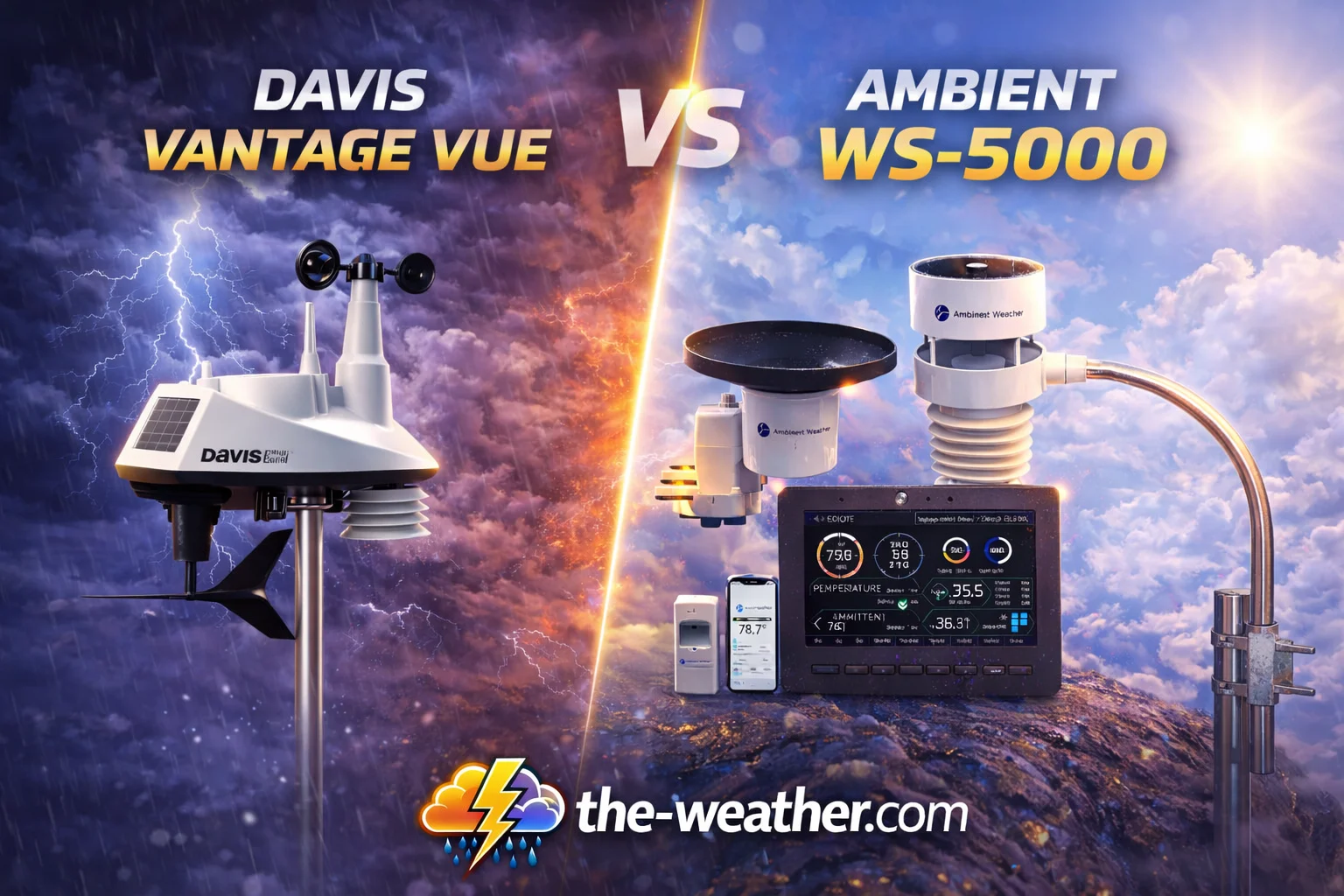
Ambient WS-2000 vs WS-5000: a visual comparison of sensor design, display features, and performance to highlight differences in accuracy and overall value.
⚡ The 5-Second Verdict
- Budget is your main constraint and you want the premium console
- You live in a mild climate with no harsh winters
- Casual monitoring is enough and 16-second updates are fine
- You want optional sensor support on a tighter budget
- Wind accuracy matters: the ultrasonic sensor is far more precise
- You live in a cold climate where cup anemometers can freeze
- You want 4.9-second updates for storm tracking or Weather Underground
- You want rain data you can actually trust across all intensities
✔ Prices checked regularly · Updated March 2026 · Amazon updates pricing daily
* As an Amazon Associate, The-Weather.com earns from qualifying purchases. Using our links costs you nothing extra.
Head-to-Head Spec Comparison
The console is identical. Every meaningful difference lives in the outdoor sensor suite. Here is where the gap between these two stations shows up clearly.
| Feature | Ambient WS-2000 | Ambient WS-5000 |
|---|---|---|
| Price (approx.) | ~$170–$200 ✓ LOWER PRICE | ~$380–$450 |
| Wind Sensor Type | Cup-and-vane anemometer, mechanical | Ultrasonic, no moving parts ✓ WINNER |
| Wind Accuracy | Often reported around 10% in independent testing | ±1 mph below 22 mph; ±5% at or above 22 mph ✓ WINNER |
| Outdoor Update Interval | Every 16 seconds | Every 4.9 seconds ✓ WINNER |
| Indoor Update Interval | Every 64 seconds | Faster (separate indoor sensor) ✓ WINNER |
| Rain Gauge | Integrated into sensor array, smaller funnel | Separate wireless unit, ~6" funnel ✓ WINNER |
| Rain Accuracy | Reported to over-count in heavier downpours (same issue as WS-2902) | Significantly improved; larger funnel within accepted specifications ✓ WINNER |
| Barometric Pressure | Can respond more aggressively than expected to pressure changes (same issue as WS-2902) | More accurate, improved sensor placement ✓ WINNER |
| Max Wind Speed | ~100 mph ✓ HIGHER CEILING | ~89 mph (practical; winds in most thunderstorms stay below this) |
| Freeze Resistance | Low, cups can freeze in icing conditions, reporting 0 mph | High, no moving parts to ice up ✓ WINNER |
| Console | Same full-color TFT LCD display ✓ IDENTICAL | Same full-color TFT LCD display ✓ IDENTICAL |
| Optional Sensors | Full range: soil moisture, AQ, lightning, leak, temp probes ✓ SAME | Full range: soil moisture, AQ, lightning, leak, temp probes ✓ SAME |
| Smart Home | Alexa, Google Assistant, IFTTT, Rachio ✓ SAME | Alexa, Google Assistant, IFTTT, Rachio ✓ SAME |
| Wi-Fi Connectivity | 915 MHz RF, 300 ft line of sight ✓ SAME | 915 MHz RF, 1,000 ft line of sight ✓ WINNER |
| Weather Underground | Yes ✓ SAME | Yes ✓ SAME |
| Best For | Budget buyers wanting premium console, mild climates | Accuracy-focused buyers, cold climates, storm trackers, CWOP reporters ✓ RECOMMENDED |
Where One Still Beats the Other
The console is the same on both stations. The price gap is smaller than most buyers expect. The differences that actually matter are all in how the sensors work, and they are real differences, not marketing.
Ambient Weather positioned the WS-2000 as a middle-ground product. It takes the premium TFT LCD console introduced with the WS-5000 and pairs it with the older WS-2902 sensor suite. That means buyers get the better display at a lower price, but they carry across the sensor limitations that reviewers flagged in the WS-2902. The WS-5000 fixes those limitations at the hardware level. Whether those fixes are worth the price difference is the question this comparison exists to answer.
1. Wind Accuracy: Cup-and-Vane vs. Ultrasonic
2. Update Speed: 16 Seconds vs. 4.9 Seconds
The WS-2000 delivers outdoor sensor data to the console every 16 seconds. The indoor sensor updates every 64 seconds. The WS-5000 cuts the outdoor update interval to 4.9 seconds. TechHive described this as "a massive improvement," noting the previous generation could sometimes take a full minute to deliver data. For casual backyard monitoring, 16 seconds is adequate. For storm tracking, feeding data to a Weather Underground public station, contributing to CWOP, or watching a fast-moving front, the 4.9-second interval on the WS-5000 gives you a meaningfully more responsive picture of what is happening outside. Wind gusts in particular are poorly captured at 16-second intervals.
3. Rain Gauge: Integrated vs. Separate Wireless Unit
This is the most underappreciated difference between these two stations. On the WS-2000, the rain gauge is built into the main sensor array. This design has two practical problems. First, the funnel opening is smaller, which reduces accuracy in light and moderate rain. Second, because the rain gauge is part of the same assembly as the wind sensor, you must compromise their placement: the wind sensor ideally sits at 33 feet for accurate readings, while a rain gauge placed at that height is more exposed to wind splash and overcounting. TechHive documented the WS-2902 sensor suite as prone to over-measuring rainfall in heavier downpours, and the WS-2000 carries the same sensor, so the same issue applies.
The WS-5000's rain gauge is a separate wireless unit. It has a funnel opening of approximately 6 inches, which Weather Station Advisor confirmed is within the commonly accepted specification of 4 inches or more for consumer-grade accuracy. Placing it at ground level (4 to 6 feet) away from obstructions, as CoCoRaHS guidelines recommend, is straightforward because the sensor is independent of the wind array. TechHive found the WS-5000's rain gauge substantially more accurate than previous Ambient Weather gauges in their testing.
4. The Price Gap Is Smaller Than It Looks
At first glance the WS-5000 appears to cost significantly more than the WS-2000. But TechHive noted that at the time of their review, the WS-2000 was priced only slightly below the WS-5000. Current pricing on Amazon fluctuates for both stations. Before buying the WS-2000 purely on price grounds, it is worth checking current prices for both on the same day. The gap may be narrower than you expect, and the sensor upgrades in the WS-5000 are permanent improvements, not temporary ones.
Honest Weaknesses of Both Stations
Neither station is perfect. Here is what the glowing parts of most reviews tend to leave out.
Real-World Scenario: Two Homeowners, Two Different Decisions
Marcus lives in central North Carolina. His winters are mild, freezing rain is rare, and his main interest is uploading data to Weather Underground for his neighborhood. He bought the WS-2000 because the price at the time was meaningfully lower than the WS-5000. His station handles spring and summer storms well. He noticed the rainfall totals run a little high compared to his neighbor's manual gauge after heavy afternoon thunderstorms, but not enough to bother him. For his use case, the WS-2000 delivers exactly what he needed.
Carol lives in suburban Minneapolis. January temperatures regularly fall below zero and freezing rain events happen every winter. She chose the WS-5000. During the first ice storm of the season, she watched a neighbor's cup-and-vane station report 0 mph for four hours while her ultrasonic sensor tracked the actual shifting wind conditions through the entire event. She also contributes data to CWOP and the 4.9-second update interval means her reports reflect real-time conditions rather than 16-second snapshots. For her, the WS-5000 was worth every cent of the premium.
Climate, use case, and how closely you look at your data make all the difference here.
Who Should Buy Which
Both stations use the same console, the same smart home integrations, and the same cloud platform. The decision comes down to what you need from your outdoor sensors.
🔵 Choose the WS-2000 if you are…
- On a tight budget and the price difference over the WS-5000 is significant enough to matter to you right now
- In a mild climate: no hard winters, no freezing rain, no ice storms that could lock up mechanical sensors
- A casual observer who checks conditions a few times a day and doesn't need sub-10-second data refresh for storm tracking
- Wanting the premium console with optional sensor support without paying for the full WS-5000 sensor suite
🟩 Choose the WS-5000 if you are…
- Serious about wind data and want the ultrasonic sensor's documented accuracy improvement over cup-and-vane
- In a cold climate where icing conditions could compromise a mechanical anemometer during exactly the storms you need data most
- A Weather Underground contributor or CWOP reporter where 4.9-second updates provide meaningfully better data quality
- Focused on rainfall accuracy across all intensities: the separate gauge with a larger funnel corrects the over-measurement issue documented in the WS-2000
- A long-term buyer who wants no moving parts to maintain or replace over time
Frequently Asked Questions
Final Verdict
The WS-2000 and WS-5000 share the same console, the same cloud platform, the same smart home ecosystem, and the same expandability. The difference is entirely in the sensors that actually measure your weather.
The WS-2000 makes sense in one specific situation: the price gap is large enough to matter to your budget right now, and you live in a mild climate where freezing rain is rare and casual monitoring is your main goal. The premium console and optional sensor support are real benefits at a lower entry point.
In every other scenario, the WS-5000 is the right station. The ultrasonic anemometer delivers genuinely better wind accuracy with no moving parts to wear or freeze. The separate rain gauge with its larger funnel corrects a documented problem in the WS-2000 sensor suite. The 4.9-second update interval is three times faster. And TechHive's conclusion still holds: it is by every measure the most accurate station Ambient Weather has released, rivaling the Davis Vantage Vue at a significantly lower price with far better smart home connectivity.
If you are undecided, check both prices on Amazon today before you buy. The gap is sometimes much smaller than you expect.
✔ Prices checked regularly · Updated March 2026
* As an Amazon Associate, The-Weather.com earns from qualifying purchases. Using our links costs you nothing extra.
📦 After You Buy: Getting the Most from Your Station
First steps that most new owners skip, and why they matter for accuracy.
More From The-Weather.com
View full profile →
Lena has reviewed more than 40 personal weather stations since 2019, evaluating every station against verified specifications, published independent tests, and real-world user reports. She only recommends what she would put on her own roof. This post was last reviewed and updated in March 2026.
Ready to decide?
Find your pick on Amazon
Prices and stock change daily. Check the current price, delivery options and what owners say in their reviews.
Our top picksCompare our picks on AmazonToday's price, delivery & owner reviews on Amazon
Check on Amazon →