

Product covered in this analysis
Raddy WF-100C Indoor Outdoor Weather Stations
See today’s price, delivery options and customer reviews on Amazon.
As an Amazon Associate, I earn from qualifying purchases.In this article 9 sections
- How the Raddy WF-100C Compares
- Pros & Cons of the Raddy WF-100C
- Who Should Buy the Raddy WF-100C?
- The Dual-Sensor Advantage: More Than Just a Weather Station
- The Display and the Outdoor Sensor
- Video Overview: A Closer Look at the WF-100C
- Getting Connected: Wi-Fi and Online Weather Communities
- Is the Raddy WF-100C Worth It?
- My Review Methodology
Raddy WF-100C Review: The Feature-Packed Weather Station Challenger
Key Takeaways: The Raddy WF-100C is a well-equipped Wi-Fi weather station. Its standout feature is the inclusion of a second, separate remote sensor, enabling multi-zone monitoring right out of the box. Add an outdoor sensor for wind, rain, temperature, humidity, UV and sunlight, a large color display and uploads to Weather Underground and Weathercloud, and you get a lot of station for a brand that is less known than AcuRite or Davis.
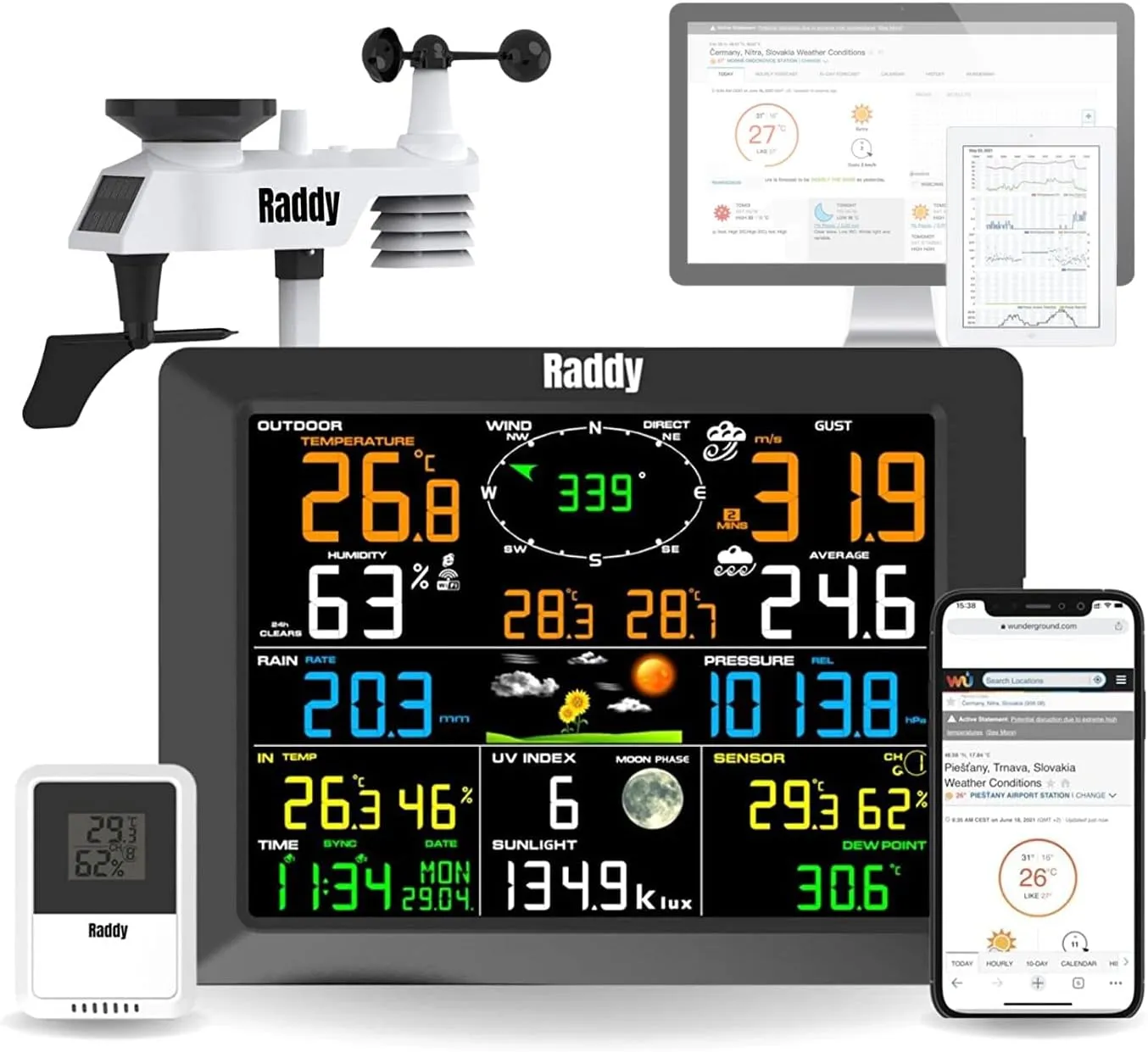
I'm Lena Thornton, and I always look twice when a station comes with an extra sensor in the box. The Raddy WF-100C, from the electronics specialist Radioddity, tries to pack a lot of features into one kit.
What stands out is the extra remote sensor in the box. This review looks at the whole kit, from the two sensors to the display and the online sharing.
How the Raddy WF-100C Compares
Compared with a basic 5-in-1 station, the WF-100C adds UV and sunlight readings and a second temperature and humidity sensor in the box. If you prefer a better-known brand, our reviews of the Ambient Weather WS-2902C (Wi-Fi, uploads to Weather Underground) and the AcuRite Iris 5-in-1 are good places to compare.
Pros & Cons of the Raddy WF-100C
Pros
- A lot in one kit: outdoor sensor, an extra remote sensor and a large color display.
- Multi-Zone Monitoring: The included remote sensor lets you watch a second spot, such as a greenhouse or basement.
- UV and sunlight: measures UV index and solar radiation, not just wind, rain, temperature and humidity.
- Large, Easy-to-Read Display: The large screen lays out all the data from your multiple sensors.
- Room to grow: Radioddity says the console supports 7 extra remote sensors (not included).
Cons
- Lesser-Known Brand: Radioddity is not as established in the weather community as AcuRite or Davis, which may concern some users.
- No Lightning Detection: Lacks the advanced lightning sensor found in some premium competitors.
- A few more setup steps: two sensors and Wi-Fi mean more to set up than a basic station; follow the manual step by step.
Who Should Buy the Raddy WF-100C?
- The hobbyist who wants many readings in one kit.
- Gardeners, farmers, or homeowners who need to monitor conditions in two separate outdoor locations simultaneously.
- People who want to share their readings on Weather Underground or Weathercloud.
- Anyone who wants a full-featured station from a smaller brand.
The Dual-Sensor Advantage: More Than Just a Weather Station
Let's focus on what truly sets the WF-100C apart. Most home weather station kits come with one outdoor sensor array and one indoor display. The Raddy WF-100C includes the main outdoor sensor array plus a separate, small remote sensor that measures temperature and humidity. That is handy.
Think of it this way: the main sensor needs an open, sunny spot for good wind, rain and UV readings. But what if you also want to know the temperature in the deep shade under your oak tree? Or the humidity inside your greenhouse? Or the temperature in your garage? The second sensor allows you to do just that. Radioddity lists up to 330 feet for the outdoor sensor; check the manual for the remote sensor. Its data appears right on the main display alongside the data from the primary array. This transforms the WF-100C from a simple weather station into a multi-zone environmental monitoring system.
The Display and the Outdoor Sensor
The central hub of the system is a large color display (Amazon lists it as 8 inches; Radioddity gives the screen as 6.7 x 4.9 inches). It's the brain that collects, displays, and transmits your weather data. The screen is well-organized, dedicating clear sections to each data point, including a 12-hour forecast icon.
This display receives information from the outdoor sensor, which Radioddity describes as a UV sensor, rain gauge, wind vane, wind speed cups and a thermo-hygrometer in a radiation shield:
- The basics: it measures temperature, humidity, wind speed and direction, and rainfall.
- UV and light: It also includes sensors for UV Index and Solar Radiation (measured in lux). This is important data for anyone concerned about sun exposure or for gardeners who need to understand the intensity of light their plants are receiving. This level of detail is a key part of my weather education guides for serious hobbyists.
The display console comes with an AC power adapter. Check the manual for the batteries the outdoor and remote sensors need.
Video Overview: A Closer Look at the WF-100C
To see how all these components come together and to get a sense of the display in action, this video provides a helpful visual guide.
Getting Connected: Wi-Fi and Online Weather Communities
The WF-100C's display console connects to your 2.4GHz Wi-Fi network, which is the key to unlocking its smartest features. Once online, it can automatically upload your real-time data to two of the most popular online weather communities: Weather Underground and Weathercloud.
This is a huge benefit for several reasons. First, it allows you to view your own weather data from anywhere in the world on your phone or computer. Second, by sharing your data with a network like Weather Underground, your readings also show up on the network's map for others nearby.
Is the Raddy WF-100C Worth It?
Based on its specifications, the Raddy WF-100C gives you a lot of features in one kit. The second remote sensor is the part that sets it apart.
While it may not have the brand recognition of an AcuRite or the lightning detection of a premium model, it covers wind, rain, temperature, humidity, pressure, UV and sunlight, plus a second sensor. For a hobbyist who wants two measuring spots and online sharing in one box, it is worth a look. Check the current price on Amazon before you decide.
My Review Methodology
This review is based on the manufacturer's specifications on the Radioddity product page, the Amazon listing and the video above. We did not test the WF-100C ourselves. Research last verified: 21 October 2026.
Ready to decide?
Get the Raddy WF-100C Indoor Outdoor Weather Stations
Prices and stock change daily. Check the current price, delivery options and what owners say in their reviews.
In this reviewRaddy WF-100C Indoor Outdoor Weather StationsToday's price, delivery & owner reviews on Amazon
Check on Amazon →