

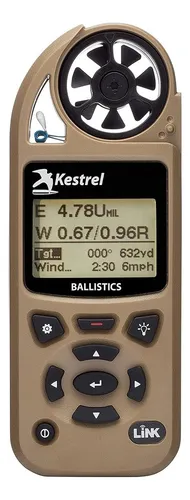
Product covered in this analysis
Kestrel 5700 Elite Meter with Applied Ballistics and LiNK
See today’s price, delivery options and customer reviews on Amazon.
As an Amazon Associate, I earn from qualifying purchases.In this article 11 sections
- Mastering the Elements: Why Precision Matters for Long-Range Shooting
- What the 5700 Elite Measures
- Kestrel 5700 Elite Meter: Key Features in Context
- What the Specs Mean in the Field
- Installation, Use & Maintenance Tips for Your Kestrel 5700 Elite
- For Whom (And For Whom Not)
- What Is Not in the Box (and Sold Separately)
- Head-to-Head: Kestrel 5700 Elite vs. Other Kestrel Models
- Frequently Asked Questions
- Explore Related Topics
- Technical Glossary
Kestrel 5700 Elite Meter: Precision Weather & Ballistics
The Kestrel 5700 Elite is a pocket weather meter with an Applied Ballistics solver built in. It measures the wind and air density where you stand and turns them into elevation and windage holds for long-range shots. Kestrel says it works "even out to the transonic and subsonic flight range of your bullet". It is a specialist tool: brilliant if you shoot long range, overkill if you only want to know how windy the backyard is.
Shopping during Black Friday? See which anemometers and wind meters are worth buying at a sale price, and what to check first: Black Friday Anemometer Deals 2026.
Mastering the Elements: Why Precision Matters for Long-Range Shooting
At long range, a bullet spends enough time in the air for wind, temperature, pressure and humidity to push it around. A small error in your wind call or air density turns into a real miss on paper. The 5700 Elite's job is to measure those conditions on the spot and do the math for you.
In Kestrel's own words, it "takes the guesswork out of long-range shooting, even out to the transonic and subsonic flight range of your bullet." It runs on the Kestrel 5 Series platform: a large, high-resolution display, a dual color backlight (white, or red to protect night vision), a polycarbonate lens, a single AA battery and optional LiNK Bluetooth connection to iOS and Android apps. Kestrel describes it as "drop-proof, dust-proof, waterproof".
Review basis: research only. This page is built on Kestrel's official 5700 Elite product page and the official "Kestrel 5700 Ballistics Weather Meter and Kestrel 5700 Elite Weather Meter with Applied Ballistics" instruction manual. We have not used or tested the meter ourselves, and Lena is not a ballistics specialist. As an Amazon Associate I earn from qualifying purchases.
Kestrel 5700 Elite Meter: Quick Verdict
A complete pocket weather meter plus a full Applied Ballistics solver, aimed at serious long-range shooters, hunters and competitors.
- Ballistics features:
- Excellent (Applied Ballistics custom drag curves, 30 gun profiles, range card, drop scale factor calibration)
- Weather sensing:
- Very good (wind, temperature, humidity, pressure, altitude, density altitude and more, with data logging)
- Ruggedness:
- Very good on paper (Kestrel: drop-proof, dust-proof, waterproof)
- Ease of use:
- Moderate (deep menus; Easy Mode and the LiNK app help)
- Portability:
- Excellent (pocket size, one AA battery)
These words are our editorial assessment of Kestrel's published specifications, not test scores.
Best For: long-range shooters, hunters and competition shooters who already understand their rifle, ammunition and scope well enough to enter accurate data.
Not For: anyone who only wants temperature, humidity or wind speed. A simpler Kestrel or a basic handheld anemometer does that job.
The button opens an Amazon search for the Kestrel 5700 Elite, because it comes in several colors (Kestrel lists tan, black, olive, blaze orange and flat dark earth). Check the listing says "Elite" and "LiNK" if you want the app connection. As an Amazon Associate I earn from qualifying purchases.
Need to measure just wind? See our page on wind speed gauges for simpler options.
What the 5700 Elite Measures
The manual lists these weather measurements for the 5700 Elite:
- Wind speed / air speed (mph, fpm, m/s, km/h, knots)
- Temperature and wind chill
- Relative humidity, heat stress index, dew point and wet bulb temperature
- Station pressure, barometric pressure, altitude and density altitude
Kestrel's product page adds wind direction (from the built-in compass), crosswind and headwind/tailwind, plus "measurement and logging of primary environmental conditions". Paired with the optional Kestrel Vane Mount on a tripod, Kestrel says it becomes "a compact, easily-deployable weather station".
One pressure detail worth knowing: the meter cannot work as a barometer and an altimeter at the same time. You set a known altitude (for barometric pressure) or a known pressure (for altitude). For ballistics you do not need either: the manual says the solver uses station pressure.
Kestrel 5700 Elite Meter: Key Features in Context
Here is what the main features are, according to Kestrel, and what they mean in plain English.
| Feature | Details (Kestrel) | What This Means For You |
|---|---|---|
| Applied Ballistics Solver | G1/G7 solver plus Applied Ballistics custom drag curves from the Litz bullet library; corrections for aerodynamic jump, spin drift and Coriolis. | Better modeling of bullets as they slow down toward the speed of sound, where simple G1/G7 numbers can drift off. |
| Gun and Target Storage | 30 gun profiles. The manual allows up to 10 targets (A to J); Kestrel's current product page lists 30 stages with 10 targets each. | Keep several rifles and loads ready, and set up several targets before a match or hunt. |
| Calibration Tools | Muzzle velocity calibration with a guided Cal MV tool; Drop Scale Factor (DSF) calibration with up to 6 values (Elite only). | You can true your solution to real impacts, including in the transonic and subsonic range. |
| Range Card and Target Card | Elite only. | See holds for many distances at once instead of one target at a time. |
| Display | High-resolution, sunlight-readable display; backlight in white or night vision preserving red. | Readable in bright sun, and the red light keeps your night vision at dawn and dusk. |
| LiNK Connectivity | Bluetooth LE to the free Kestrel LiNK Ballistics app (iOS and Android); typical range 100 ft (30 m) line of sight. | Build gun profiles on your phone, change target range and view the solution without touching the meter. |
| Solution Units | Mil, TMOA, SMOA, inches, cm or clicks. | Works with whatever turrets or reticle you use. |
| Max Range | 5,500 yards (Kestrel's comparison chart). | Well beyond what most shooters will ever need. |
| Power | One AA battery (lithium recommended; the manual says a lithium AA is provided). | Spares are easy to find. Kestrel's FAQ notes no battery shim is needed on the 5 Series. |
What the Specs Mean in the Field
The real value is the combination: built-in wind and air density measurements feeding a full Applied Ballistics solver. The trade-off is depth. There are a lot of menus (Weather Mode, Ballistics Mode and a simpler Easy Mode), and the solution is only as good as the gun, bullet and scope data you enter. Kestrel itself offers getting-started documents, a menu navigation tree and video tutorials on its support pages, which tells you something about the learning curve.
Proven vs. claimed: all specifications on this page are Kestrel's. We have not measured anything ourselves.
Installation, Use & Maintenance Tips for Your Kestrel 5700 Elite
These steps follow the official Kestrel 5700 / 5700 Elite instruction manual.
First setup:
- Slide the battery door latch, open the door and insert the provided AA lithium battery as shown on the label. Close the door until it clicks fully into place (Kestrel's FAQ: slide the top tab in first, then press the bottom down, and make sure the O-ring stays in place).
- Press the power button to turn the Kestrel on.
- Press the Options button to open the Options menu.
- Calibrate the compass: go to System, then Compass Cal. Place the base of the Kestrel on a flat surface at least 3 feet from large metal objects, start the routine and rotate the unit around its vertical axis 3 times, about 10 seconds per full turn, keeping it as vertical as possible. You may need a few tries to get the timing right. Kestrel's 5 Series spec pages say compass calibration must be repeated after every full power-down (battery removal or change).
- Exit the Options menu.
- Optional settings from the same menu: auto shutdown time, backlight color (white or red), time and date, which measurement screens are on, and units (all imperial, all metric, or one by one).
- Build your gun profile: in Ballistics Mode, go to Manage Guns, select New Gun, name it and fill in the gun, bullet and scope values. Make sure the new gun is set to On. (Or build it in the LiNK Ballistics app and send it to the meter.)
Measuring wind for a shot:
- In the Target menu, select DoF (direction of fire), then Capture. Hold the Kestrel vertical, point the back of the unit at the target and select Capture.
- Select WD, WS1 or WS2, then Capture. Hold the Kestrel vertical, point the back of the unit directly into the wind and select Capture.
- Keep pointing into the wind for at least 5 seconds so it records a rolling 5 second average and the peak, then select End Capture.
- Read the elevation and windage holds on the Targeting Screen. The windage shows two values: one for the average wind, one for the maximum wind.
The manual stresses holding the meter as vertical as possible during both captures, because the compass reading depends on it.
Truing to real impacts: after entering your data, use Cal MV (muzzle velocity calibration) at the suggested range, ideally 85% to 100% of it but no further. Then, on the Elite, use Cal DSF beyond that distance to true the solution into the transonic and subsonic range. Entering a DSF value at a shorter range than an earlier one overwrites the longer one.
Care:
- Impeller: it is replaceable. Press only on the sides of the impeller when removing or inserting it, to protect the hub bearing, and insert the new one with the small triangle facing the front of the Kestrel. Kestrel sells replacement impellers.
- Battery: lithium AA is recommended. The backlight turns off by itself after one minute, which helps the battery.
- Firmware: Kestrel publishes firmware updates, installed through the Kestrel LiNK apps or desktop software.
For Whom (And For Whom Not)
- For long-range shooters and competitors: the custom drag curves, range card and DSF calibration are aimed squarely at shots where the bullet slows toward the speed of sound.
- For hunters who shoot at distance: one pocket device for wind, air density and holds, with the red backlight for low light.
- For people who want a portable weather meter too: the weather side logs data and, with the optional vane mount, can sit on a tripod as a small weather station.
- Not for casual users: if you only need temperature or wind speed, the ballistics side is wasted.
- Not if you will not enter good data: the solver needs accurate gun, bullet, scope and range inputs to be useful.
Check the current price on Amazon before you decide; this is a premium instrument compared with a basic wind meter.
What Is Not in the Box (and Sold Separately)
- The manual mentions the provided AA lithium battery. Kestrel's 5700 Elite page does not publish a full box list.
- Sold separately (offered as add-ons by Kestrel): carry cases and holsters, the Kestrel Vane Mount, the Kestrel LiNK Dongle for PC/Mac and the waterproof USB Data Transfer Cable.
- Kestrel says a 5700 Elite without LiNK Bluetooth is available by phone order only.
Head-to-Head: Kestrel 5700 Elite vs. Other Kestrel Models
Kestrel's own comparison chart makes the differences clear. All values below are Kestrel's.
| Feature | Kestrel 5700 Elite | Kestrel 5700X Elite | Kestrel 5700 Ballistics (non-Elite) | Kestrel 5500 Weather Meter |
|---|---|---|---|---|
| Primary Function | Weather + Applied Ballistics | Weather + Applied Ballistics | Weather + G1/G7 ballistics | Weather only |
| Applied Ballistics Custom Curves | Yes | Yes | No | No ballistics |
| Gun Profiles | 30 | 30 | 3 | N/A |
| Targets | 30 stages with 10 targets each | 30 stages with 10 targets each | 1 | N/A |
| Range Card, Target Card, DSF | Yes | Yes | No | N/A |
| Easy Mode | Yes | No (per Kestrel's chart) | Yes | N/A |
| Max Range | 5,500 yards | 5,500 yards | 4,000 yards | N/A |
| Extras | None | Faster processor for extreme long range; adjustable Bluetooth strength | None | Logs over 10,000 data sets |
| Connectivity | LiNK (Bluetooth) | LiNK (Bluetooth) | LiNK (Bluetooth) | LiNK optional |
In short: the Elite's extra money buys the Applied Ballistics curves, far more gun and target storage, and the truing tools. The 5700X Elite adds speed, not new ballistics features, according to Kestrel's chart.
Frequently Asked Questions
Quick answers, based on Kestrel's product page, FAQ and manual.
What is the primary function of the Kestrel 5700 Elite Meter?
It is a pocket weather meter with a built-in Applied Ballistics solver. It measures conditions such as wind, temperature, humidity and pressure where you stand and calculates elevation and windage holds for long-range shots.
How does the Kestrel 5700 Elite help long-range shooting?
It combines live wind and air density measurements with your gun, bullet and scope data. The solver corrects for factors such as spin drift, Coriolis and aerodynamic jump, and the Elite's custom drag curves and Drop Scale Factor calibration are meant to keep solutions accurate into the transonic and subsonic range. The result depends on the quality of the data you enter.
Is the Kestrel 5700 Elite rugged and waterproof?
Kestrel describes it as "drop-proof, dust-proof, waterproof and able to withstand harsh environments without damage". Kestrel's spec pages for its 5 Series weather meters list drop testing to MIL-STD-810G and waterproofing to IP67 (3 feet / 1 meter for 30 minutes). We have not tested this ourselves.
Can the Kestrel 5700 Elite connect to a smartphone?
Yes, on LiNK models. LiNK uses Bluetooth LE to connect to the free Kestrel LiNK Ballistics app on iOS and Android, where you can build gun profiles, adjust the target and view the solution. Typical range is 100 feet (30 meters) line of sight. A computer needs the LiNK Dongle or the USB Data Transfer Cable, both sold separately.
What is the Applied Ballistics bullet library?
It is a library of custom drag models (Kestrel calls it the Litz library) that describe how specific bullets slow down. Kestrel says these give "the most precise transonic and subsonic range solutions" compared with standard G1/G7 numbers.
Does the Kestrel 5700 Elite measure wind direction?
Yes. It uses its built-in compass: you capture the direction of fire by pointing the back of the unit at the target, then capture the wind by pointing the back of the unit into the wind for at least 5 seconds. Kestrel lists crosswind and headwind/tailwind as well.
What battery does the Kestrel 5700 Elite use?
One AA battery. The manual recommends lithium and says a lithium AA is provided. The backlight switches off by itself after one minute.
Technical Glossary
Expand Glossary of Ballistics & Weather Meter Terms
- Applied Ballistics
- A ballistics company whose custom drag models and solver are built into the Kestrel 5700 Elite.
- Transonic Flight
- The speed range near the speed of sound (Mach 1). The Kestrel manual uses Mach 1.2 as the point where it suggests calibrating muzzle velocity, and Mach 0.9 for the first DSF calibration.
- Subsonic Flight
- Speeds below the speed of sound. Bullets behave differently here than at supersonic speed, which is why the Elite offers DSF calibration.
- Drag Model
- A mathematical description of how a bullet's air resistance changes with speed. Custom drag models describe a specific bullet instead of a standard shape (G1 or G7).
- Drop Scale Factor (DSF)
- A Kestrel Elite calibration that adjusts the bullet's ballistic coefficient beyond the supersonic range, based on your real impacts.
- Coriolis Effect
- An apparent deflection of moving objects caused by the Earth's rotation. It only matters at very long range.
- Spin Drift
- A sideways drift caused by the bullet's spin as it follows its curved path.
- Aerodynamic Jump
- A vertical shift of the bullet caused by a crosswind acting on a spinning bullet.
- Station Pressure
- The actual, unadjusted air pressure where you are. The ballistics solver uses this.
- MIL-STD-810G
- A U.S. military standard describing environmental test methods, such as drop tests.
- IP67
- An ingress protection rating: dust-tight (6) and protected against temporary immersion (7). Kestrel states 3 feet / 1 meter for 30 minutes.
Disclosure: This article is based on research of publicly available information: Kestrel's official 5700 Elite product page and FAQ, the official Kestrel 5700 / 5700 Elite instruction manual and Kestrel's 5 Series spec pages. We have not physically tested the Kestrel 5700 Elite Meter ourselves. Research last verified: 24 October 2026.
As an Amazon Associate I earn from qualifying purchases.
Read more about how we research.
Update Log
- : rewritten from Kestrel's official page and manual. Corrected gun and target storage (30 guns, not 16) and the comparison table, removed an invented statistic, an invented expert quote, a placeholder and an unrelated video, replaced number scores with an editorial assessment, and added setup, wind capture and calibration steps.
- : Initial publication.
Ready to decide?
Get the Kestrel 5700 Elite Meter with Applied Ballistics and LiNK
Prices and stock change daily. Check the current price, delivery options and what owners say in their reviews.
In this reviewKestrel 5700 Elite Meter with Applied Ballistics and LiNKToday's price, delivery & owner reviews on Amazon
Check on Amazon →