

We may earn a commission when you buy through links on this page, at no extra cost to you. Learn more
In this article 8 sections
- Tornado Alley in 2024 and 2025: Why Preparedness Matters More Than Ever
- The 3 Best Weather Radios for Tornado Alley 2026
- WR400 vs WR120B vs ER310: Tornado Alley Comparison
- Tornado Alley Risk: What Oklahoma, Kansas and Texas Residents Need to Know
- Tornado Radio Preparedness Checklist: Before Storm Season
- Greatest Storms on Earth: Best of Tornado Alley
- Frequently Asked Questions
- Our Recommendation for Tornado Alley
Best Weather Radio for Tornado Alley 2026 (Oklahoma, Kansas & Texas Guide)
Our picks in this guide
Compare the models in this guide
See today’s price, delivery options and customer reviews on Amazon.
As an Amazon Associate we earn from qualifying purchases, at no extra cost to you. Learn moreBest weather radio for Tornado Alley? The Midland WR400 for home monitoring: S.A.M.E. county alerts, permanently backlit display, 4 AA battery backup. The Midland WR120B for budget-conscious households: 90dB siren, county-filtered alerts under $40. The Midland ER310 for storm shelters and go-bags: hand crank, solar panel, 130-lumen flashlight. All operate independently of cellular networks.
Information verified against NOAA, FEMA, the NOAA Storm Prediction Center, and Midland's official product documentation. I'm Lena Thornton, a weather station analyst and CWOP contributor. This guide is specifically for residents of Oklahoma, Kansas, and Texas, the core states of Tornado Alley, where the combination of tornado frequency, overnight storms, and occasional cell tower overload during major outbreaks makes a dedicated NOAA radio one of the most practical preparedness investments available in this region. If you want to compare all available NOAA radios, see our full NOAA weather radio comparison.
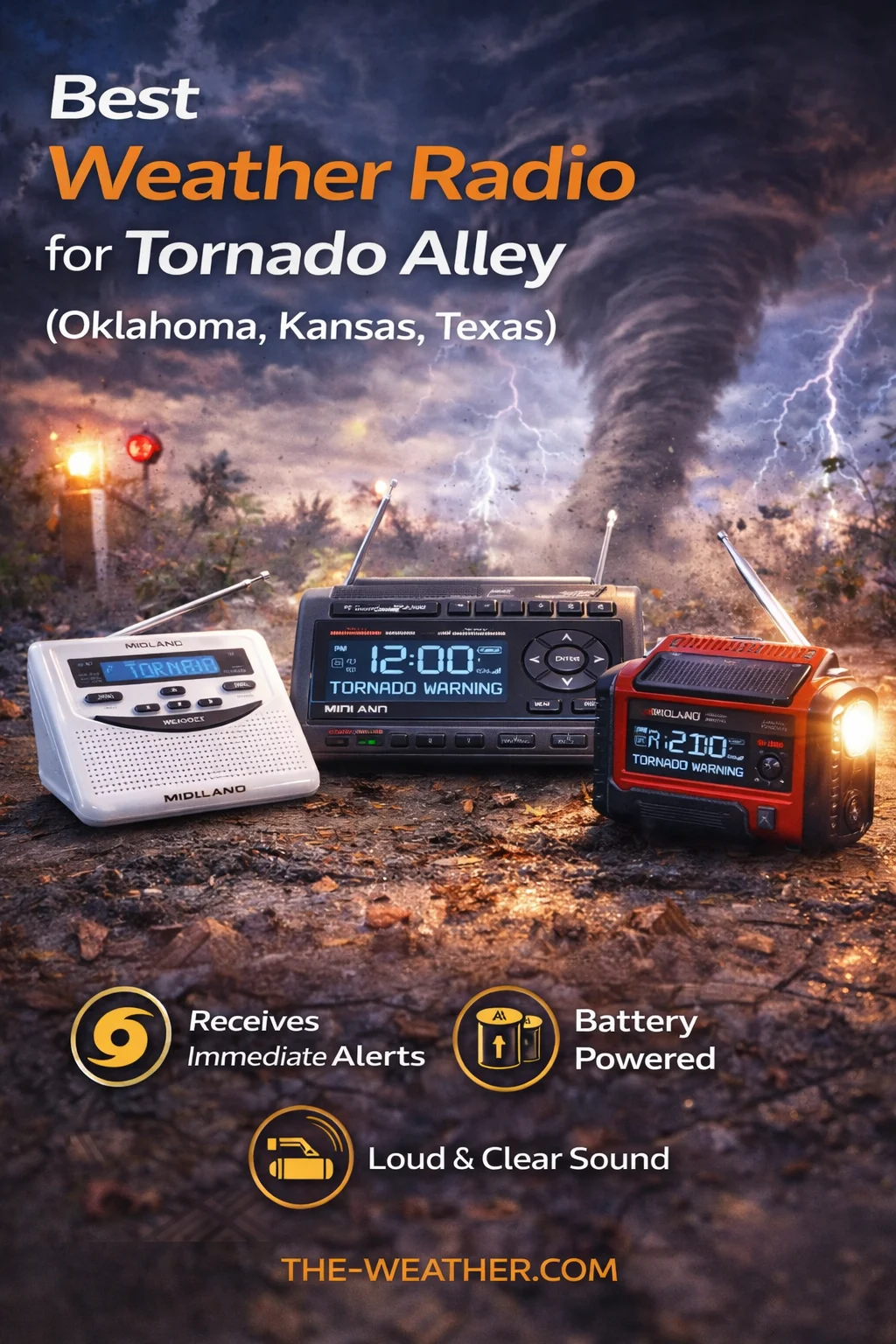
Reliable weather radios built for Tornado Alley, delivering fast NOAA alerts when severe storms hit Oklahoma, Kansas and Texas.
Tornado Alley in 2024 and 2025: Why Preparedness Matters More Than Ever
Most people who grew up in Tornado Alley already understand the risk. But the numbers from the last two years are worth knowing before you decide what level of preparedness is right for you.
Texas averages more tornadoes than any other state, with the NOAA Storm Prediction Center data showing roughly 135–155 per year. Kansas averages around 90–96 annually, and Oklahoma averages 60–75. Oklahoma leads the nation historically in EF4 and stronger tornadoes: 65 between 1950 and 2016, per World Population Review's NOAA-sourced analysis.
2024 was the second most active tornado year on record, with at least 1,796 confirmed tornadoes, based on compiled NWS storm reports and data summaries: a month-long stretch between late April and late May alone produced nearly 700 touchdowns across the country. In 2025, Oklahoma recorded 94 tornadoes and Kansas 87, with peak activity on May 24–25 during a Memorial Day weekend outbreak that produced an EF4 and caused five deaths, compiled from NWS Storm Data and aggregated datasets (including The World Data).
If you've ever watched a storm cell develop faster than expected on a spring evening, you already know that 13 minutes is not much time. Most people don't fully appreciate how fast that window closes until a storm is already on top of them.
Why a Dedicated Radio Matters Specifically in Tornado Alley
During a major outbreak, the kind that produces dozens of tornadoes across multiple counties simultaneously, cell networks in affected areas can become congested or partially fail. A NOAA weather radio broadcasts on dedicated VHF government frequencies that operate as a separate system from the cellular network. It does not require internet, does not require cell signal, and sounds automatically when your county receives a warning, even at 2 a.m. when your phone is in another room.
According to NOAA's Tornadoes 101 resource, the NWS specifically recommends listening to NOAA Weather Radio All Hazards for tornado warnings. The 2025 detection rate of 89.3%, meaning roughly nine out of ten tornadoes received a warning before touchdown, represents a real improvement in the system. That performance only reaches you reliably if your alert device is working and audible.
For some households in lower-risk areas, a smartphone with WEA alerts may be sufficient. For residents of Oklahoma, Kansas, and Texas in the peak of tornado season, a dedicated NOAA radio adds meaningful redundancy that a phone cannot fully replicate.
The 3 Best Weather Radios for Tornado Alley 2026
These three radios cover every tornado preparedness scenario: home monitoring, budget home use, and storm shelter backup. All specifications verified against Midland's official product documentation.
Midland WR400
The most capable home NOAA radio for Tornado Alley. The permanently backlit LCD means you can read the alert type the moment it wakes you: critical when a tornado warning gives you 13 minutes to reach your shelter.
- S.A.M.E. for up to 25 counties: your county only
- 85dB siren: audible through closed doors at night
- Permanently backlit LCD: readable in the dark
- 4 AA battery backup: works during power outages
- Stores last 10 alerts: review what was issued
- AM/FM + dual alarm clock: daily use device
- USB-A charging: keep phone charged during outages
- ~$45–$55
Full review: detailed WR400 breakdown
Midland WR120B
One of the loudest sirens in Midland's desktop weather radio range at 90dB: louder than the WR400. S.A.M.E. county-filtered alerts, color-coded LED severity indicators, and reliable standby monitoring under $40.
- S.A.M.E. for up to 25 counties
- 90dB siren: one of the loudest sirens in Midland's desktop weather radio range
- Color-coded LED: Red/Orange/Green severity
- 3 AAA battery backup
- Trilingual: English/Spanish/French
- Single alarm clock + snooze
- ~$30–$40
Full review: detailed WR120B breakdown
Midland ER310
The best portable radio for storm shelters and go-bags. Hand crank, solar panel, and 6 AA backup means it works for days without power: exactly what you need when sheltering during an extended outbreak.
- Hand crank: 1 min cranking ≈ 9 min radio
- Solar panel: maintains charge in sunlight
- 6 AA alkaline backup: deep power reserve
- 130-lumen CREE flashlight: High/Low/Strobe/SOS
- NOAA auto-alert from standby (all-channel)
- USB-A device charging output
- Ultrasonic dog whistle: search-and-rescue signal
- ~$55–$65 · approximately 1 lb
Full review: detailed ER310 breakdown
WR400 vs WR120B vs ER310: Tornado Alley Comparison
The right radio depends on where you need coverage: bedside, kitchen, or storm shelter. Here is exactly how the three compare on the features that matter most during a tornado outbreak.
| Feature | full WR400 breakdown ~$49 |
full WR120B breakdown ~$35 |
full ER310 breakdown ~$60 |
|---|---|---|---|
| Best Use Case | Bedside home Top pick |
Budget home Best value |
Storm shelter Portable |
| S.A.M.E. County | Up to 25 counties | Up to 25 counties | None, all-channel No county filter |
| Alert Siren | 85dB · 3 levels | 90dB · 3 levels Loudest |
Audible siren |
| Backlit Display | Permanently backlit Readable at night |
Backlit LCD | Basic display |
| Battery Backup | 4 AA alkaline | 3 AAA alkaline | Li-ion + solar + crank + 6 AA Most versatile |
| Hand Crank | No | No | Yes Shelter ready |
| Flashlight | No | No | 130-lumen CREE SOS + Morse |
| USB Charging | Yes · 5V/1A Phones & small devices |
No | Yes · USB-A output |
| AM/FM Radio | Yes · 4 presets/band | No | Yes |
Tornado Alley Risk: What Oklahoma, Kansas and Texas Residents Need to Know
Reliable weather radios built for Tornado Alley: fast NOAA alerts when severe storms hit Oklahoma, Kansas and Texas.
The core states of Tornado Alley collectively account for a disproportionate share of US tornado activity. Texas leads all states with approximately 135–155 tornadoes per year, driven by warm Gulf air meeting cold continental air across the Southern Plains. Kansas averages roughly 90–96 annually, and Oklahoma 60–75, but Oklahoma's EF4+ rate is the highest in the nation historically, reflecting the particular intensity of storms that form in this region.
A key finding from the 2025 tornado season data is that Oklahoma and Kansas together experienced significant activity but relatively fewer fatalities than states like Mississippi and Missouri. Researchers attribute this partly to well-established warning systems and strong community preparedness culture in traditional Tornado Alley states: communities where NOAA weather radios have been a household fixture for decades.
The eastward shift in tornado activity documented by researchers since 2018 means that the risk is spreading beyond the traditional Southern Plains footprint. Areas in the Mid-South and Ohio Valley are seeing increased tornado frequency, but the core Oklahoma/Kansas/Texas triangle remains the highest-risk zone for strong and violent tornadoes.
Tornado Alley may be shifting, but if you live in Oklahoma, Kansas, or Texas, the risk has not moved away from you. It has only grown more complex.
Tornado Radio Preparedness Checklist: Before Storm Season
If you already own a Midland weather radio, this checklist confirms it is actually ready when a storm develops. Most people don't think about this until a watch is already posted, by then it is too late to program and test.
- Program your county's S.A.M.E. code, Menu → SET LOCATION (WR120B) or COUNTY CODES (WR400) → select your state and county. See our full Midland programming guide for step-by-step instructions for both models.
- Enable tornado warning alerts specifically: Menu → SET EVENTS → confirm that Tornado Warning and Tornado Watch are both enabled. These cannot be turned off by default, but confirming is good practice.
- Set siren volume to High: Menu → ALERT VOLUME → HIGH. A siren at medium volume may not wake a sound sleeper in an adjacent room during a stormy night.
- Install fresh backup batteries before storm season: 4 AA (WR400) or 3 AAA (WR120B). Replace annually, not when a watch is already posted and stores are running low.
- Place the radio where you sleep: a radio in the living room will not reliably wake you at 2 a.m. Bedroom placement is the single most impactful positioning decision you can make.
- Add an ER310 to your storm shelter: once you are in the shelter, your bedside radio may be out of earshot. A portable crank radio with a flashlight in the shelter keeps you informed throughout the event.
- Know your NOAA channel for your area: use the NOAA county frequency lookup to confirm the strongest transmitter for your location and tune to it manually if auto-scan is not locking on cleanly.
🌪️ Texas, Kansas, and Oklahoma collectively see hundreds of tornadoes each year: 13 minutes is the average warning window
A radio that wakes you before the storm arrives is not optional in Tornado Alley.Amazon Associate: no extra cost to you.
Greatest Storms on Earth: Best of Tornado Alley
This documentary captures severe storm development across the core of Tornado Alley: the same geography where the annual tornado averages cited in this guide are recorded. Watch the speed at which supercell thunderstorms develop and the compressed timeline between storm formation and tornado touchdown.
What the footage makes viscerally clear is the time pressure involved. These storms do not announce themselves slowly. A supercell can go from a developing thunderstorm to a tornado-producing storm in minutes, and the period between NWS warning issuance and impact, that roughly 13-minute average, is exactly as short as it sounds in practice.
If you are still deciding whether a dedicated NOAA radio is worth it for your household, this is the most honest way to calibrate that decision. The storms in this video are the ones your radio would alert you to.
Frequently Asked Questions
What is the best weather radio for Tornado Alley?
The Midland WR400 is generally the most suitable option for home use: S.A.M.E. county programming, permanently backlit display readable at night, 85dB siren, and 4 AA battery backup that continues operating during power outages. The Midland WR120B is more suitable for budget-conscious households at under $40, with a slightly louder 90dB siren. The Midland ER310 is best for storm shelters and go-bags: hand crank, solar panel, and a 130-lumen flashlight. See our full NOAA weather radio comparison for all options.
How much warning time do I get before a tornado?
According to NOAA's official tornado resource, the current average tornado warning lead time is approximately 13 minutes. In 2025, the National Weather Service achieved a detection rate of 89.3%, per NWS Storm Data reports. A dedicated NOAA weather radio with S.A.M.E. county programming receives those warnings directly the moment they are issued, without relying on cell towers or app notifications that may be delayed during a major outbreak.
Do I need a weather radio if I live in Oklahoma, Kansas, or Texas?
A dedicated NOAA weather radio is one of the most practical preparedness tools for residents of these states. Texas averages approximately 135–155 tornadoes per year, Kansas approximately 90–96, and Oklahoma 60–75, per NOAA SPC data. For some households outside high-risk zones, a smartphone with WEA alerts may be sufficient. For Tornado Alley residents, particularly in counties with historically high tornado frequency, a dedicated radio adds meaningful redundancy, especially overnight when phones may be silenced.
What features matter most in a tornado weather radio?
For Tornado Alley specifically: S.A.M.E. county programming (so you are not woken by adjacent county warnings), a siren of 85dB or higher, battery backup for power outages, and a permanently backlit display so you can read the alert type in the dark. The WR400's continuously backlit LCD is particularly useful during overnight storms when you wake to an alert and need to immediately assess the threat level. See our WR400 vs WR120B detailed analysis for a feature-by-feature comparison.
What is the difference between a tornado watch and a tornado warning on a weather radio?
A tornado watch means conditions are favorable for tornado development: issued by the NOAA Storm Prediction Center. A tornado warning means a tornado has been detected on radar or confirmed by a spotter: issued by your local National Weather Service office and requiring immediate shelter action. Both are broadcast automatically by NOAA Weather Radio All Hazards. On S.A.M.E.-programmed radios like the WR400 and WR120B, the color-coded LED indicators show severity: red for warnings, orange for watches, green for advisories.
Is the Midland ER310 suitable for Tornado Alley?
The ER310 is more suitable as a portable storm shelter backup than as a primary home monitoring device. It lacks S.A.M.E. county programming: it monitors all seven NOAA channels and alerts on any warning rather than filtering by county. For a household in these states that wants county-filtered overnight alerts, the WR400 or WR120B is more suitable as the primary device. The ER310 adds real value as a secondary radio in the shelter or go-bag: hand crank, solar, and flashlight in one unit. See the full ER310 detailed breakdown.
Our Recommendation for Tornado Alley
The WR400 belongs on your bedside table. Its permanently backlit display, county-filtered siren, and battery backup make it the most practical home monitoring device for overnight tornado season. The ER310 belongs in your storm shelter: hand crank, flashlight, and no dependency on household power or cell service.
If budget is the priority, the WR120B delivers the same county-filtered alert capability as the WR400 at under $40, with a slightly louder 90dB siren. Any of these three radios represents a meaningful improvement over relying solely on phone alerts in a region that sees hundreds of tornadoes per year.
Specifications and features may vary slightly depending on firmware version and production batch. Always verify current specifications on the manufacturer's official product page before purchasing.
Sources
Tornado statistics: NOAA Tornadoes 101; World Population Review, Tornado Alley States (NOAA SPC data); HowStuffWorks, States with Most Tornadoes (NOAA SPC). Warning lead time: NOAA official tornado FAQ. 2025 detection rate and 2024 season data: based on NWS Storm Data reports compiled by independent weather data trackers including aggregated datasets including The World Data. NOAA Weather Radio system: NWS NOAA Weather Radio All Hazards. Emergency preparedness: Ready.gov Emergency Alerts. Midland product specifications: Midland official product documentation. No manufacturer compensation was received.


