We may earn a commission when you buy through links on this page, at no extra cost to you. Learn more
In this article 8 sections
- Who This Guide Is For
- The Best Weather Radios for Camping and RV Travel
- ER310 vs WR400 vs WR120B: Camping and RV Comparison
- S.A.M.E. Programming for RV Travel: The One Thing Most People Get Wrong
- Camping and RV Weather Radio Checklist
- 7 Mistakes Beginners Make Camping in Cold and Winter Weather
- Frequently Asked Questions
- Our Recommendation
Best Weather Radio for Camping and RV Travel (2026)

Our picks in this guide
Compare the models in this guide
See today’s price, delivery options and customer reviews on Amazon.
As an Amazon Associate we earn from qualifying purchases, at no extra cost to you. Learn moreBest weather radio for camping and RV travel? The Midland ER310: hand crank, solar panel, 2600mAh battery, 6 AA backup, and a 130-lumen flashlight in one portable unit. Works without shore power, cell signal, or any hookups. For RVers on shore power who also want AM/FM and USB charging, the WR400 is the better daily driver.
Information verified against NOAA, FEMA, Midland's official product documentation, and independent reviews from established outdoor and weather tech sites. I'm Lena Thornton, a weather station analyst and CWOP contributor. Choosing the best weather radio for camping depends on power options, portability, and alert reliability: this guide covers all three. If you've ever driven into a dead zone mid-trip and wondered what would happen if a storm came through, this guide answers that question. For a full comparison of all NOAA radios, see our complete NOAA weather radio comparison.
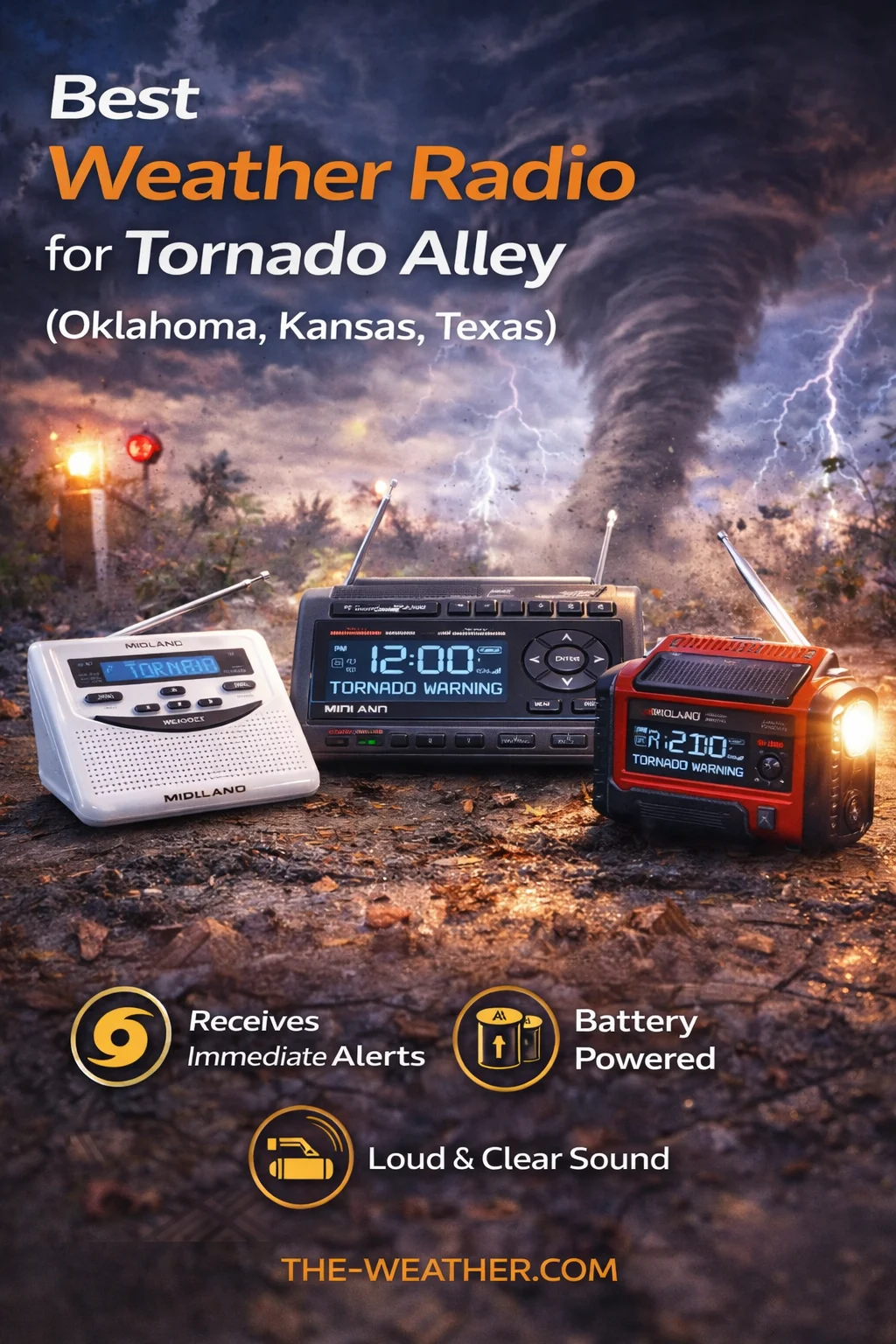
Compact weather radios designed for camping and RV travel, with solar charging, hand crank power and reliable NOAA alerts.
Who This Guide Is For
The right radio depends entirely on how you camp. The features that matter for a weekend tent camper are different from a full-time RVer on shore power. Here are the main scenarios this guide covers.
Why a Dedicated Radio Is Worth Carrying
Most people assume their phone covers them. It does: until you lose signal. As one experienced RVer put it plainly in an active RV community forum: "I have yet to find a spot where an analog NOAA radio signal is absent. Relying on a cell phone for emergencies is a false sense of security."
NOAA's VHF broadcast network reaches areas that cell towers do not. The signal travels farther than cellular LTE, requires no internet connection, and does not depend on a tower that may itself be damaged during a severe weather event. For some campers in well-connected campgrounds near urban areas, a phone may be entirely sufficient. For anyone heading into national forests, mountain campgrounds, or remote boondocking sites, a portable weather radio is one of the most practical pieces of safety equipment you can carry.
As an Amazon Associate, we earn from qualifying purchases at no extra cost to you.
The Best Weather Radios for Camping and RV Travel
These three radios cover every outdoor scenario: backcountry camping, RV boondocking, and full-hookup sites. All specifications verified against Midland's official documentation and independent reviewer testing.
Midland ER310
The most capable portable NOAA radio for outdoor use. Multiple independent power sources mean it works regardless of your power situation: tent camping, boondocking, or caught in an extended outage at a full-hookup site.
- Hand crank: ~26 min radio from 60 sec cranking (based on CNN Showed testing)
- Solar panel: charges to ~⅓ battery after 6 hrs direct sun (based on CNN Showed testing)
- 2600mAh rechargeable Li-ion battery
- 6 AA alkaline backup: deepest power reserve
- 130-lumen CREE flashlight: High/Low/Strobe/SOS Morse code
- USB-A device charging for phones and small devices
- Ultrasonic dog whistle: can assist in search-and-rescue situations
- NOAA auto-alert from standby: all 7 channels
- AM/FM radio · approximately 1 lb · compact form
- ~$55–$65
Full review: Midland ER310 review
Midland WR400
The best choice for RVers who spend most nights on shore power. S.A.M.E. county filtering so you only hear alerts relevant to your current location, AM/FM for daily listening, and USB charging to keep devices topped up.
- S.A.M.E. for up to 25 counties: reprogram at each destination
- 85dB siren: audible through RV walls at night
- Permanently backlit LCD: readable in the dark
- AM/FM with 4 presets per band
- USB-A charging: phones and small devices
- 4 AA battery backup: continues during power outages
- Dual alarm clock: wake to weather, FM, or buzzer
- ~$45–$55
Full review: WR400 weather radio review
Midland WR120B
The most affordable S.A.M.E.-capable desktop radio for RVers on shore power. Slightly louder siren than the WR400 at 90dB, simple setup, and under $40: a solid choice if you want reliable county alerts without extras.
- S.A.M.E. for up to 25 counties
- 90dB siren: slightly louder than WR400
- Color-coded LED: Red/Orange/Green severity
- 3 AAA battery backup
- Trilingual: English/Spanish/French
- ~$30–$40
Full review: WR120B weather radio review
ER310 vs WR400 vs WR120B: Camping and RV Comparison
The ER310 is the clear leader for off-grid and portable use. The WR400 and WR120B make more sense when shore power is available. Here is exactly how the three compare on the features that matter most outdoors.
| Feature | ER310 ~$60 |
WR400 ~$49 |
WR120B ~$35 |
|---|---|---|---|
| Best For | Off-grid camping Top pick |
Shore power RV Daily driver |
Budget shore power |
| Works Without AC Power | Yes, 4 power sources Most versatile |
Yes, 4 AA backup | Yes, 3 AAA backup |
| Hand Crank | Yes ~26 min/60 sec crank |
No | No |
| Solar Panel | Yes ⅓ battery/6hr sun |
No | No |
| Flashlight | 130-lumen CREE SOS + Morse |
No | No |
| S.A.M.E. County | None, all-channel No county filter |
Up to 25 counties Reprogram per stop |
Up to 25 counties |
| Portable | Yes, ~1 lb Pack-ready |
No, desktop | No, desktop |
| AM/FM Radio | Yes | Yes · 4 presets/band Daily use |
No |
| USB Charging Output | Yes, USB-A | Yes, 5V/1A | No |
S.A.M.E. Programming for RV Travel: The One Thing Most People Get Wrong
Portable NOAA weather radios for camping and RV travel: solar charging, hand crank power, and reliable alerts without cell coverage.
The most common mistake RVers make with desktop weather radios is leaving them programmed to their home county. A WR400 or WR120B programmed for your home in Texas will receive Texas county alerts, not alerts for the Kansas county you're camped in tonight.
The fix is simple but often skipped: reprogram your S.A.M.E. county every time you move to a new location. Both the WR400 and WR120B support up to 25 county slots and can be set to "ALL" mode which triggers on any SAME-coded alert regardless of county: a practical option for RVers who move frequently and don't want to reprogram daily. See our full Midland programming guide for step-by-step instructions.
The ER310 sidesteps this problem entirely: it monitors all seven NOAA channels and alerts on any warning broadcast regardless of county. This makes it naturally suited for travel, even though it lacks the county-filtering precision of the desktop models. Most people only realize this matters after their first long RV trip.
A practical setup many experienced RVers use: WR400 on the counter when plugged in, programmed to the current county. ER310 in the sleeping area as backup, always on, always scanning, requiring no reprogramming at each stop.
Camping and RV Weather Radio Checklist
Before your next trip, run through this list. Most of these take under 5 minutes and most people skip at least two of them.
- Charge the ER310 fully before departure: plug in via USB-C the night before. Arriving at a campsite with a depleted battery defeats the purpose of bringing it.
- Install fresh AA batteries: the ER310's 6 AA backup slot should have fresh alkaline batteries, not year-old ones left from last season. Replace before each trip.
- Reprogram your WR400/WR120B to your destination county: look up the county name and FIPS code using the NOAA county frequency lookup before you leave, or switch to ALL mode while traveling.
- Extend the antenna fully: the telescoping antenna must be fully extended for best VHF reception. In dense forest or canyon terrain, position the radio near an open window or elevated surface.
- Test the alert function before you need it: Menu → ALERT TEST on the ER310 confirms the siren is working. Do this at home, not at the campsite during a watch.
- Keep the ER310 accessible at night, not buried in a pack. If a flash flood warning or tornado alert sounds at 3 a.m., you need the radio within reach and the flashlight immediately available.
- Check NOAA transmitter coverage for your route: use the NWS NOAA Weather Radio coverage map to confirm signal strength at your planned campsite. Signal degrades significantly in deep canyons and some mountain valleys.
7 Mistakes Beginners Make Camping in Cold and Winter Weather
This guide covers common preparation mistakes that catch new campers off guard: many of which apply directly to weather awareness. Rapid temperature drops, incoming storm fronts, and unexpected overnight freezes are scenarios where advance warning from a NOAA radio makes a concrete difference to decision-making.
One pattern experienced outdoor guides consistently observe: campers who rely entirely on phone forecasts for trip planning are often the ones caught by rapid weather changes. Forecast apps show what is expected: a NOAA weather radio tells you what is actually happening right now in your county, issued directly by the National Weather Service.
The cold weather mistakes covered in this video are a good complement to this guide: weather preparedness and gear preparedness are the same conversation, especially for campers who venture out in shoulder seasons when conditions change faster than expected.
Frequently Asked Questions
What is the best weather radio for camping and RV travel?
The Midland ER310 is generally the most suitable option for camping and RV travel: hand crank, solar panel, 2600mAh rechargeable battery, 6 AA backup, and a 130-lumen flashlight in one portable unit. For RVers primarily on shore power, the WR400 is more suitable: S.A.M.E. county filtering, AM/FM, and USB charging. For a budget shore-power option, the WR120B covers the core alert function reliably under $40.
Do I need a weather radio for camping if I have a smartphone?
A dedicated weather radio adds meaningful redundancy that a smartphone cannot fully replicate in outdoor settings. Cell coverage is frequently absent at national forests, state parks, and remote campgrounds, and may be degraded during the severe weather events when alerts matter most. The NOAA Weather Radio network operates on dedicated VHF frequencies from more than 1,000 transmitters, reaching areas where phones show no signal. For campers in well-connected areas near urban campgrounds, a phone may be sufficient. For backcountry use, boondocking, or travel through rural regions, a dedicated radio operates independently of cellular networks.
How long does the Midland ER310 hand crank last?
Based on CNN Showed testing, the ER310 provided approximately 26 minutes of radio runtime from 60 seconds of hand cranking: the strongest crank performance of the radios tested. The solar panel charged the battery to approximately one-third capacity after six hours of direct sunlight. The internal 2600mAh battery provides substantially longer runtime under normal conditions, and 6 AA batteries provide a further deep backup reserve. Actual performance varies depending on crank speed, sunlight intensity, and radio usage patterns.
Can I use a desktop weather radio in my RV?
Yes, when connected to shore power. The WR400 works well as a permanent RV fixture when plugged in: S.A.M.E. county alerts, AM/FM for daily listening, and USB phone charging. Remember to reprogram the S.A.M.E. county setting at each destination, or switch to ALL mode while traveling through multiple counties. When boondocking or dry camping without hookups, the ER310 is the more suitable option since it operates entirely without AC power. See our WR400 vs WR120B detailed analysis for a full feature comparison of the desktop options.
Does a portable weather radio work in remote areas?
Generally yes, more reliably than a smartphone. NOAA VHF signals typically reach areas where cell coverage is absent, though signal strength varies with terrain and distance from transmitters. Extending the antenna fully and positioning the radio near an open window or elevated spot improves reception in marginal areas. Deep canyons and heavily forested areas may see reduced signal: check the NWS NOAA Weather Radio coverage map for your planned route before departure.
What is the difference between the Midland ER310 and ER210 for camping?
The ER310 has a larger 2600mAh battery and larger solar panel for faster charging. The ER210 is more compact and lighter: better suited for backpacking where weight is a constraint. Both have hand cranks, solar panels, AM/FM/NOAA, USB output, and flashlights. For family camping, car camping, and RV use, the ER310 is generally the more suitable choice due to greater power capacity. For ultralight backpacking, the ER210's smaller footprint may be worth the tradeoff.
Our Recommendation
For most campers and RVers, the ER310 is the one radio worth carrying. It handles every power scenario, shore power, solar, hand crank, and alkaline backup, and the 130-lumen flashlight with SOS strobe adds practical value beyond just weather alerts. Most people who bring one on their first trip never leave for a camping trip without one again.
RVers spending most nights on shore power should consider adding a WR400 as a permanent fixture: S.A.M.E. county filtering and AM/FM make it a daily-use radio, not just emergency equipment. The WR120B covers the same alert function at a lower price if you only want the basics. After a few trips, most campers end up relying on a dedicated weather radio more than they expected.
Specifications and features may vary slightly depending on firmware version and production batch. Always verify current specifications on the manufacturer's official product page before purchasing.
Sources
ER310 crank and solar performance: CNN Showed: Best Emergency Radios tested 2026. NOAA Weather Radio network coverage: NWS NOAA Weather Radio All Hazards. Cell coverage and NOAA radio for RV use: Midland official blog: Weather Alert Radio vs Cell Phone. Emergency preparedness: Ready.gov Emergency Alerts. Midland product specifications: Midland official product documentation. Independent reviews from established outdoor and weather tech sites including GearJunkie, Field & Stream, and Outdoor Life. No manufacturer compensation was received.
Which NOAA Weather Radio Is Right for Your Home or Next Trip?
We compared five NOAA weather alert radios on portability, battery backup, alert reliability, and value: full rankings for every use case.

Lena Thornton
Weather Tech Specialist & CWOP Contributor. Lena covers NOAA weather radio reviews, portable emergency radio technology, and outdoor weather preparedness at The-Weather.com. Every guide is grounded in verified NOAA, FEMA, and Midland documentation, supplemented by independent reviews from established outdoor and weather tech sites. Last updated April 2026.
Ready to decide?
Find your pick on Amazon
Prices and stock change daily. Check the current price, delivery options and what owners say in their reviews.
Our top picksCompare our picks on AmazonToday's price, delivery & owner reviews on Amazon
Check on Amazon →