
Product covered in this analysis
Beyond the Breeze
See today’s price, delivery options and customer reviews on Amazon.
As an Amazon Associate, I earn from qualifying purchases.In this article 7 sections
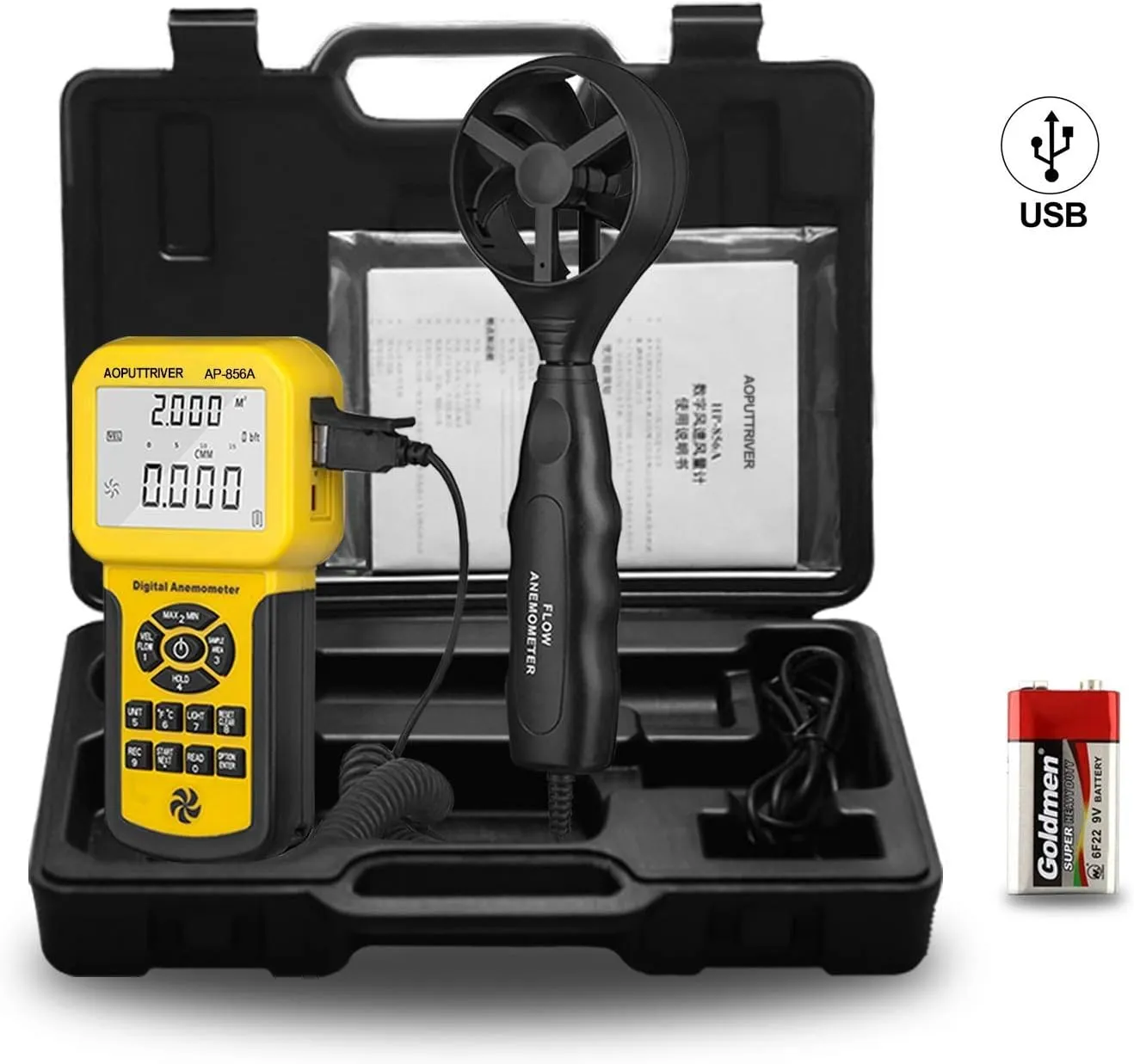
Expert Verdict & Key Takeaways: The AOPUTTRIVER AP-856A is far more than a simple wind meter; it's a professional-grade diagnostic tool that offers features once reserved for instruments costing three or four times as much. Its specifications list precise air velocity measurement and the ability to calculate airflow volume (CFM/CMM). The standout feature is its USB data logging capability, which transforms it from a handheld meter into a serious data acquisition device for HVAC technicians, engineers, and researchers.
I'm Lena Thornton, a weather station analyst whose work depends on accurate data. While we often think of wind speed in the context of weather forecasts, its precise measurement is critical in dozens of industries and hobbies. This is where a dedicated handheld anemometer comes into play, and the AOPUTTRIVER AP-856A is a device that immediately caught my professional attention.
This isn't a toy for guessing the breeze. It's a purpose-built instrument designed for tasks where precision matters, from balancing an HVAC system to ensuring safe conditions for a drone flight. This in-depth review is my expert analysis of its technical specifications, its real-world applications, and its major data logging features. We'll explore whether this affordable tool truly delivers the professional-level performance it promises.
Shopping during Black Friday? See which anemometers and wind meters are worth buying at a sale price, and what to check first: Black Friday Anemometer Deals 2026.
Pros & Cons of the AP-856A Anemometer
Pros
- USB Data Logging: The ability to export data to a PC for analysis is a professional feature at a consumer price point.
- HVAC-Ready: Accurately calculates airflow volume (CFM/CMM), making it an essential tool for technicians.
- High Precision: Sensitive vane can measure very low air speeds, with readings down to 0.001 mph.
- Versatile Units: Displays readings in 5 different units (m/s, km/h, ft/min, knots, mph) to suit any application.
- Exceptional Value: Offers a feature set that is highly competitive with much more expensive industrial meters.
Cons
- No Wind Direction: As a vane anemometer, it only measures speed, not the direction of the airflow.
- Basic Software: The included PC software is functional for data export but lacks advanced analytical features.
- ABS Plastic Body: While durable for most uses, it may not withstand heavy industrial abuse like a rubber-armored unit.
Who is the AP-856A Anemometer Built For?
- HVAC Technicians: For measuring airflow from vents, checking blower motor performance, and balancing systems.
- Drone Pilots: To verify safe wind conditions for takeoff, flight, and landing.
- Long-Range Shooters & Archers: For gathering precise wind speed data at the firing line to calculate bullet/arrow drift.
- Sailors & Windsurfers: To get instant, accurate wind speed readings on the water.
- Engineers & Researchers: For affordable data collection in wind tunnels, environmental studies, or ventilation testing.
The Core Function: Measuring What You Can't See
At its heart, the AP-856A is a high-precision wind speed gauge. It uses a sensitive, low-friction vane that begins to spin in even the slightest airflow. This is important; many cheaper anemometers have a high "startup speed," meaning they won't register very light breezes. The AP-856A's ability to resolve down to 0.001 mph makes it useful for subtle indoor air balancing as well as outdoor measurements.
The unit is built with an extendable rod, allowing you to safely reach ceiling vents or hold the sensor away from your body to avoid interfering with the airflow. The large, backlit LCD screen is easy to read and can display the current wind speed, the maximum gust (MAX), or the average speed (AVG) over a period of time. This is particularly useful for understanding the character of the wind, not just its instantaneous speed: a key concept in both meteorology and practical applications like sailing.
The Professional's Feature: CFM Calculation and Data Logging
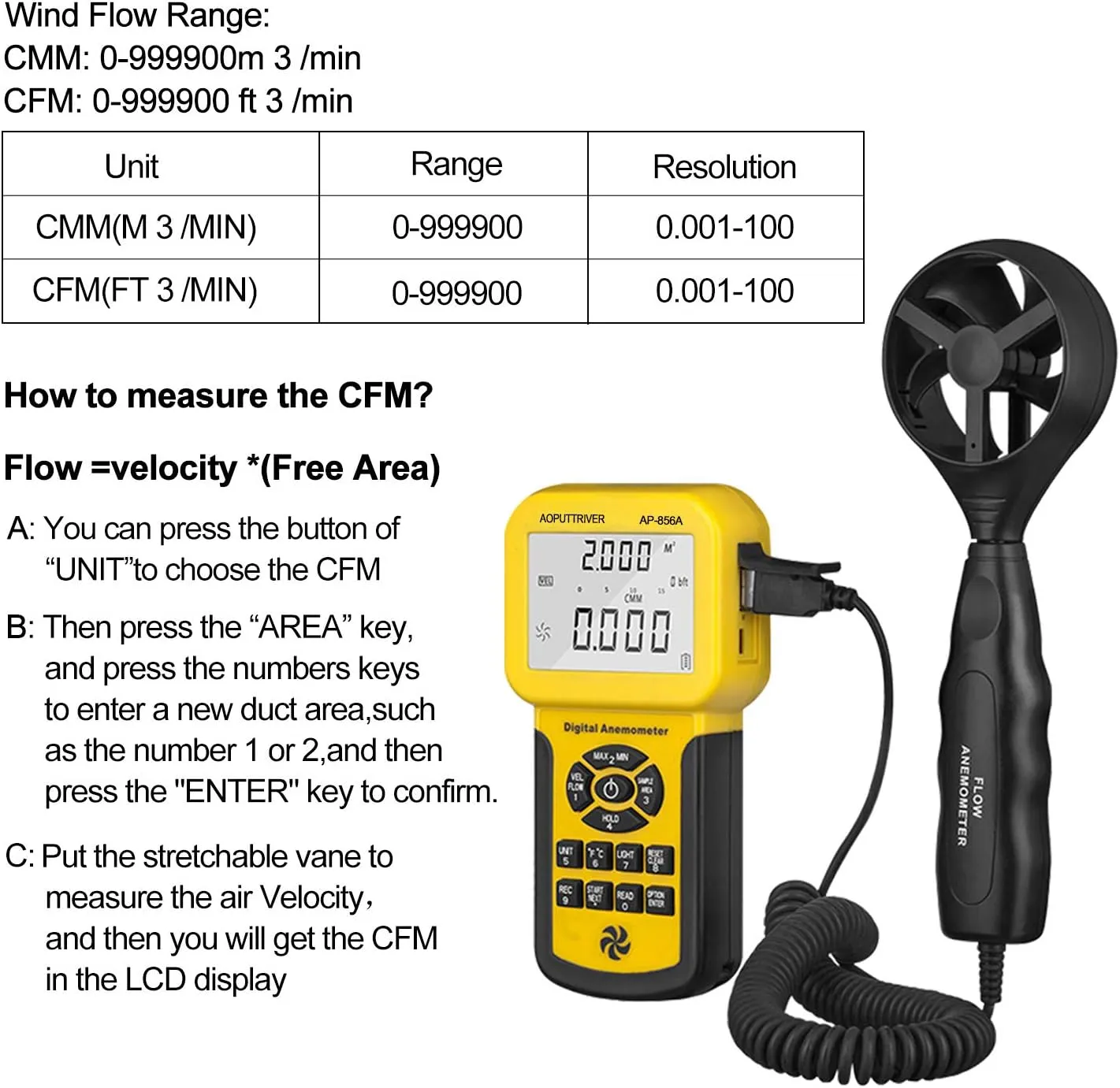
This is where the AP-856A separates itself from basic wind meters. For an HVAC professional, knowing the speed of air coming out of a vent (measured in feet per minute, or ft/min) is only half the story. They need to know the *volume* of air being moved, which is measured in Cubic Feet per Minute (CFM).
The AP-856A makes this complex calculation simple. You press the "AREA" button, enter the dimensions of the duct opening, and the device uses the formula `Flow = Velocity x Area` to give you a direct CFM reading. This is an indispensable function for diagnosing whether a system is performing to spec, finding blockages, or ensuring a building's air is being exchanged properly. It's a level of diagnostic power that is rarely found at this price point.
From Measurement to Analysis: USB Data Export
The true big step forward is the USB port. By connecting the AP-856A to a PC with the included software, you can transform it into a data logger. This allows you to:
- Stream Live Data: Watch a real-time graph of wind speed fluctuations on your computer screen.
- Log Data Over Time: Set the device to record measurements at set intervals, perfect for monitoring conditions over several hours.
- Export for Reports: Save the collected data as a spreadsheet or text file. An HVAC technician can use this to provide a client with a detailed report of their system's performance. A researcher can use it for scientific analysis.
This feature elevates the AP-856A from a simple measurement tool to a genuine piece of analytical equipment, a core principle in any scientific field, from atmospheric science at Colorado State to your local HVAC service.
Video Demonstration
To see the device in action, including its menu navigation and how the extendable vane works, this video provides a clear and concise overview.
Analyst's Recommendation: Is the AP-856A the Best Choice?
After a thorough analysis of its technical specifications and feature set, my conclusion is that the AOPUTTRIVER AP-856A offers an almost unbeatable combination of precision, functionality, and value. For any professional or serious hobbyist who needs to do more than just guess the wind speed, this device is a powerhouse.
The inclusion of CFM calculations and, most importantly, USB data logging, provides a level of utility that is simply not found in other anemometers in its price class. While it may lack the ruggedized build of a high-end industrial meter, it delivers the core data-driven features that professionals need. For HVAC work, drone safety, or scientific data collection on a budget, the AP-856A is an outstanding and highly recommended investment.
Still comparing? See how it stacks up in our best handheld anemometer guide.
My Review Methodology
This review is a comprehensive analysis grounded in my expertise in meteorology and scientific instrumentation. My assessment is based on manufacturer-provided specifications and official technical documentation, read with HVAC and drone use in mind. I interpret this information against the standards of accuracy and utility required for professional fieldwork, as guided by principles from organizations like NOAA, to provide an expert, evidence-based assessment of the product's capabilities and value.
Ready to decide?
Get the Beyond the Breeze
Prices and stock change daily. Check the current price, delivery options and what owners say in their reviews.