
In this article 7 sections
AcuRite Atlas vs Ambient WS-2902C: Which Weather Station Should You Buy?
Our picks in this guide
Compare the models in this guide
See today’s price, delivery options and customer reviews on Amazon.
As an Amazon Associate, I earn from qualifying purchases.The AcuRite Atlas and the Ambient WS-2902C are the two most commonly compared stations in the prosumer category, and for good reason. They are close enough in price and feature set to make the choice genuinely difficult, but different enough that picking the wrong one is a real mistake.
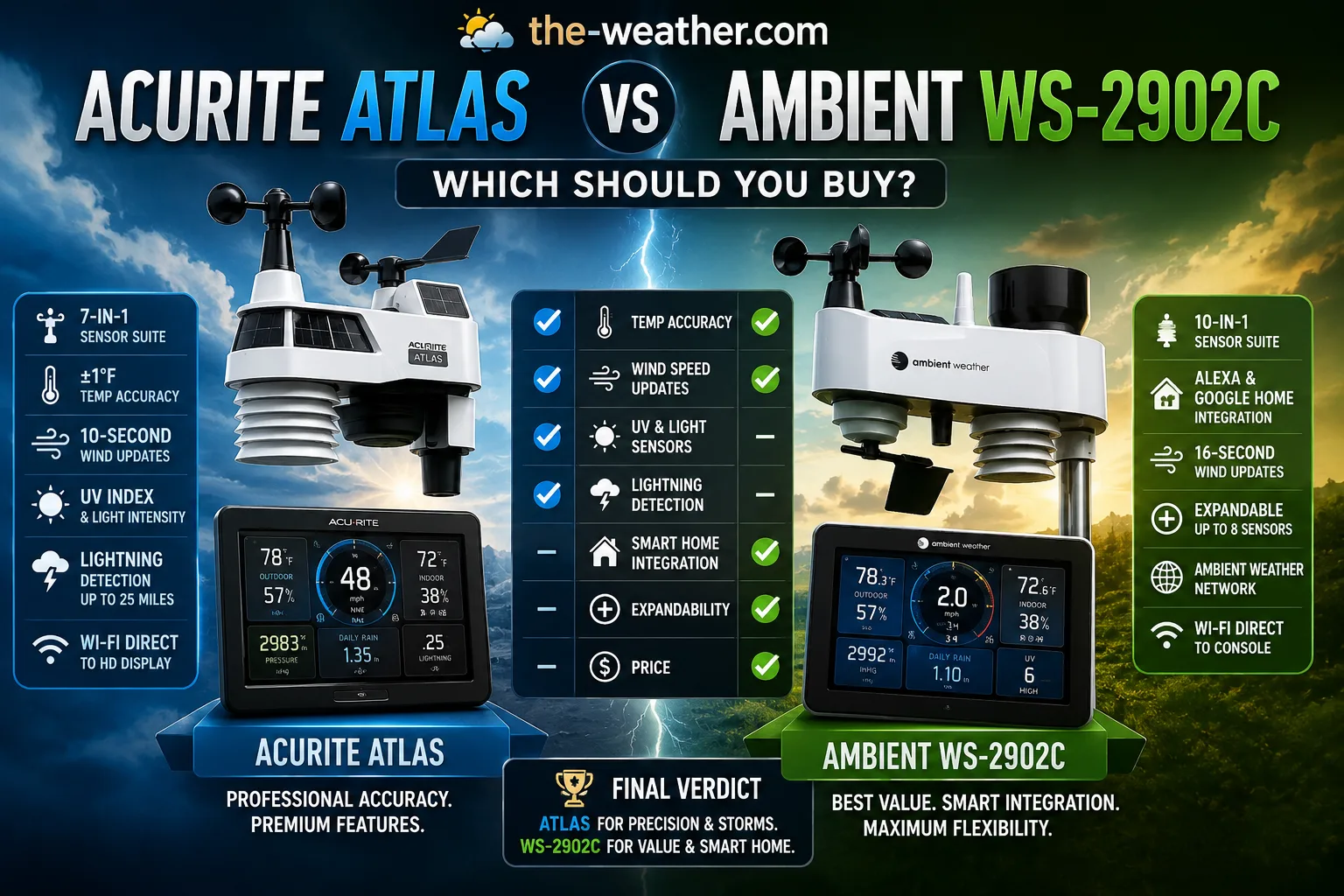
The short version: the Atlas wins on accuracy, wind update speed, UV, and lightning detection. The WS-2902C wins on price, smart home integration, platform quality, and expandability. Which matters more depends entirely on what you need from your station.
Quick Winner by Category
| Category | AcuRite Atlas | Ambient WS-2902C |
|---|---|---|
| Temperature accuracy | Atlas, ±1°F aspirated | ±2°F passive |
| Wind speed updates | Atlas, every 10 sec | Every 16 sec |
| Lightning detection | Atlas, up to 25 miles | ✗ None |
| UV index | Both, direct measurement | Both, dedicated UV sensor |
| Light intensity | Atlas, up to 120k lux | ✗ Not measured |
| Price | Higher | WS-2902C, lower cost |
| Alexa / Google Home | ✗ Neither | WS-2902C, both supported |
| Expandability | Limited | WS-2902C, up to 8 extra sensors |
| Platform quality | My AcuRite | WS-2902C, Ambient Weather Network |
| Solar radiation data | ✗ Not output | WS-2902C, measured and displayed |
| Owner community size | Moderate | WS-2902C, one of the largest |
| Wi-Fi band | Tie, both 2.4GHz only | Tie, both 2.4GHz only |
| Best for | Storm safety · serious data | Best value · smart home |
You need lightning detection, UV index, 10-second wind updates, or the ±1°F aspirated temperature accuracy. You live in a storm-prone area or contribute data to CWOP. You have already outgrown a basic 5-in-1 station.
Check Atlas Price Amazon Associate: no extra cost to you.You want the best value for core weather data. You use Alexa or Google Home. You want to expand with extra sensors. You want one of the largest owner communities and a well-regarded data platform.
Check WS-2902C Price Amazon Associate: no extra cost to you.Full Specifications Compared
Where the Atlas Has the Edge
Temperature accuracy
The Atlas achieves ±1°F via three solar panels that power an internal aspirating fan, which continuously draws fresh ambient air across the temperature sensor. The WS-2902C uses a passive radiation shield. On calm, sunny afternoons, when passive shields trap heat and readings drift upward, the Atlas consistently outperforms. For CWOP and Weather Underground data contributors, this difference is real and measurable.
Wind speed update rate
The Atlas updates wind speed every 10 seconds. The WS-2902C updates every 16 seconds. During fast-moving convective events, thunderstorm gust fronts, frontal passages, afternoon squalls, the Atlas captures gust peaks the WS-2902C may miss between updates. For storm tracking and safety decisions this 6-second difference matters more than it sounds.
Lightning detection
The Atlas detects cloud-to-ground and in-cloud lightning up to 25 miles away. The WS-2902C has no lightning detection at all. For buyers in the US Southeast, Great Plains, or any thunderstorm-prone region, this is the single biggest differentiator between these two stations. Per NOAA's National Severe Storms Laboratory, 25-mile detection range provides actionable warning time for outdoor safety decisions.
Light intensity
Both the Atlas and WS-2902C include dedicated UV sensors: UV index is a direct measurement on both stations, not a calculated estimate. Where the Atlas differentiates is on light intensity: the Atlas measures light intensity up to 120,000 lux as a separate data output. The WS-2902C measures solar radiation in W/m² but does not output a separate lux light intensity reading. For gardeners tracking precise light levels for plant health decisions, the Atlas's light intensity sensor adds practical value the WS-2902C does not match.
Where the WS-2902C Has the Edge
Price
The WS-2902C costs significantly less than the Atlas. For most buyers who don't need lightning detection or aspirated temperature accuracy, this price gap is hard to justify. The WS-2902C delivers complete core weather data, wind, rain, temperature, humidity, UV, solar radiation, at a fraction of the Atlas premium.
Solar radiation data
The WS-2902C measures and outputs solar radiation as a data point. The Atlas has solar panels on the sensor but they power the aspirating fan: solar radiation is not output as a data measurement. For solar energy monitoring, garden light management, and evapotranspiration calculations, the WS-2902C has a genuine advantage here.
Alexa, Google Home, and IFTTT
The WS-2902C integrates natively with Amazon Alexa, Google Home, and IFTTT. You can ask your smart speaker the current outdoor temperature, trigger automations based on weather conditions, and connect your station data to dozens of other smart home devices. The Atlas connects to My AcuRite only: no smart home integrations supported.
Expandability
The WS-2902C supports up to 8 additional WH31 thermo-hygrometer sensors, WH31P probe thermometers, and optional PM2.5 air quality sensors. This makes it the right choice for multi-zone monitoring: greenhouse plus outdoor plus basement plus garage from a single console. The Atlas has limited add-on sensor support by comparison.
Platform and community
The Ambient Weather Network generally offers more tools and expandability for advanced users, including a stronger API for developers and a broader personal weather station community, compared to My AcuRite. If you plan to contribute data publicly or analyse long-term trends, the WS-2902C's platform gives you more to work with.
One Important Note on Wind Direction Accuracy
Both stations use a mechanical wind vane, and neither maker publishes a direction-response figure, so we cannot say one tracks wind direction better. The Atlas's aspirated fan temperature advantage is documented by AcuRite.
Easy-to-Miss Points Before You Buy
- Assuming the solar panels power the instruments: they power the fan only. Regular battery changes still required without the optional Solar Power Pack
- 5GHz-only router causing Wi-Fi setup failure: both stations require 2.4GHz
- No Alexa or Google Home: discovering this after purchase when trying to add it to a smart home setup
- Lightning detection adds cost: make sure you will use it
- No aspirated fan: temperature can read higher on sunny afternoons
- No lightning detection, particularly for buyers who later move to a storm-prone climate
- Display feeling cluttered once all sensor zones are populated
- The UV sensor is consumer-grade, not professional equipment
The honest decision
- Buy the Atlas if: you live in a thunderstorm-prone region, you contribute data to CWOP or Weather Underground and want the best temperature accuracy, or you specifically need UV index as a direct measurement
- Buy the WS-2902C if: you want the best value for core weather data, you use a smart home system with Alexa or Google Home, or you want to expand with multiple sensors across multiple locations
- Buy neither if: you want solar-powered instruments with no battery changes: the Ambient WS-5000 has an ultrasonic anemometer with no moving parts, or the WeatherFlow Tempest is fully solar-powered
- Step up to Davis if: you need research-grade reliability and accuracy above what either station provides
Frequently Asked Questions
AcuRite Atlas vs Ambient WS-2902C: which should I buy?
Buy the Atlas if you need lightning detection, UV measurement, or ±1°F aspirated temperature accuracy. Buy the WS-2902C if you want the best value for core weather data, Alexa or Google Home, and a large owner community at a lower price point.
Is the AcuRite Atlas more accurate than the Ambient WS-2902C?
For temperature: yes, ±1°F aspirated versus ±2°F passive. For UV: both stations include a dedicated UV sensor: neither calculates UV from solar radiation. For wind direction: both use a mechanical wind vane; neither maker publishes a response figure that shows one is better. Rain gauge accuracy is comparable on both. The Atlas's temperature advantage is its most consistent and well-documented edge.
Does the Ambient WS-2902C have lightning detection?
No. Lightning detection is available only on the AcuRite Atlas. If storm safety alerts are a priority, the Atlas is the right choice.
Does the AcuRite Atlas work with Alexa or Google Home?
No. The Atlas connects to My AcuRite only: no Alexa, Google Home, or IFTTT support. The WS-2902C supports all three.
Which station has better Wi-Fi setup?
Both require 2.4GHz Wi-Fi: neither supports 5GHz. Both can fail to connect on mesh systems that merge 2.4GHz and 5GHz under one network name. Separate the bands in your router settings during initial setup for either station. The WS-2902C has a large and active owner community for troubleshooting Wi-Fi issues, which can be helpful on first setup.
Can I expand the AcuRite Atlas with extra sensors?
The Atlas has limited add-on sensor support. The WS-2902C supports up to 8 additional WH31 thermo-hygrometer sensors, WH31P probe thermometers, and an optional PM2.5 air quality sensor: making it significantly more expandable for multi-zone monitoring.
Our full reviews cover every spec, real-world owner patterns, who each station is not right for, and how each fits into the broader market.
Sources
Specifications from the official AcuRite Atlas product page and the official Ambient Weather WS-2902C product page. No manufacturer compensation was received.

Lena Thornton
Weather Station Analyst & CWOP Contributor. Lena has researched, reviewed and analysed weather stations from AcuRite, Ambient Weather, Davis Instruments, Ecowitt, La Crosse Technology, and Tempest. Published June 2026.
Ready to decide?
Find your pick on Amazon
Prices and stock change daily. Check the current price, delivery options and what owners say in their reviews.
Our top picksCompare our picks on AmazonToday's price, delivery & owner reviews on Amazon
Check on Amazon →