As an Amazon Associate, I earn from qualifying purchases.
In this article 13 sections
- What 7 Inches Actually Means on a Rain Gauge Tube
- 7-Inch vs 5-Inch: Which Do You Need?
- The Critical Measurement: Opening Diameter
- Best 7-Inch Rain Gauge Replacement Tubes
- Glass vs Plastic for 7-Inch Tubes
- Which 7-Inch Tube Fits My Brand?
- Measuring Checklist Before You Buy
- Common Buying Mistakes
- Who Should Buy a 5-Inch Tube Instead?
- Expected Lifespan by Material
- Installing a 7-Inch Replacement Tube
- Final Recommendations
- Frequently Asked Questions


The 7-inch rain gauge replacement tube is the most common size sold on Amazon and the size most standard garden rain gauges use. If your tube has cracked, yellowed, or gone missing, there is a good chance a 7-inch replacement is what you need, but before you order, you need to confirm one more dimension: the opening diameter at the top.
A 7-inch tube with the wrong opening diameter will give you inaccurate readings even if it physically fits in the housing. This guide covers everything you need to order the right tube, the best options currently available, which brands use this size, and whether to choose glass or plastic.
A 7-inch rain gauge replacement tube is 7 inches tall and records up to 7 inches of rainfall before needing to be emptied. Before ordering, confirm the opening diameter of your existing tube: either 1.5 inches or 2.24 inches are the most common. All other dimensions being equal, a 7-inch tube is the better choice over a 5-inch tube if you live in a high-rainfall region or check your gauge infrequently.
What 7 Inches Actually Means on a Rain Gauge Tube

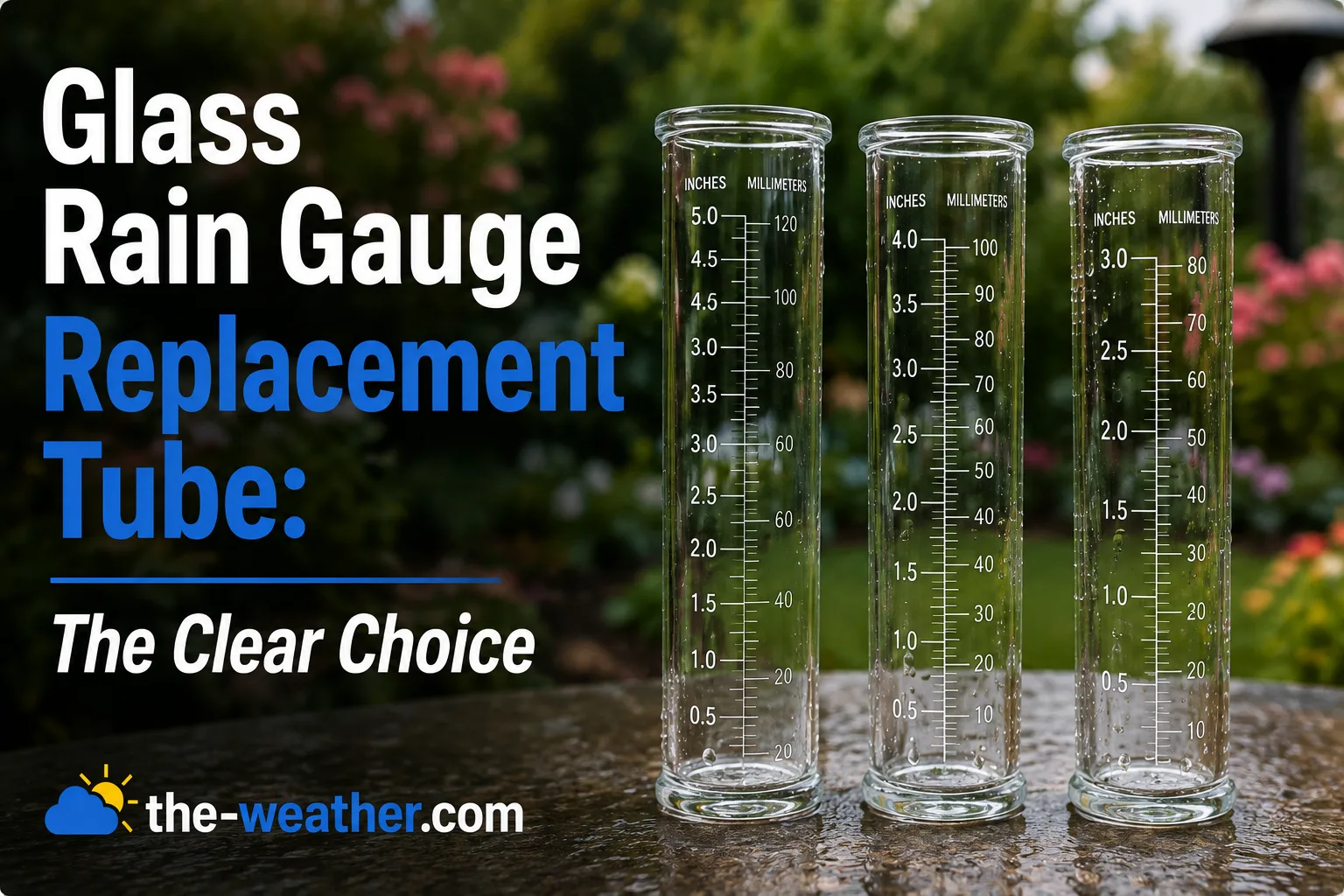
The 7-inch measurement refers to the total height of the tube from base to lip, not the width, not the opening, and not the funnel. A 7-inch tube is exactly 7 inches tall and can record up to 7 inches of accumulated rainfall before it overflows and needs to be emptied.
This is a straightforward measurement that applies regardless of whether the tube is glass or plastic, regardless of brand, and regardless of opening diameter. Every dimension you need to confirm before buying is listed below.
| Dimension | What it means | Typical values |
|---|---|---|
| Total height | Tube height from base to lip: determines max rainfall capacity | 7 inches (this page), 5 inches (smaller gauges) |
| Opening diameter | Inner diameter of the top opening: must match your gauge exactly | 1.5 inches or 2.24 inches (most common) |
| Body diameter | Outer diameter of the tube body: must fit inside your housing | 0.75 to 1.25 inches typically |
| Capacity | Maximum rainfall the tube records before overflow | 7 inches of rain |
7-Inch vs 5-Inch: Which Do You Need?

The choice between 5-inch and 7-inch comes down to two factors: how much it rains where you live, and how often you check and empty your gauge.
- Records up to 5 inches of rainfall
- Suitable for moderate rainfall climates
- Needs emptying more frequently
- Good for daily or every-other-day checkers
- Lower profile: fits smaller housings
- Slightly lower cost
- Records up to 7 inches of rainfall
- Better for high-rainfall regions
- Handles heavy storm events without overflow
- More forgiving if you check weekly
- The most common size available
- Best all-round choice for most users
The Critical Measurement: Opening Diameter
Height alone is not enough. Two 7-inch tubes can have different opening diameters, and ordering the wrong one will produce systematically inaccurate readings even though the tube physically fits in the housing.
The reason is simple: the measurement scale printed or etched on the tube is calibrated to a specific opening diameter. A larger opening collects more water per millimetre of rainfall, so the scale markings are spaced differently for a 2.24-inch opening than for a 1.5-inch opening. Put a 2.24-inch scale tube in a gauge designed for 1.5-inch, and every reading will be wrong.
| Opening diameter | Most commonly found on | How to confirm |
|---|---|---|
| 1.5 inches (38mm) | Taylor, Headwind, Conant, many decorative gauges | Measure the inner opening diameter with a ruler or calipers |
| 2.24 inches (57mm) | AcuRite larger models, Ambient Weather, Gardener's Select, many generic brands | Measure the inner opening diameter with a ruler or calipers |
| 2.0 inches (51mm) | Some mid-range and European-spec gauges | Less common: measure carefully before ordering |
Best 7-Inch Rain Gauge Replacement Tubes
All four products below are confirmed 7-inch tubes with strong review histories on Amazon. Each is selected for a specific use case.
The JMBay 7-inch plastic tube is the best all-round choice for most buyers. The 2-pack gives you a spare, the freeze-proof plastic handles cold climates without cracking, and the included cleaning brush makes maintenance easy. Wide compatibility with most standard garden rain gauge housings. The most popular 7-inch plastic option on Amazon based on review volume.
- 2-pack value: spare included
- Freeze-proof and crack-resistant
- Cleaning brush included
- Clear scale markings
- High review volume confirms reliability
- Plastic yellows after 3 to 5 years
- Not glass: less premium appearance
Best for: Most home gardeners wanting a reliable 7-inch plastic tube that works in any climate.
Check Price on Amazon As an Amazon Associate we earn from qualifying purchases at no extra cost to you.The thick-walled version of the standard plastic 7-inch tube. Extra wall thickness reduces cracking risk on impact and improves cold weather performance compared to standard-wall plastic. The better choice for cold climates with hard winters, hail-prone regions, or areas where garden tools might accidentally strike the gauge.
- Thicker walls than standard plastic
- More impact and cold resistant
- Cleaning brush included
- Single unit: no spare included
- Still yellows over time like all plastic
Best for: Cold climate gardeners or hail-prone regions who want maximum plastic durability.
Check Price on Amazon As an Amazon Associate we earn from qualifying purchases at no extra cost to you.The best single 7-inch glass tube for mild climates. Stays optically clear indefinitely: no yellowing after years of UV exposure. The 2.24-inch opening is the most common standard size. Must be emptied before hard freezes. A premium long-term choice for gardeners who want the best possible readability over many years.
- Stays crystal clear indefinitely
- Premium look and feel
- 2.24" opening fits most standard gauges
- Easier to clean than plastic
- Must be emptied before hard freezes
- Single unit: no spare
- More fragile on impact than plastic
Best for: Mild climate gardeners who want maximum long-term clarity from a 7-inch glass tube.
Check Price on Amazon As an Amazon Associate we earn from qualifying purchases at no extra cost to you.Two 7-inch glass tubes for the price of one and a half singles. The best value for glass tube buyers who want a spare on hand. Glass cracks occasionally, from a hard freeze, hailstorm, or accidental drop, and having a spare means you are back up in minutes rather than waiting for delivery. Standard 7-inch size, clear measurement markings.
- Glass clarity, never yellows
- 2-pack, spare always on hand
- Best value for glass buyers
- Must be emptied before hard freezes
- Fragile on impact
Best for: Glass tube buyers who want a spare ready for when the inevitable break happens.
Check Price on Amazon As an Amazon Associate we earn from qualifying purchases at no extra cost to you.Glass vs Plastic for 7-Inch Tubes
The choice between glass and plastic applies equally to 7-inch tubes as to any other size. Here is the decision at a glance:
| Choose glass if... | Choose plastic if... |
|---|---|
| You live in a mild climate with few or no hard freezes | You live where temperatures regularly drop below 32°F (0°C) |
| You want a tube that never yellows | You want zero winter maintenance |
| Long-term clarity and premium appearance matter | You want the lowest upfront cost |
| You are willing to empty the tube before each frost | You prefer set-and-forget convenience |
For a full comparison of glass and plastic properties, see our glass rain gauge replacement tube guide.
Which 7-Inch Tube Fits My Brand?
Most standard garden rain gauge brands use 7-inch tubes. The table below shows compatibility, opening diameter, and whether glass and plastic options are available for each brand.
| Brand | Common tube size | Opening diameter | Glass available | Plastic available |
|---|---|---|---|---|
| AcuRite (larger garden models) | 7 inch | 1.5 in or 2.24 in | Yes | Yes |
| Ambient Weather (garden gauges) | 7 inch | 2.24 in typically | Yes | Yes |
| Headwind / Springfield | 7 inch | 1.5 in or 2.0 in | Yes | Yes |
| Evergreen Garden | 7 inch | 1.5 in typically | Yes | Yes |
| Gardener's Select | 7 inch | 2.0 in or 2.24 in | Yes | Yes |
| Toland | 7 inch | 2.0 in typically | Yes | Yes |
| Taylor | Often 5 inch: check model | 1.5 in if 7 inch | Yes | Yes |
| Davis, Ambient WS-2902, Ecowitt | No tube: tipping bucket | N/A | No | No |
Measuring Checklist Before You Buy
Run through all four measurements before placing any order. Missing even one can mean the wrong tube.
- Height: Measure from base to top lip. Should be 7 inches. If it is 5 inches, you need a different size.
- Opening diameter: Measure the inner diameter at the very top of the tube. Most common: 1.5 inches or 2.24 inches. This must match exactly: it affects reading accuracy.
- Body diameter: Measure the outer diameter of the tube body. This must fit inside your housing or bracket. Typically 0.75 to 1.25 inches.
- Housing depth: If upgrading from a 5-inch to a 7-inch tube, measure the depth of your housing to confirm a 7-inch tube will fit without hitting the funnel above.
Common Buying Mistakes
These are the most frequent ordering errors and the consequences of each.
| Mistake | Result | How to avoid it |
|---|---|---|
| Wrong opening diameter | Incorrect rainfall readings: systematic error on every measurement | Always measure the inner opening diameter before ordering. Do not assume from the tube height alone. |
| Wrong body diameter | Tube will not fit inside the housing | Measure the outer diameter of your existing tube body or the inner diameter of the housing. |
| Tube too tall for housing | Tube hits the funnel above and cannot be seated correctly | Measure housing depth before upgrading from 5-inch to 7-inch. |
| Choosing glass in a cold climate | Tube cracks during the first hard freeze if left full | Choose freeze-proof plastic if temperatures drop regularly below 32°F (0°C). |
| Ordering for a tipping bucket station | No tube needed: the part does not exist for your gauge type | Home weather stations (Davis, Ambient, Ecowitt) use tipping buckets. See the station parts guide. |
Who Should Buy a 5-Inch Tube Instead?
The 7-inch tube is the better choice for most buyers, but not all. Here is a quick decision guide.
| Your situation | Choose 7-inch | Choose 5-inch |
|---|---|---|
| You check your gauge daily | 5-inch is fine | |
| You check weekly or less often | 7-inch | |
| High-rainfall region (Gulf Coast, Pacific NW) | 7-inch | |
| Moderate rainfall (Midwest, Mid-Atlantic) | 7-inch preferred | 5-inch acceptable |
| Housing only fits 5-inch tube | 5-inch only option | |
| Decorative or ornamental gauge | Measure housing first |
Expected Lifespan by Material
| Material | Expected lifespan | Main limiting factor |
|---|---|---|
| Standard plastic | 2 to 5 years | UV degradation causing yellowing and brittleness |
| Thick-wall plastic | 4 to 7 years | UV degradation: slower than standard wall due to thicker material |
| Glass | Decades if protected from freezing | Physical breakage: freeze cracking, impact, dropping during cleaning |
Installing a 7-Inch Replacement Tube
Installation is straightforward for most standard garden rain gauges.

- Remove old tube: Lift or unclip the existing tube from the housing. Note how it sits in relation to the funnel above: the new tube must align the same way.
- Clean the housing: Rinse the housing and funnel with clean water before inserting the new tube. Remove any debris or mineral deposits.
- Test fit before committing: Lower the new tube into the housing slowly. It should sit snugly without forcing. The opening at the top should align with the funnel.
- Check level: Verify the gauge is still level with a spirit level. An unlevel gauge causes rain to pool to one side, producing inaccurate readings.
- Test with known water volume: Pour a small amount of water through the funnel and verify the scale reads as expected before the next rainfall event.
Final Recommendations
Freeze-proof, spare included, cleaning brush, best review volume. Works in any climate.
Thicker walls for better impact and cold resistance. Best for hard winters and hail-prone areas.
Never yellows. Premium clarity for years. Empty before each frost warning.
Best value for glass buyers. Two tubes means you are back up immediately after any break.
Frequently Asked Questions
What does 7-inch mean on a rain gauge tube?
The 7-inch measurement refers to the total height of the tube from base to lip. A 7-inch tube can record up to 7 inches of accumulated rainfall before it overflows. This is the most common size for standard garden rain gauges and suits most residential use in moderate to high-rainfall climates.
Is a 7-inch rain gauge tube better than a 5-inch?
A 7-inch tube is better if you live in a high-rainfall region, check your gauge infrequently, or want to capture heavy storm events without overflow. A 5-inch tube is sufficient for moderate climates where rainfall rarely exceeds 5 inches between readings. The 7-inch provides roughly 40 percent more recording capacity.
What opening diameter does a 7-inch rain gauge tube have?
A 7-inch tube can have different opening diameters. The two most common are 1.5 inches and 2.24 inches. The opening diameter is critical: the measurement scale is calibrated to a specific size. Always measure the opening diameter of your existing tube before ordering any replacement.
Can I replace a 5-inch tube with a 7-inch tube?
Only if the 7-inch tube fits inside your rain gauge housing. The tube body diameter must match and the 7-inch tube must not extend above the funnel opening. Measure your housing depth before attempting this upgrade. If the housing is too short, stay with 5-inch or replace the whole gauge.
Which brands use a 7-inch rain gauge tube?
Most standard garden rain gauge brands use either a 5-inch or 7-inch tube. Brands commonly using 7-inch include AcuRite larger models, Ambient Weather garden gauges, Headwind, Evergreen Garden, Gardener's Select, and Toland. Always measure your existing tube to confirm: the same brand may use different sizes across different models.
Should I choose a glass or plastic 7-inch tube?
Choose glass if you live in a mild climate with few freezing nights and want a tube that stays clear indefinitely. Choose freeze-proof plastic if temperatures regularly drop below 32°F (0°C) and you want zero winter maintenance. Glass must be emptied before each hard freeze. Plastic yellows after 2 to 5 years but survives freezes far better.
Sources
Product specifications from manufacturer listings on Amazon. Rain gauge calibration principles from the World Meteorological Organisation. Brand compatibility guidance based on manufacturer documentation and common model specifications. No manufacturer compensation was received. As an Amazon Associate we earn from qualifying purchases.
Lena Thornton
Weather Station Analyst and CWOP Contributor. Lena has researched, reviewed and analysed weather stations and instruments for over a decade. She contributes observation data to the Citizen Weather Observer Program (CWOP) and writes exclusively for the-weather.com.