
Reviewed product
C. Crane CC Skywave SSB 2
See today’s price, delivery options and customer reviews on Amazon.
As an Amazon Associate we earn from qualifying purchases, at no extra cost to you. Learn moreWe may earn a commission when you buy through links on this page, at no extra cost to you. Learn more
In this article 8 sections
C. Crane CC Skywave SSB 2 Review: Portable NOAA, Aviation & SSB Emergency Radio
Expert Verdict & Key Takeaways: The C. Crane CC Skywave SSB 2 is the most capable emergency and travel radio available in this size class. Unlike standard weather radios, it offers Single Side Band (SSB) and VHF Aviation reception, allowing you to monitor long-range communications when local cell towers fail. While it lacks a hand crank, its 70-hour runtime on two AA batteries makes it a superior choice for professional-grade go-bags and international travel.
In the world of disaster preparedness, information is the most valuable currency. Most people rely on smartphones, but when cell towers lose power or networks become congested during a crisis, those devices become useless bricks. This is where the C. Crane CC Skywave SSB 2 shines. It is not just a radio; it is a gateway to the world's information infrastructure that continues to operate when the internet goes dark.
We have analyzed dozens of radios used in emergency and preparedness contexts, from bulky desktop receivers to cheap crank-powered plastic units. The CC Skywave SSB 2 occupies a unique "sweet spot." It packs professional-grade features, specifically Single Side Band (SSB) and Aviation band scanning, into a device smaller than a paperback book. Whether you are a traveler wanting airport situational awareness or a prepper looking for a backup link to the outside world, this device is engineered to perform. In this review, we analyze why this specific model has become a favorite among safety professionals.
Why SSB (Single Side Band) is a Big Step Forward
The defining feature of the "SSB 2" model is right in the name: Single Side Band. Standard AM/FM radios can only pick up local commercial stations. However, in a regional disaster like a hurricane or massive grid failure, local stations may be knocked off the air.
SSB capability allows this tiny radio to listen to High Frequency (HF) transmissions that bounce off the ionosphere, traveling hundreds or even thousands of miles. This grants you access to:
- FEMA and Government Updates: Long-range coordination networks often use SSB.
- Amateur Radio Operators (Hams): During emergencies, hams are often the first to relay critical on-the-ground information about road closures and damage.
- International Broadcasts: If your entire country's grid is down, you can receive news from other continents.
Most portable radios lack the circuitry to decode these signals, resulting in garbled noise. The CC Skywave SSB 2 features 10Hz fine-tuning, allowing you to clarify these voices with professional precision. For a deeper understanding of this technology, read our guide on long-range emergency communication.
Pros & Cons
Pros
- Aviation Band Scanning: Monitor pilots and air traffic control (118-137 MHz). This is very useful for understanding weather impacts on travel or airspace restrictions.
- AA Battery Efficiency: Runs for approx. 60-70 hours on two standard AA batteries. No proprietary lithium packs to fail; just easy-to-stock alkaline or NiMH cells.
- Compact Form Factor: Weighing just 6 ounces, it disappears into a glove box or carry-on bag.
- NOAA with Alerts: Full 7-channel weather band support with a standby alert mode to wake the radio during severe warnings.
Cons
- Speaker Limitation: Due to physics, the small speaker emphasizes voice clarity (mid-range) over musical bass. It is designed for information, not a concert experience.
- Learning Curve: Tuning SSB signals requires patience and a bit of practice compared to standard "scan and listen" FM radio.
Who Needs This Radio?
- Disaster Preppers: This is the ideal "redundancy" radio. While you might have a crank radio for light, the Skywave is for gathering intelligence from outside the disaster zone.
- Frequent Travelers: TSA-friendly and small enough for a pocket, it ensures you receive local weather and news in any country, plus aviation traffic if your flight is delayed.
- Aviation Enthusiasts: The ability to scan 10 aviation memory channels makes it perfect for airshows or spotting near airports.
- Apartment Dwellers: If you don't have space for a large base station antenna, the included wire reel antenna and the radio's high sensitivity provide excellent reception in smaller spaces.
Features Close Look
Beyond the SSB capability, the C. Crane unit is packed with thoughtful engineering for the field.
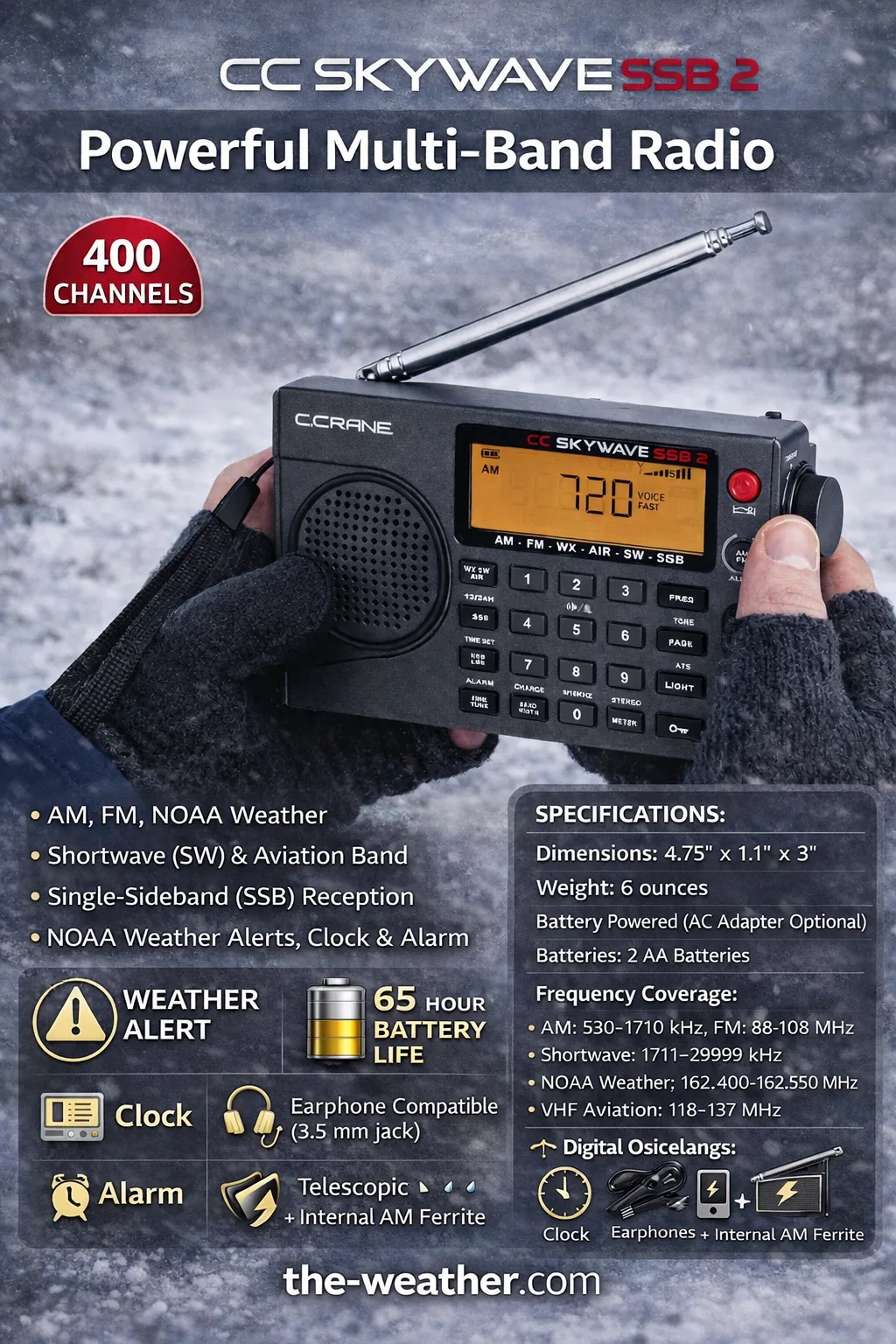
The Power System
Unlike many modern devices that rely on built-in, non-replaceable batteries, the Skywave SSB 2 sticks to the gold standard of preparedness: AA batteries. In a prolonged blackout, you can't recharge a USB bank easily, but you can store a brick of AA batteries for 10 years. The radio also supports USB power for daily listening, saving your batteries for when it counts.
VHF Aviation Band
Based on documented aviation band usage and receiver specifications, the radio is designed to monitor tower and ground control frequencies effectively. With the "Scan" function, users can quickly lock onto active transmissions. Hearing pilot reports of turbulence or visibility issues often gives you a faster, more accurate picture of incoming weather than a standard forecast app. This band covers 118-137 MHz, which is the spectrum allocated by the FCC for aviation safety and communication, making it a reliable source for situational awareness.
Build & Interface
The rubberized coating feels grippy and durable, not like cheap slick plastic. The keypad allows for direct frequency entry: a massive time saver compared to tuning knobs. The lighted LCD display is clear and readable in total darkness, essential for power outage scenarios.
Comparison: Skywave SSB 2 vs. The Competition
Is it worth the premium price tag compared to a standard crank radio? The data suggests yes, if your goal is information access.
| Feature | Standard Crank Radio (e.g., Midland ER310) | C. Crane CC Skywave SSB 2 | Heavy Desktop Receiver |
|---|---|---|---|
| Primary Use | Local Alerts & Light | Long-Range Comms & Travel | Hobby Listening |
| SSB Capability | No | Yes (10Hz Tuning) | Yes |
| Aviation Band | No | Yes (Scannable) | Sometimes |
| Power Source | Crank / Solar / Internal | 2x AA / USB (60+ Hours) | AC Wall Power / D-Cells |
| Portability | Bulky | Pocket Size | Not Portable |
Video Overview
Watch this hands-on demonstration to hear the audio quality and see the compact size of the CC Skywave SSB 2 in action. Note how the tuning knob allows for precise frequency adjustments.
Editorial Team Recommendation
The C. Crane CC Skywave SSB 2 is not the cheapest radio on the market, but it is arguably the most valuable per cubic inch. For those who take preparedness seriously, the ability to listen to Single Side Band and Aviation traffic provides a layer of safety that standard radios cannot match.
If you are looking for a simple radio just to hear a local siren, a cheaper model may suffice. But if you want a professional-grade tool that keeps you connected to the world when local infrastructure fails, this is the radio to buy. It is a permanent fixture in our team's emergency kits.
As an Amazon Associate, we earn from qualifying purchases.Which NOAA Weather Alert Radio Should You Buy?
We put five NOAA weather alert radios head to head on alert coverage, S.A.M.E. county programming, siren volume, and battery backup. See which one we recommend for most homes.
Review Methodology
This review is based on manufacturer specifications, documented performance data, regulatory standards, expert consensus in emergency communication, and comparisons with similar devices used in preparedness scenarios. Our evaluation prioritizes reliability, signal clarity, and power efficiency: the three pillars of effective crisis communication.
Ready to decide?
Get the C. Crane CC Skywave SSB 2
Prices and stock change daily. Check the current price, delivery options and what owners say in their reviews.
In this reviewC. Crane CC Skywave SSB 2Today's price, delivery & owner reviews on Amazon
Check on Amazon →