
Product covered in this analysis
Sainlogic SA68
See today’s price, delivery options and customer reviews on Amazon.
As an Amazon Associate, I earn from qualifying purchases.In this article 7 sections
Our verdict: The Sainlogic SA68 is a full weather station that works without Wi-Fi: wind speed and direction, rain, temperature, humidity and pressure, all on a 6.5-inch display at home. It suits gardeners, rural homeowners and anyone who wants real weather data without an app or an account. If you want your readings on your phone, look at the Ambient WS-2902C instead.
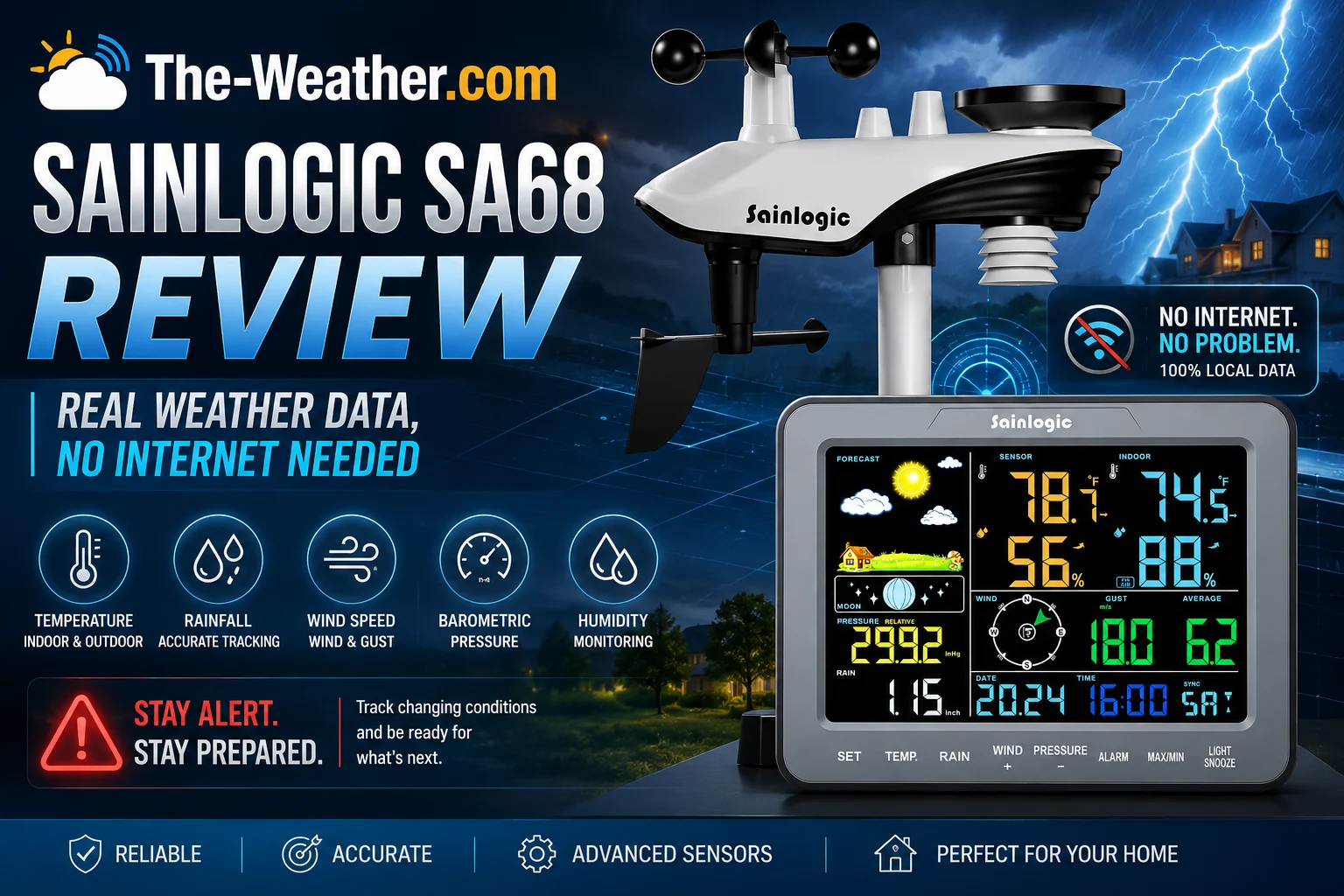
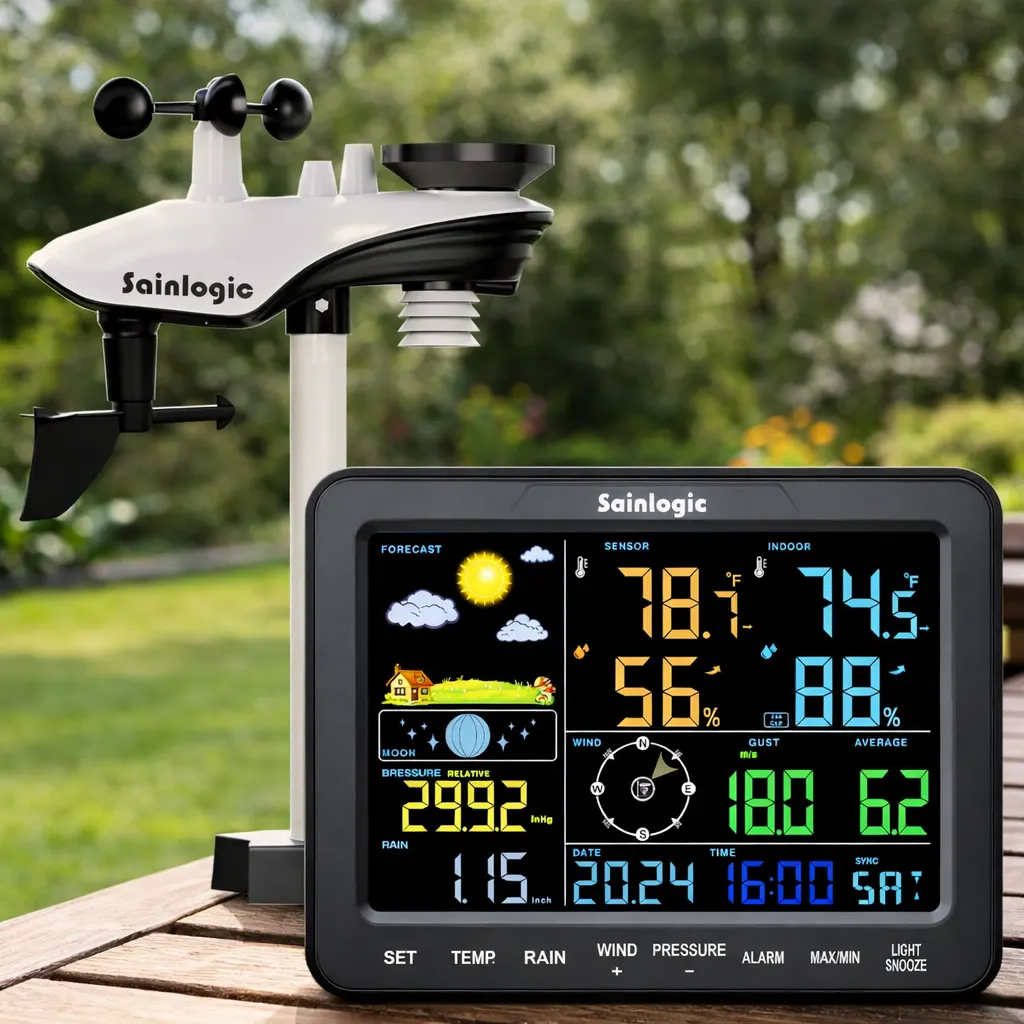
The SA68 display shows wind, rain, temperature, humidity, pressure and moon phase, sent by radio from the outdoor sensor: no internet required.
Correction, October 2026: an earlier version of this review said the SA68 has no wind sensor, a separate rain gauge and an 8.15-inch display. That was wrong. The listing describes wind speed and direction, an outdoor sensor that mounts on a pole and a 6.5-inch display. We have corrected the whole review. Sorry about that: even a weather station reviewer can misread the forecast.
Best Choice Summary
A Full Weather Station Without Wi-Fi
| If you want... | Consider this |
|---|---|
| Wind, rain and temperature on a screen, no Wi-Fi | Sainlogic SA68 ← you are here |
| A compact offline wind and temperature display | AcuRite Notos: compact, no Wi-Fi |
| Wi-Fi + full weather station | Ambient WS-2902C: wind, rain, UV, app |
| Wi-Fi + colour display | La Crosse 328-69357: full Wi-Fi station |
Sainlogic SA68: Specifications
From the Sainlogic SA68 listing on Amazon, checked October 2026.
Pros and Cons
- No Wi-Fi: nothing to set up online, no app, no account
- Wind speed, gusts and direction, rain, temperature, humidity and pressure on one screen
- Solar powered with battery backup, according to the listing
- 6.5-inch display with large, high-contrast digits and 3 backlight levels
- Stated rain accuracy (±1 mm up to 15 mm, ±7% in heavy rain), with manual calibration
- Dew point, feels-like temperature and moon phase
- No router password to re-enter when your Wi-Fi changes
- No remote monitoring: console only, no app
- Alerts show on the display only, not on your phone
- Data not shareable to Weather Underground or other networks
- One sensor array: wind wants height, temperature wants about 5 feet
One Sensor Array: Where to Mount It
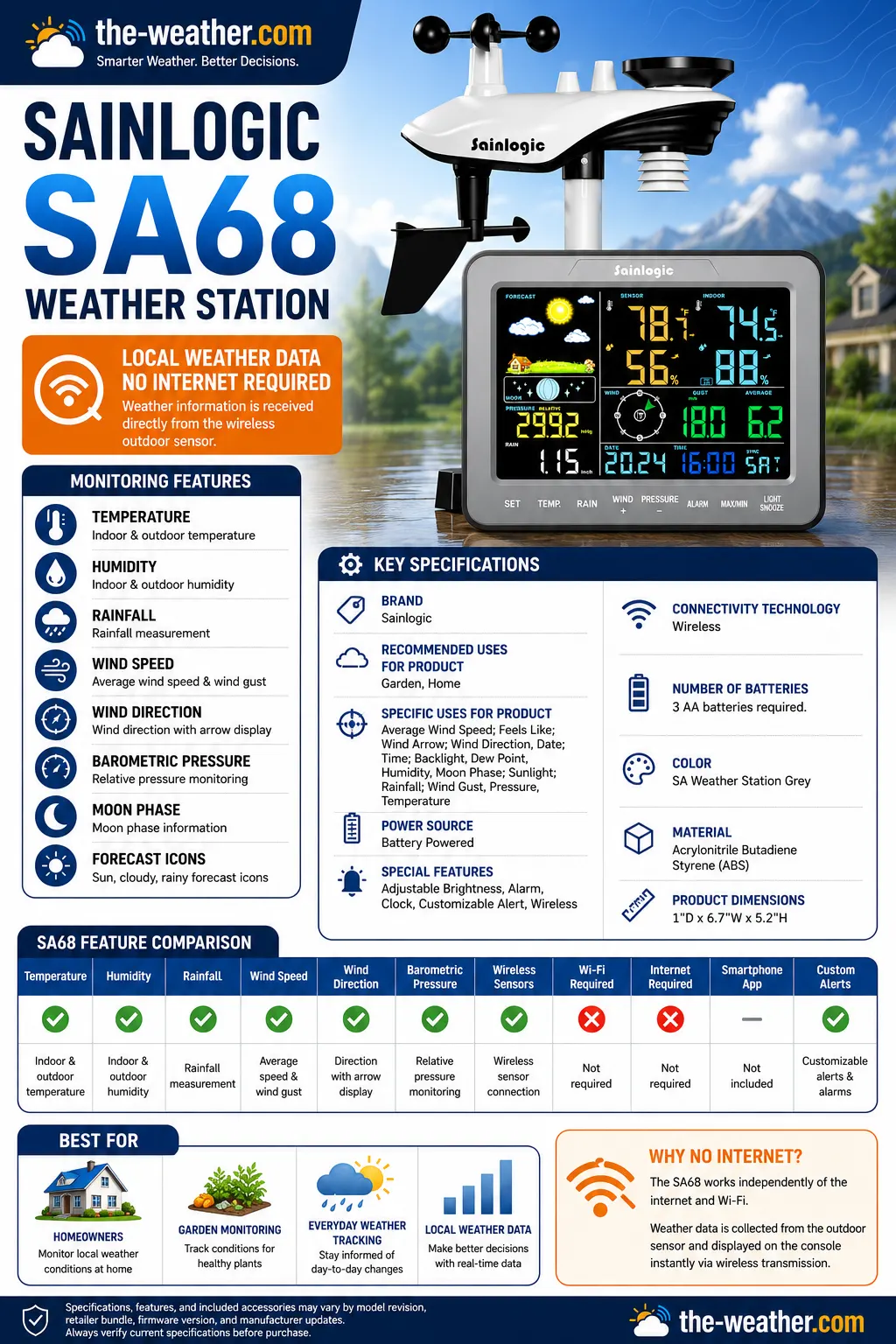
The SA68 outdoor sensor mounts on a pole and measures wind, rain, temperature and humidity in one spot.
Like most consumer weather stations, the SA68 measures wind, rain, temperature and humidity with one outdoor sensor that mounts on a pole. That makes setup easy, but it means one spot has to work for everything. NOAA sensor siting guidance recommends rain gauges be mounted low and away from obstructions to reduce wind-induced splash errors, while temperature sensors should be at approximately 5 feet high in permanent shade with free airflow.
Wind, on the other hand, reads best high up and away from roofs and trees. So you pick a compromise: an open spot in the yard, clear of buildings, with the rain collector level. Put it on a sunny roof and the temperature will think it is always summer.
The offline advantage explained
Wi-Fi weather stations depend on a chain of connections: sensor to console, console to router, router to the internet, and from there to an app on your phone. If one link breaks, your phone stops showing data. The SA68 skips that chain: the outdoor sensor sends its readings by radio straight to the display.
That also means a new router or a changed Wi-Fi password is nothing to worry about: there is no Wi-Fi to re-enter and no app to pair again.
Setup Walkthrough
Sainlogic's own SA68 user guide video walks through the battery and pairing steps.
The Sainlogic SA68 is generally not right for you if:
- You want to monitor remotely while away from home: The SA68 has no app and no Wi-Fi. Readings are only visible on the console display. For remote monitoring the La Crosse 328-69357 or Ambient WS-2902C add app connectivity.
- You want to contribute to Weather Underground or citizen weather networks: The SA68 cannot share data to any external platform. Wi-Fi stations like the WS-2902C support Weather Underground natively.
- You want alerts on your phone: The SA68 has alarms and alerts on the display, but no app to send them to your phone.
- You only want wind and temperature in a small package: the AcuRite Notos is a compact offline alternative without rain.
How the SA68 Compares to Alternatives
| Model | Wind | Rain | Wi-Fi | Display | Often chosen for |
|---|---|---|---|---|---|
| Sainlogic SA68 | ✓ | ✓ | ✗ | 6.5-inch | Full station offline · no app |
| AcuRite Notos | ✓ | ✗ | ✗ | LCD | Offline wind + temp · simple setup |
| Ambient WS-2902C | ✓ | ✓ | ✓ | Colour | Full station · Wi-Fi · Weather Underground |
| La Crosse 328-69357 | ✓ | ✓ | ✓ | ✓ Colour | Wi-Fi + colour display |
Before You Buy: Three Trade-offs
No Wi-Fi means no remote access. If you want to check the rain total during a holiday or the overnight temperature for frost from your bed, a Wi-Fi station such as the La Crosse 328-69357 or WS-2902C is the step up.
The SA68 is a closed system: data does not leave the console. Buyers who want to contribute readings to citizen weather networks or see their history online will find this limiting. Wi-Fi stations like the WS-2902C support Weather Underground natively.
Because wind, rain and temperature share one array, the mounting spot is always a compromise. Plan it before you buy: an open part of the yard, away from roofs and trees, where you can still reach the rain collector to clean it.
More from this brand: our page on the Sainlogic wireless weather station.
Frequently Asked Questions
Does the Sainlogic SA68 require Wi-Fi?
No. The outdoor sensor sends its readings by radio straight to the indoor display: no internet connection, router or app required. It works as a completely standalone unit.
Does the Sainlogic SA68 measure wind speed?
Yes. According to its Amazon listing, the SA68 shows wind speed, wind gusts and wind direction, along with rain, temperature, humidity and pressure. (An earlier version of this review said it had no wind sensor; that was wrong.)
How accurate is the Sainlogic SA68 rain gauge?
The listing gives ±1 mm for light rain up to 15 mm and ±7% for heavy rain, and the rain reading can be calibrated by hand. Mount the array level and in the open, so the rain collector is not sheltered by a roof or tree.
What does the Sainlogic SA68 measure?
Wind speed, gusts and direction, rainfall, indoor and outdoor temperature, humidity, barometric pressure, dew point and feels-like temperature, plus moon phase, date and time.
If you want remote monitoring or app connectivity, our Wi-Fi weather station roundup covers four stations from mid-range to professional grade.
Sources
Specifications from the Sainlogic SA68 listing on Amazon, checked October 2026; more about the brand on the Sainlogic website. NOAA siting guidance from weather.gov/coop. Not independently tested. No manufacturer compensation was received. Product specifications may change: verify before purchasing.

Lena Thornton
Weather Station Analyst & CWOP Contributor. Lena has researched, reviewed and analysed weather stations and environmental sensors from AcuRite, Ambient Weather, Davis Instruments, La Crosse Technology, Sainlogic, and Govee. Updated October 2026.
Ready to decide?
Get the Sainlogic SA68
Prices and stock change daily. Check the current price, delivery options and what owners say in their reviews.