
Our picks in this guide
Compare the models in this guide
See today’s price, delivery options and customer reviews on Amazon.
As an Amazon Associate we earn from qualifying purchases, at no extra cost to you. Learn moreNeed it fast? Prime members get free, fast delivery on eligible items. Try Amazon Prime
We may earn a commission when you buy through links on this page, at no extra cost to you. Learn more
In this article 9 sections

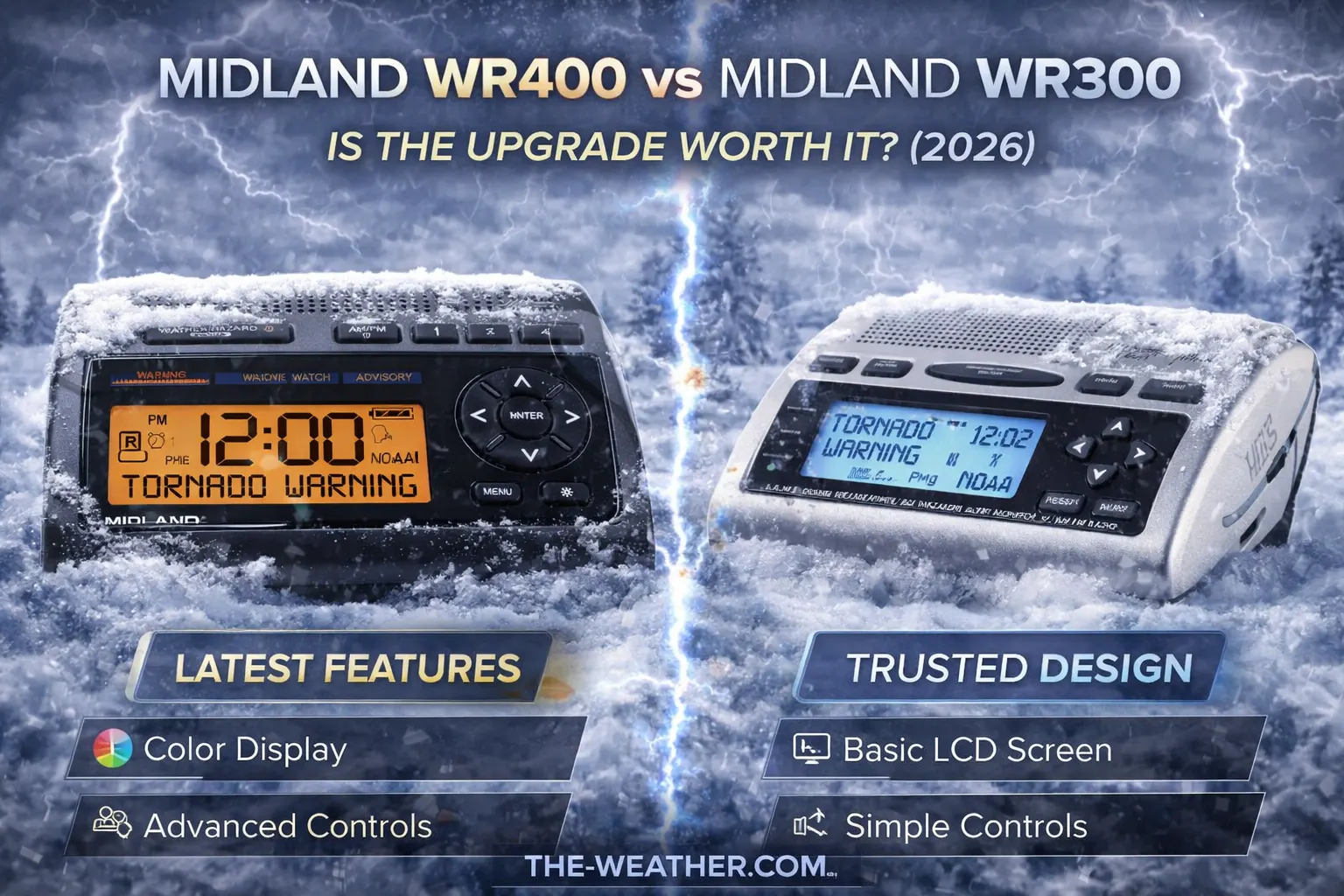
Midland WR400 vs WR300: a visual comparison of display, controls, and alert features to see whether upgrading is worth it in real-world conditions.
⚡ The 5-Second Verdict
- You want to charge a phone from the radio during a power outage
- You need more than 23 S.A.M.E. county slots or a second alarm
- You want the WR400DSP's county subdivision alerts for large counties
- The improved LCD display and 4 radio presets matter to your daily use
- You want the EXP expiration indicator to know when a threat has ended
- A louder 90 dB adjustable siren is a priority
- You don't need USB charging and want to save money
- You are already monitoring a well-known set of counties
✔ Prices checked regularly · Updated March 2026 · Amazon updates pricing daily
📦 Free shipping on most listings · Check individual product pages for current delivery options
Spec-by-Spec Comparison
Three numbers in this table tell most of the story: 80 vs 80 alerts (essentially tied), 25 vs 23 counties (WR400 edges ahead), and 85 vs 90 dB (WR300 is rated louder, though perceived loudness varies with placement and room acoustics). Everything else comes down to the features you actually use day to day.
| Feature | Midland WR400 | Midland WR300 |
|---|---|---|
| Price (approx.) | ~$50–$75 | ~$35–$55 ✓ LOWER PRICE |
| Alert Types | 80+ selectable ✓ SAME | 80+ selectable ✓ SAME |
| S.A.M.E. Counties | 25 programmable ✓ MORE | 23 programmable |
| Siren Volume | 85 dB fixed (v1-3); adjustable Hi/Med/Low on WR400DSP | 90 dB, selectable High/Low ✓ LOUDER + ADJUSTABLE |
| Alert Modes | Siren, Voice, Display (LED flasher only) ✓ MORE OPTIONS | Siren, Voice |
| EXP Expiration Indicator | No | Yes, displays "EXP" when alert expires ✓ WR300 ONLY |
| USB Output | Yes, USB-A, 5V/1A ✓ WR400 ONLY | No |
| AM/FM Presets | 4 AM + 4 FM ✓ MORE | 3 AM + 3 FM |
| Alarms | 2 programmable alarms ✓ MORE | 1 alarm |
| LCD Display | Improved, continuously backlit, blue text ✓ BETTER | Standard backlit LCD, continuous backlight option |
| Color-Coded Indicators | Yes, Advisory/Watch/Warning ✓ SAME | Yes, Advisory/Watch/Warning ✓ SAME |
| Stored Alert Memory | 10 alerts ✓ SAME | 10 alerts ✓ SAME |
| Battery Backup | 4 AA batteries ✓ SAME | 4 AA batteries ✓ SAME |
| Headphone Jack | No | Yes, 3.5mm ✓ WR300 ONLY |
| NOAA Channels | All 7 ✓ SAME | All 7 ✓ SAME |
| WR400DSP Extras | DSP receiver, county subdivision alerts, beep disable ✓ 2025 VERSION | Not applicable |
What Actually Separates Them
Both radios cover all seven NOAA channels, both support S.A.M.E. county programming, and both will wake a household with an alert. The gaps are in the extras, and one of the WR300's extras is something the WR400 still does not have.
1. USB Output: The WR400's Most Practical Advantage
2. The EXP Indicator: The WR300's Most Underrated Feature
Almost every review focuses on what the WR400 adds. Fewer mention what it is missing. The WR300's EXP display is the most useful feature that did not carry forward to the WR400. When a weather watch or warning expires, the WR300 displays "EXP" on its screen, giving a clear signal that the National Weather Service has ended the alert. This is particularly useful in regions with frequent alerts, where watches, warnings, and advisories may stack and cycle through an evening. In those situations, seeing an expiration status removes the guesswork about whether a threat has passed. The WR400, confirmed by multiple user reports on Dick's Sporting Goods and the Weather Radio Wiki, does not display an expiration indicator. For households where alert frequency is lower, this gap matters less, but for anyone in a high-alert region, it is a real functional difference worth considering alongside the rest of our full NOAA weather radio rankings.
3. Siren Volume: WR300 Is Louder by Design
The WR300's siren is rated at 90 dB, confirmed by Crutchfield and Midland's retailer documentation. Its two-level adjustment (High and Low) lets you set it appropriately for a bedroom versus a larger room. Earlier versions of the WR400 fixed the siren at 85 dB with no adjustment at all: a genuine usability complaint documented in real user reviews. The Gadgeteer reviewer specifically noted that the 85 dB fixed siren on the WR400 was loud enough to be disruptive in bedroom use, and that only the Display mode (which silences the siren entirely and shows text only) offered a quieter alternative. Rated dB figures reflect laboratory measurements: perceived loudness in a real home varies depending on placement, room size, and the frequency of the alert tone itself.
The 2025 WR400DSP version addressed this, adding High, Medium, and Low siren adjustment to match the flexibility the WR300 has offered for years. If you are purchasing the WR400DSP specifically, the siren gap is closed. If you are buying an older WR400 version, this remains a real difference. Check the listing carefully: the DSP version is currently sold primarily online through Midland's own site and major retailers, as noted in the Weather Radio Wiki's August 2025 update.
4. County Capacity and the WR400DSP's Subdivision Feature
The WR400 supports 25 programmable S.A.M.E. locations versus 23 on the WR300. For most households monitoring one or two counties, this difference is academic. Where it becomes relevant is for users who monitor multiple areas: a primary home county, a vacation property, counties where family members live, or counties through which they commute. Based on manufacturer listings and retailer documentation, the WR400 supports 25 S.A.M.E. county slots versus 23 on the WR300.
The WR400DSP, specifically, adds a county subdivision feature that has no equivalent anywhere in the WR300 lineup. Rather than receiving alerts for an entire county, users can now program the radio to alert for a specific quadrant of the county. For residents of large rural counties where a tornado warning may cover an area 80 miles from their home, this reduces false activation significantly. This feature is exclusive to the WR400DSP and was not available on any previous WR400 or WR300 version.
Honest Weaknesses of Both Radios
Neither radio is without real limitations. Here is what the positive sections of most reviews tend to leave out.
Two Households, Two Different Right Answers
Paul lives in suburban Kansas City. Spring storm season means multiple tornado watches and warnings per week in April and May, often stacking overnight. What he valued most when choosing a radio was being able to tell when a warning had actually expired, so he and his wife knew when it was safe to go back upstairs from the basement. He chose the WR300 for its EXP indicator. The 90 dB siren on High is loud enough to hear clearly from the basement. He has no interest in charging his phone from the radio.
Sandra lives in coastal Louisiana. Her main concern is hurricane season and multi-day power outages. She keeps her radio on a kitchen counter where it also serves as her everyday alarm clock and AM/FM morning radio. During the last significant outage her area experienced, being able to top up her phone from the WR400's USB port, while the radio ran on AC and she still had power in her area, was a practical benefit. She set the WR400DSP's siren to Medium. The dual alarms let her and her husband run different morning schedules from one radio.
The same NOAA coverage, two genuinely different real-world priorities.
Who Each Radio Is Built For
Both radios are solid home weather alert radios from a brand with a long track record. The decision is a close one that comes down to two or three specific features.
🟩 Choose the WR400 if you are…
- Buying the WR400DSP (2025 version) specifically, which addresses the siren volume issue and adds county subdivision alerts and DSP reception
- Planning to charge a phone from the radio during power outages while on AC power
- Monitoring more than 23 counties, or want more AM/FM presets and a second alarm for a two-person household
- Living in a large county where the WR400DSP's subdivision feature meaningfully reduces false alert activations
- Wanting the most feature-complete desktop radio Midland currently makes for home use
🟣 Choose the WR300 if you are…
- In a tornado-prone region where the EXP expiration indicator is particularly useful for tracking when a watch or warning has ended
- Prioritizing siren volume and control: the 90 dB adjustable siren is louder than the WR400 (v1-3) and adjustable on all versions
- Using the headphone jack for private late-night listening without waking others
- Saving money without sacrificing the core functions that keep a household safe during severe weather
- Not needing USB device charging from the radio itself
Frequently Asked Questions
Final Verdict
This comparison is genuinely close, which is why it matters to understand which features actually apply to your household rather than treating the WR400 as automatically superior because it costs more.
The WR400 is the better radio for most buyers, particularly the WR400DSP version, which resolves the siren volume complaint that followed earlier versions and adds county subdivision alerts that are genuinely useful in large rural counties. The USB output, improved display, dual alarms, and broader county capacity make it a more capable everyday radio for households that want full functionality in one device. Weather Station Experts named it their top home weather radio.
The WR300 earns its place for a specific group of buyers. If you live in a tornado-prone state where weather watches and warnings stack across spring evenings, the EXP indicator is a feature the WR400 still has not matched. The louder 90 dB siren with adjustable levels is more flexible than the fixed 85 dB on older WR400 versions. The headphone jack is a small but practical addition for households where private listening matters. At a lower price, it covers all core S.A.M.E. alert functions without compromise.
Buy the WR400DSP for the most complete home alert radio Midland makes. Buy the WR300 if the EXP indicator or siren control are priorities, or if budget is a factor.
✔ Prices checked regularly · Updated March 2026
📦 Free shipping on most listings · Check individual product pages for current delivery options
* As an Amazon Associate, The-Weather.com earns from qualifying purchases. Using our links costs you nothing extra.
📦 Setting Up Either Radio Correctly
A few configuration steps that most new owners skip, and why they change how well the radio actually works.
More From The-Weather.com
View full profile →
Lena covers emergency weather preparedness technology and home weather monitoring tools. Every comparison on The-Weather.com is based on verified manufacturer specifications, independent published reviews, and documented user feedback. This post was last reviewed and updated in March 2026.
Ready to decide?
Find your pick on Amazon
Prices and stock change daily. Check the current price, delivery options and what owners say in their reviews.
Need it fast? Prime members get free, fast delivery on eligible items. Try Amazon Prime
Amazon PrimeGet it before the next stormPrime members get free, fast delivery on eligible items
Try Prime →Our top picksCompare our picks on AmazonToday's price, delivery & owner reviews on Amazon
Check on Amazon →More from Midland Weather Alert Radios & Reviews
Keep reading: the newest guides and reviews in this topic.

Best Weather Radio for Camping and RV Travel (2026)
Discover the best weather radios for camping and RV trips. Lightweight, portable NOAA radios with solar charging and emergency alerts for reliable outdoor safety.
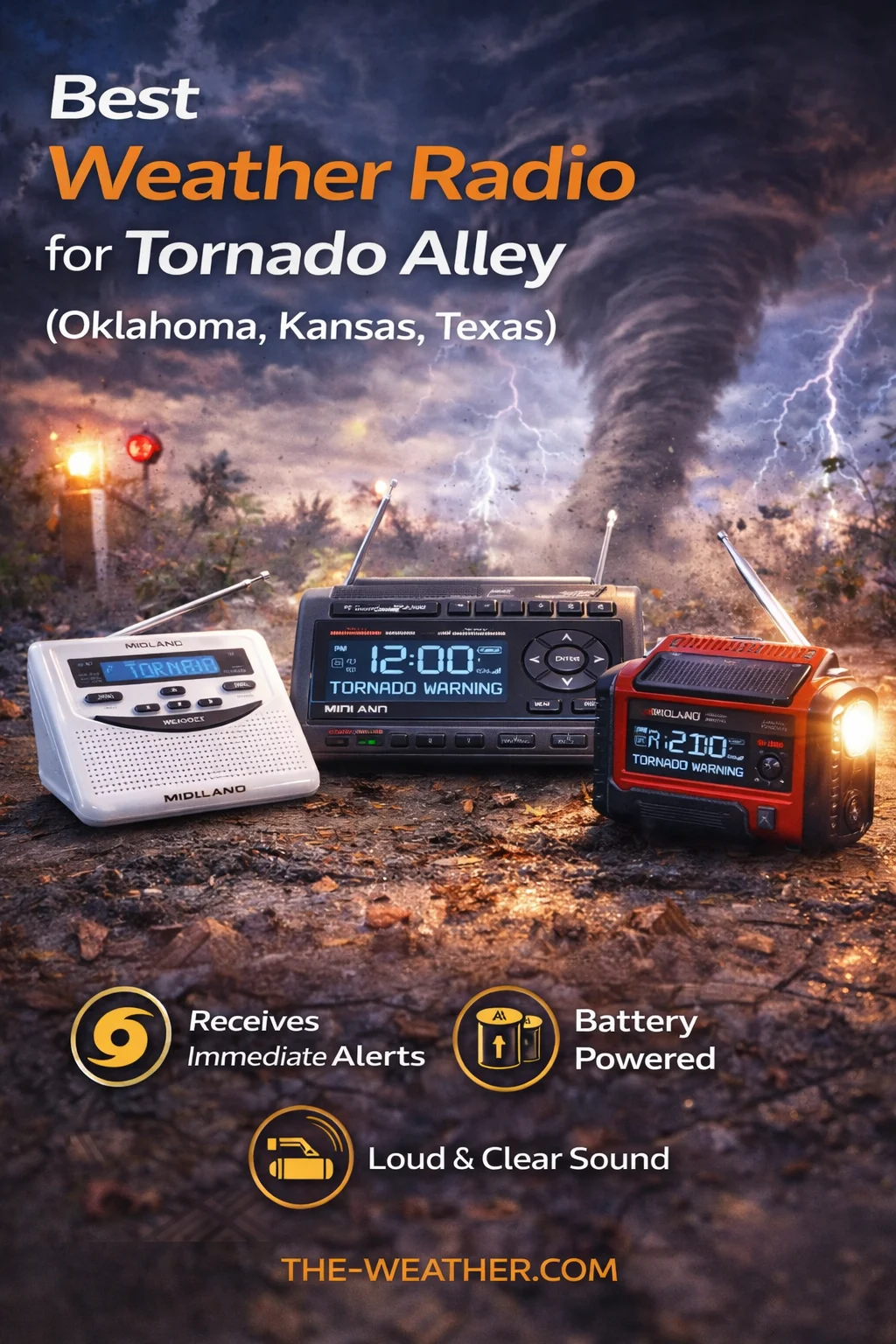
Best Weather Radio for Tornado Alley (Oklahoma, Kansas, Texas)
"Average tornado warning: 13 minutes. A bedside NOAA radio hears it the second the NWS issues it no app, no cell signal needed. Best radios for Oklahoma, Kansas and Texas

Midland WR400 vs WR120B: Which NOAA Radio Is Right for You?
Compare the Midland WR400 and WR120B side by side: alert types, siren volume, battery backup, USB charging, and price. Find out which NOAA weather radio is right for you in 2026.
Find the right weather gear
Our ranked picks for home weather stations and NOAA weather alert radios.