
Product covered in this analysis
Ambient Weather EZ2-35W2MC Pole Mounting Kit
See today’s price, delivery options and customer reviews on Amazon.
As an Amazon Associate, I earn from qualifying purchases.In this article 7 sections
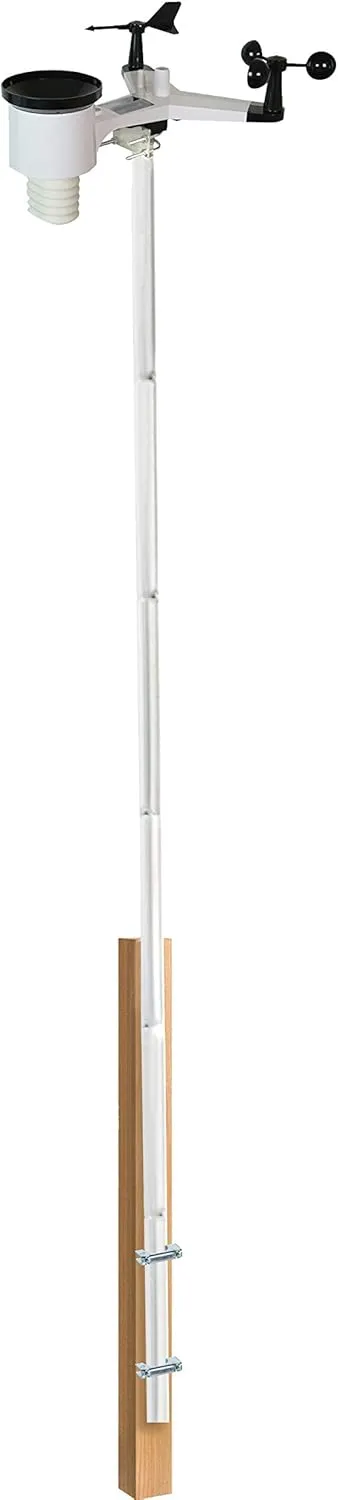
Short answer: the EZ2-35W2MC is a simple, sturdy-on-paper pole kit: six 14-inch galvanized steel mast sections that slot together into a 66-inch (5.5 ft) pole, plus two clamps and four lag screws to bolt it to a fence post or another flat vertical surface. It lifts your sensor array above the fence line. It does not get you anywhere near the 33 feet that is ideal for wind, it does not include roof or chimney hardware, and it does not fit every station. Check your sensor's pole size first.
I have a soft spot for boring hardware. A weather station on a wobbly broomstick is like a nice camera on a shaky table: the expensive part is not the problem. This kit is the unglamorous bit that holds the sensors up, so let's look at exactly what you get and what you still need.
Review basis: research only. This page is based on Ambient Weather's EZ2-35W2MC instruction sheet, Ambient Weather's product listing and the kit's Amazon listing, plus the station manuals named below. We have not installed or tested this kit ourselves, and every figure here is the manufacturer's. As an Amazon Associate I earn from qualifying purchases.
The button goes to the Ambient Weather EZ2-35W2MC Pole Mounting Kit on Amazon. The weather station or anemometer shown in some photos is not included.
These words are our editorial assessment of the published specifications, not test scores.
What Is in the Box
According to Ambient Weather's instruction sheet and listing, the kit contains:
- Six mast sections, each 14 inches long and 1.25 inches in diameter. Each one has a swaged (narrowed) end that slides into the smooth end of the next, and one section is smooth at both ends: that one goes at the bottom.
- Two 1.25-inch clamps (the installation steps call them saddles and give their size as 1-1/8 inch, so do not be surprised by that small mismatch in the paperwork).
- Four 1/4-inch x 3-inch lag screws for fixing the clamps to a post or other vertical surface.
Material: Ambient describes it as "rust proof 10-steel tubing, galvanized using the Flo-Coat (zinc-chromate polymer)". We cannot tell you how many years it lasts outdoors: Ambient does not give a lifespan, and we have not seen one outside.
Not included: the weather station or sensor array, the 35-inch mast extension (sold separately), a drill, a wrench and a level, and any grounding wire.
Warranty: 1-year limited warranty from Ambient, LLC, according to the instruction sheet.
Will It Fit My Weather Station?
This is the question to answer before you click buy. The mast is 1.25 inches in diameter, so your sensor's mounting bracket has to grip a pole that size.
- Ambient Weather WS-2000: its manual says the sensor array's U-bolts fit a pole "between 1.25 and 2 inch diameter", so this kit's mast is inside that range. (See our WS-2000 review.)
- Ambient Weather WS-4000: Ambient's own listing says the kit is not compatible with the WS-4000.
- AcuRite Iris (5-in-1): the AcuRite manual says its mounting bracket screws onto a wooden post (2x4 or larger) or mounts directly on 3/4-inch steel pipe. A 1.25-inch mast is not on AcuRite's list, so check with AcuRite before pairing the two.
- Any other brand: look up the pole diameter range in your station's manual. If the manual does not list 1.25 inch, assume it might not fit.
The Science of Siting: Why Your Weather Station's Location Is Everything
A mounting kit only helps if it puts the sensors in a better spot. A few rules from the station manuals:
- For wind: higher is better. AcuRite's Iris manual notes that the National Weather Service recommends 33 feet (10 meters) for wind measurements. A 66-inch pole adds 5.5 feet to whatever post you clamp it to, so think of this kit as "better than the fence top", not as an official-height mast.
- For obstructions: Ambient's WS-2000 manual suggests installing the sensor array at least 4 times the height difference away from the tallest obstruction. Their example: a 20-foot building and a 6-foot pole means about 56 feet away.
- For temperature: keep sensors away from heat sources such as chimneys, vents, asphalt and concrete (AcuRite).
- For rain: the sensor must be level and have no obstructions above it. Ambient's manual says that if the array is not level, the rain gauge, UV and solar radiation sensors will not measure properly.
The honest takeaway: in most backyards you are choosing the "least bad" spot. A straight, level, solid pole makes that spot work as well as it can.
Installation and Best Practices: Step by Step
Tools you need (per Ambient): an adjustable wrench, a level or plumb line, and a drill.
Safety first: Ambient warns that any metal pole may attract lightning. Never install during a thunderstorm, and Ambient recommends grounding the pole; it suggests asking a licensed electrician or lightning expert before you add a ground wire.
- On a fence post or other flat vertical surface, drill two holes, using one of the saddles (clamps) as a guide.
- Drill a second set of holes at least 12 inches away from the first pair.
- Fix the saddles to the post with the lag screws (do not fully tighten yet).
- Build the mast: push a swaged end into a smooth end and twist it hand-tight, so it will not rotate loose later. Repeat for all six sections. The section that is smooth at both ends goes at the bottom.
- Slide the assembled mast between the post and the clamps.
- Tighten the lag screws until the mast cannot slide up or down, check that it is level (plumb), then tighten all four screws securely.
Then mount your sensor array following your station's own manual. You do not have to use all six sections: fewer sections simply means a shorter pole.
Our Take: Who Should Buy It
A good fit if: you have a solid fence post or wooden structure, your sensor array fits a 1.25-inch pole (for example the Ambient WS-2000), and you want to lift the sensors a few feet above the fence line.
Skip it if: you need to mount on a roof, eave or chimney (there is no roof or chimney hardware in the kit), you own a WS-4000, or your sensor only fits a smaller pipe such as 3/4 inch.
Want the bigger picture on placement? Read our home weather station installation walkthrough.
Check the EZ2-35W2MC Kit on Amazon
As an Amazon Associate I earn from qualifying purchases.
Frequently Asked Questions
What is the total height of the Ambient Weather EZ2-35W2MC mounting kit?
The kit includes six 14-inch mast sections that assemble to a total height of 66 inches (5.5 feet). You can use fewer sections for a shorter pole. A 35-inch mast extension is sold separately.
Can I mount this kit on my roof?
The kit is made for a fence post or other flat vertical surface: it comes with two clamps and four lag screws, and the instructions only cover vertical-surface mounting. There is no roof, eave or chimney hardware in the box.
Is this mounting kit compatible with weather stations from other brands like AcuRite or La Crosse?
Only if the sensor's bracket fits a 1.25-inch pole. Check the pole range in your station's manual. For example, the Ambient WS-2000 array fits 1.25 to 2 inch poles, AcuRite's Iris manual lists wooden posts and 3/4-inch steel pipe, and Ambient says the kit is not compatible with its WS-4000.
How We Researched This
This page is based on Ambient Weather's EZ2-35W2MC instruction sheet and product listing, the kit's listing on Amazon, the Ambient Weather WS-2000 user manual (version 2.20) and the AcuRite Iris (5-in-1) sensor manual. We have not installed or tested the kit ourselves. Research last verified: 24 October 2026. Read more about how we research.
Ready to decide?
Get the Ambient Weather EZ2-35W2MC Pole Mounting Kit
Prices and stock change daily. Check the current price, delivery options and what owners say in their reviews.
In this reviewAmbient Weather EZ2-35W2MC Pole Mounting KitToday's price, delivery & owner reviews on Amazon
Check on Amazon →