
We may earn a commission when you buy through links on this page, at no extra cost to you. Learn more
In this article 7 sections
- What to Expect: A Comprehensive Hardware Package
- The Setup Process: A Two-Part Approach
- A Deeper Analysis of Zivron's Pro-Level Technology
- Summary of Pros & Cons (Based on Research)
- Analyst's Recommendation: Who Should Buy the Zivron Pro?
- Key Questions Answered
- My Review Methodology: A Research-Driven Analysis
Expert Analysis: The Zivron Pro WiFi Weather Station is a feature-rich powerhouse for enthusiasts. My research confirms its comprehensive 5-in-1 sensor suite (wind, rain, UV), true atomic clock, and solid app connectivity are professional-grade features. Its primary limitation is the requirement for AC power for WiFi and a constant display.
Beyond the Basics: A Meteorologist’s Analysis of the Zivron Pro WiFi Weather Station
I'm Lena Thornton. As a meteorologist who has dedicated my career to analyzing weather technology, I get excited when a device promises to bring professional-level data into the home. The Zivron Pro WiFi Weather Station, with its full suite of sensors for wind, rain, and UV, is exactly that kind of ambitious product.
This review is my in-depth analysis of its capabilities, based on a careful breakdown of its technical specifications, app features, and power systems. We have not tested this unit ourselves; this review checks its claims against the specifications and owner reviews to see whether it is a good fit for the serious weather enthusiast, gardener or data-driven homeowner.
Reviewed product
Beyond the Basics
See today’s price, delivery options and customer reviews on Amazon.
As an Amazon Associate we earn from qualifying purchases, at no extra cost to you. Learn moreWhat to Expect: A Comprehensive Hardware Package
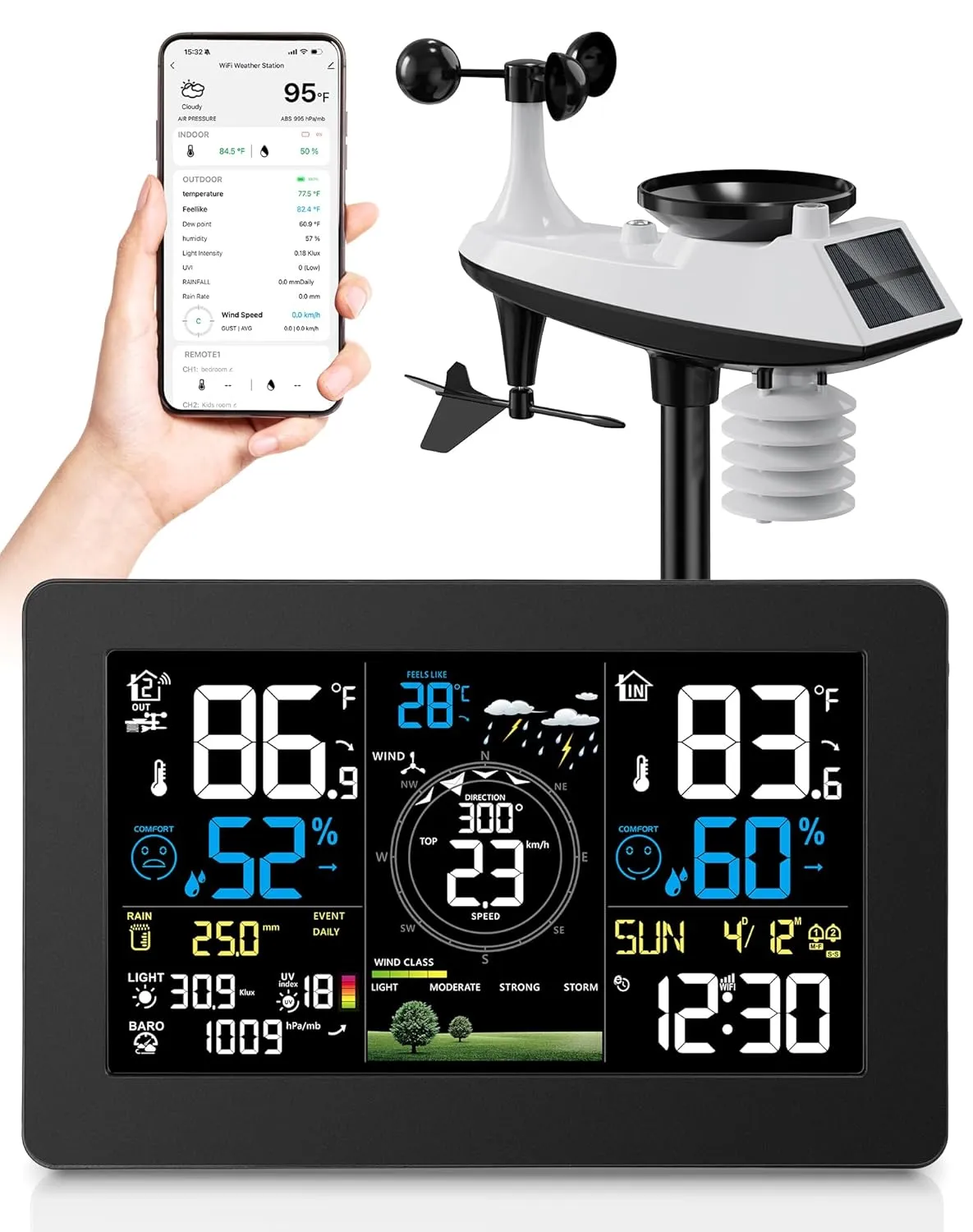
An analysis of the product's components reveals a system far more advanced than a basic thermometer. The package contains two main parts:
- The 7.5-inch HD VA Display Console: This is your indoor command center, featuring a high-contrast color screen and an AC power adapter.
- The 5-in-1 Remote Sensor Array: This is the heart of the system. It's a single, integrated unit that includes a wind vane (direction), wind cups (anemometer for speed), a self-emptying rain funnel (rain gauge), a thermo-hygrometer (temp/humidity), light & UV sensors, and an integrated solar panel.
This all-in-one sensor design simplifies installation compared to older professional systems that required mounting multiple separate components.
The Setup Process: A Two-Part Approach
The manual outlines a setup that involves both physical installation and digital configuration.
- Sensor Assembly & Mounting: The 5-in-1 sensor array needs to be assembled and mounted in an open location away from obstructions like trees and buildings for accurate wind and rain readings. Following guidelines from agencies like NOAA for sensor placement is important for data quality. The solar panel should face south for optimal charging of the 3 AA backup batteries (not included).
- Console Power-Up: For full functionality, the indoor console MUST be plugged in with the AC adapter. This is required for both the always-on display and the WiFi connection.
- WiFi & App Connection: Once plugged in, you can connect the station to your home's 2.4GHz WiFi network using the smart app. The app guides you through the process and becomes the primary way to access historical data and adjust settings.
- Atomic Clock Sync: The console will automatically search for the atomic time signal to set the clock with perfect accuracy.
A Deeper Analysis of Zivron's Pro-Level Technology
This station's feature set clearly targets the user who wants more than just the temperature. Here's my breakdown of its most significant technologies.
The 5-in-1 Sensor Suite: A True Weather Hub
This is what separates a basic thermometer from a true home weather station. The integrated array provides a wealth of data points that give you a complete picture of your microclimate:
- Wind Data: It measures both wind speed and direction, allowing it to calculate metrics like Wind Chill.
- Rainfall Data: The self-emptying rain gauge measures precipitation and can calculate rain rate. This is very useful for gardeners and for understanding storm intensity.
- Atmospheric Data: Beyond temperature and humidity, it calculates Dew Point and Heat Index, which are often better indicators of comfort and safety than temperature alone.
- Solar Data: The inclusion of a UV Index sensor is a fantastic feature for sun safety, helping you decide when sunscreen is essential.
WiFi Connectivity and the Smart App
The ability to connect to WiFi and a smart app is a massive upgrade. It unlocks the station's full potential, allowing you to view your home's weather conditions from anywhere in the world. More importantly, it provides access to detailed historical data, graphs of temperature, rainfall, wind speed, and more, which is something a non-connected station simply cannot do. This data logging is a key feature for any serious weather enthusiast who wants to track trends over time, similar to the capabilities of high-end brands like Davis Instruments.
Power Systems: Understanding the Nuances
The power design is smart but has critical limitations. The outdoor sensor's use of a solar panel with battery backup is excellent, making it a low-maintenance, set-and-forget unit. However, the indoor console's reliance on AC power for its key features (WiFi and always-on display) is an important detail. You must plan to place the console near a power outlet. It is not designed to be a portable, battery-operated unit for full-time use.
Summary of Pros & Cons (Based on Research)
Pros (Confirmed by Specs)
- Comprehensive 5-in-1 Sensor: Measures wind, rain, temperature, humidity, and UV.
- WiFi & Smart App: Allows for remote monitoring and detailed historical data logging.
- Solar-Powered Sensor: Low-maintenance design with battery backup.
- True Atomic Clock: Ensures perfect, maintenance-free timekeeping.
- High-Quality VA Display: Provides excellent clarity and contrast.
Cons (Noted in Specs)
- AC Power Required: WiFi and the always-on display do not work on battery power.
- 2.4GHz WiFi Only: Will not connect to 5GHz networks, a common limitation but important to note.
- Complex Installation: Proper placement of the outdoor sensor is critical for accuracy and requires more effort than a simple thermometer.
- Only One Sensor Included: While it supports up to 3 sensors, the package only comes with the main 5-in-1 array.
Analyst's Recommendation: Who Should Buy the Zivron Pro?
My analysis concludes that the Zivron Pro WiFi Weather Station is an exceptional value for the aspiring weather enthusiast, avid gardener, or data-driven homeowner. It successfully bridges the gap between basic indoor/outdoor thermometers and expensive, professional-grade systems.
If you are ready to move beyond just temperature and want to understand the complete weather picture in your backyard, wind, rain, and all, and you value the ability to track that data on your phone, this is a powerful and highly capable choice. You just need to have a power outlet ready for the display console.
Key Questions Answered
Does this station need to be plugged in for WiFi to work?
Yes, this is a critical detail. According to the manufacturer, the console must be powered by the AC adapter for the WiFi connection and the always-on display to function. On battery power, these features are disabled to save energy.
What does the outdoor sensor measure?
The 5-in-1 sensor array is comprehensive. It measures wind speed (anemometer), wind direction (vane), rainfall (rain gauge), temperature, humidity, light intensity, and UV index.
Is the clock really atomic?
Yes. The specifications confirm it has a true RCC (Radio-Controlled Clock) feature that syncs with the official atomic time signal, ensuring accuracy and automatic adjustments for Daylight Saving Time.
My Review Methodology: A Research-Driven Analysis
This review is a comprehensive analysis based on manufacturer-provided specifications, the official product manual, and an aggregation of available customer data. This unit was not tested by us; this review is based on research of the manufacturer's specifications and owner reviews, interpreted with more than ten years of experience in weather technology. My conclusions are independent and grounded in this rigorous research process.
Ready to decide?
Get the Beyond the Basics
Prices and stock change daily. Check the current price, delivery options and what owners say in their reviews.