
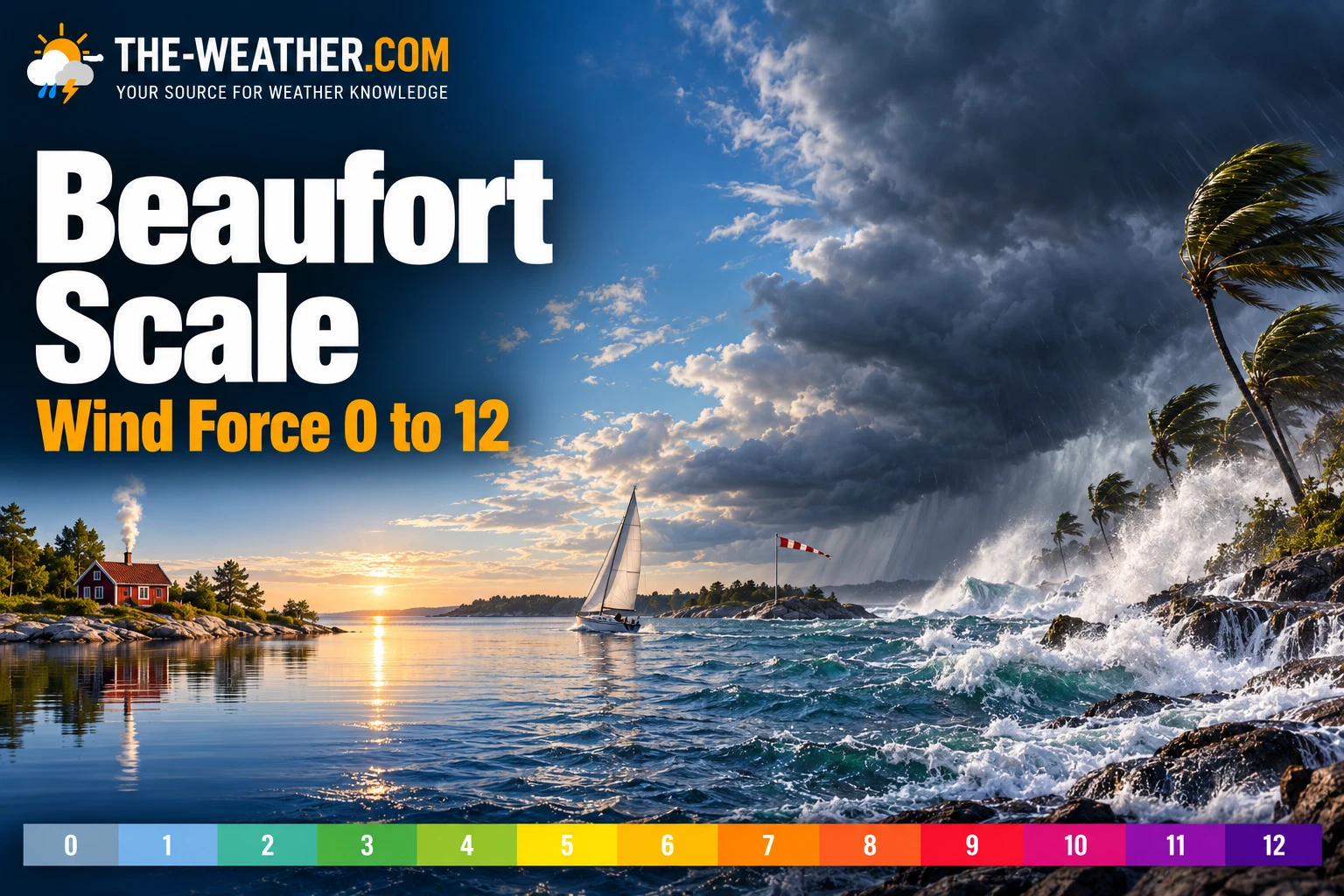
What force is my wind?
The Beaufort wind scale
| Force | Name | mph | knots | km/h | m/s | On land | At sea |
|---|---|---|---|---|---|---|---|
| 0 | Calm | 0-1 | 0-1 | 0-2 | 0-1 | Calm; smoke rises vertically. | Sea like a mirror. |
| 1 | Light Air | 1-3 | 1-3 | 2-6 | 1-2 | Direction of wind shown by smoke drift, but not by wind vanes. | Ripples with the appearance of scales are formed, but without foam crests. |
| 2 | Light Breeze | 4-7 | 4-6 | 7-11 | 2-3 | Wind felt on face; leaves rustle; ordinary vanes moved by wind. | Small wavelets, still short, but more pronounced. Crests have a glassy appearance and do not break. |
| 3 | Gentle Breeze | 8-12 | 7-10 | 13-19 | 4-5 | Leaves and small twigs in constant motion; wind extends light flag. | Large wavelets. Crests begin to break. Foam of glassy appearance. Perhaps scattered white horses. |
| 4 | Moderate Breeze | 13-18 | 11-16 | 20-30 | 6-8 | Raises dust and loose paper; small branches are moved. | Small waves, becoming larger; fairly frequent white horses. |
| 5 | Fresh Breeze | 19-24 | 17-21 | 31-39 | 9-11 | Small trees in leaf begin to sway; crested wavelets form on inland waters. | Moderate waves, taking a more pronounced long form; many white horses are formed. |
| 6 | Strong Breeze | 25-31 | 22-27 | 41-50 | 11-14 | Large branches in motion; whistling heard in telegraph wires; umbrellas used with difficulty. | Large waves begin to form; the white foam crests are more extensive everywhere. |
| 7 | Near Gale | 32-38 | 28-33 | 52-61 | 14-17 | Whole trees in motion; inconvenience felt when walking against the wind. | Sea heaps up and white foam from breaking waves begins to be blown in streaks along the direction of the wind. |
| 8 | Gale | 39-46 | 34-40 | 63-74 | 17-21 | Breaks twigs off trees; generally impedes progress. | Moderately high waves of greater length; edges of crests begin to break into spindrift. The foam is blown in well-marked streaks along the direction of the wind. |
| 9 | Severe Gale | 47-54 | 41-47 | 76-87 | 21-24 | Slight structural damage occurs (chimney-pots and slates removed). | High waves. Dense streaks of foam along the direction of the wind. Crests of waves begin to topple, tumble and roll over. Spray may affect visibility. |
| 10 | Storm | 55-63 | 48-55 | 89-102 | 25-28 | Seldom experienced inland; trees uprooted; considerable structural damage occurs. | Very high waves with long overhanging crests. The resulting foam, in great patches, is blown in dense white streaks along the direction of the wind. On the whole the surface of the sea takes on a white appearance. The tumbling of the sea becomes heavy and shock-like. Visibility affected. |
| 11 | Violent Storm | 64-72 | 56-63 | 104-117 | 29-32 | Very rarely experienced; accompanied by wide-spread damage. | Exceptionally high waves (small and medium-size ships might be for a time lost to view behind the waves). The sea is completely covered with long white patches of foam lying along the direction of the wind. Everywhere the edges of the wave crests are blown into froth. Visibility affected. |
| 12 | Hurricane | 72-83 | 64-71 | 119-131 | 33-37 | See the Saffir-Simpson Hurricane Wind Scale. | The air is filled with foam and spray. Sea completely white with driving spray; visibility very seriously affected. |
Names, mph, knots and the land and sea descriptions are quoted from the National Weather Service Miami "Beaufort Wind Scale", including its own overlap at 72 mph between force 11 (64-72) and force 12 (72-83). The km/h and m/s columns are our conversion of the NWS knots column (1 knot = 1.852 km/h), rounded. For force 12 on land the NWS refers to the Saffir-Simpson Hurricane Wind Scale.
Where the scale comes from
In the words of the National Weather Service: "One of the first scales to estimate wind speeds and the effects was created by Britain's Admiral Sir Francis Beaufort (1774-1857). He developed the scale in 1805 to help sailors estimate the winds via visual observations. The scale starts with 0 and goes to a force of 12. The Beaufort scale is still used today to estimate wind strengths."
How to use it without an instrument
Look at what moves. Smoke drifting but a wind vane standing still means force 1. Leaves rustling and wind on your face: force 2. Small branches moving and dust rising: force 4. Whole trees in motion and walking into the wind gets harder: force 7. These are the NWS land descriptions from the table above, so you can estimate the wind from your window.
Want the real number? Our live wind speed tool shows the wind and its Beaufort force for your ZIP code right now, and the wind speed converter turns any speed into mph, km/h, knots, m/s and Beaufort at once. To measure it yourself, see how to measure wind speed and our handheld anemometer picks.
Quick answers
What is force 8 on the Beaufort scale?
A "Gale", 39-46 mph (34-40 knots) on the NWS table. On land: "Breaks twigs off trees; generally impedes progress."
What Beaufort force is 20 mph?
Force 5, "Fresh Breeze" (19-24 mph): "Small trees in leaf begin to sway; crested wavelets form on inland waters."
What is the highest Beaufort number?
Force 12, "Hurricane", from 64 knots on the NWS table. For stronger hurricanes the NWS points to the Saffir-Simpson Hurricane Wind Scale.
Is the Beaufort scale still used?
Yes. The NWS says: "The Beaufort scale is still used today to estimate wind strengths."
Source: National Weather Service Miami - South Florida: Beaufort Wind Scale