
Product covered in this analysis
VEVOR 7-in-1
See today’s price, delivery options and customer reviews on Amazon.
As an Amazon Associate, I earn from qualifying purchases.In this article 9 sections
- The Hardware: A Close Look
- 💰 Why This Station Pays for Itself (The ROI)
- The Setup: From Box to Cloud
- 💸 The Price Reality Check: VEVOR vs. Davis
- Maintenance & Longevity: Keeping it Pro
- Pros & Cons (The Honest Truth)
- 🛒 Analyst's Recommendation: Who Should Buy This?
- Want to Understand the Data You’re Seeing?
- Frequently Asked Questions
VEVOR 7-in-1 Review: A Budget Alternative to Davis
The Expert Verdict: The VEVOR 7-in-1 Wi-Fi Weather Station is a "Market Disruptor." It offers a sensor suite close to that of a professional system for a fraction of the cost. Its listed 492ft (150m) range is longer than most stations in its class, and the SmartLife App integration makes it future-proof for home automation. However, users must know that the indoor console requires AC power for Wi-Fi connectivity.
- 📡 Range: 492 ft / 150m (Exceptional).
- 📱 App: SmartLife (No subscription fees).
- ☀️ Outdoor Power: Solar Panel + NiMH Backup.
- 🔌 Indoor Power: AC Adapter (Required for Wi-Fi).
- ⛈️ Sensors: Wind (Speed/Dir), Rain, Temp, Humidity, UV, Light.
The Hardware: A Close Look
I'm Lena Thornton. With a career spent analyzing weather technology, I've seen many devices that promise to bring the power of a professional weather station to your backyard. The VEVOR 7-in-1 Wi-Fi station is one of the most ambitious I've seen in its class.
Most budget stations give you temperature and maybe wind speed. VEVOR gives you the "Holy Grail" of gardening data: UV Index and Light Intensity (Lux). This is critical for managing greenhouses or protecting your skin.
What’s in the Box?
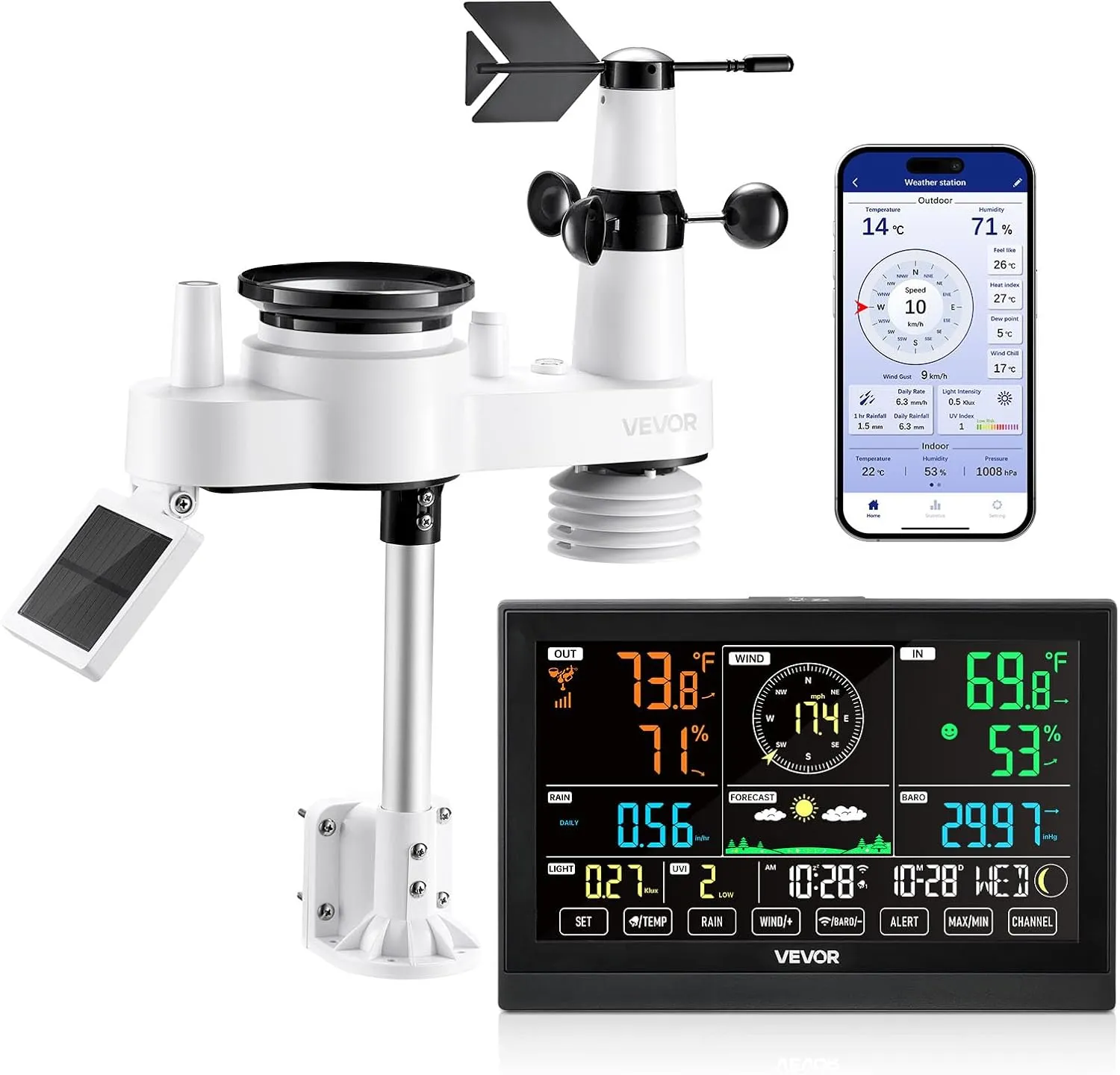
- The 7.5-inch VA Display Console: Your indoor hub for viewing all the data at a glance. It features a high-contrast color screen.
- The 7-in-1 Outdoor Sensor Array: This is the core of the system. A single, integrated unit houses a wind vane, wind cups, a rain funnel, a thermo-hygrometer, and sunlight/UV sensors.
- Mounting Hardware: The station includes a durable aluminum alloy rod and bracket for secure installation.
💰 Why This Station Pays for Itself (The ROI)
Many people hesitate at the price tag, but let's look at the math. A weather station isn't just a toy; it's an asset protection device.
- Save Your Garden: One unexpected frost can kill hundreds of dollars of plants. The VEVOR sends alerts to your phone via the SmartLife app the moment temps drop, giving you time to cover your crops.
- Lower Water Bills: Why water the lawn if it just rained? By tracking exact rainfall totals in your backyard (not at the airport 10 miles away), you can skip watering days and save on your utility bill.
- Protect Your Home: High wind alerts can warn you to retract expensive awnings or secure patio furniture before a storm hits.
The Bottom Line: If this station saves your tomato crop once, or prevents one awning from ripping in the wind, it has effectively cost you $0.
📊 VEVOR vs. The Competition
How does the VEVOR stack up against a standard "Big Box Store" station or even a pro-level Davis? The difference is in the data density.
The Setup: From Box to Cloud
The setup for a comprehensive station like this is more involved than a simple thermometer, but the process is logical. Here is the workflow:
Place the sensor array on a pole (not included) in an open area. Ensure the solar panel faces South (in the Northern Hemisphere) for maximum charge. Follow NOAA guidelines for placement.
Plug the indoor display into the wall. Important: Do not rely on batteries. Wi-Fi only activates when plugged in.
Open the SmartLife app on your phone. It should auto-detect the station. No subscription fees, no proprietary websites.
Why the SmartLife App Matters
In my analysis of weather tech, app integration is a major factor. VEVOR’s choice to use the universal SmartLife app is a brilliant move. Unlike proprietary apps that often get abandoned by developers, SmartLife is a global standard for home automation.
This means you can create "Scenes." For example, you can program your smart sprinkler system to turn off automatically if your VEVOR station detects rain. Or, you can have your smart blinds close if the VEVOR detects high UV levels. This level of automation is usually reserved for systems costing three times as much.
💸 The Price Reality Check: VEVOR vs. Davis
Many weather hobbyists love Davis Instruments. Their Vantage Vue is the gold standard. But let's be honest about the price.
A full Davis setup with Wi-Fi connectivity (WeatherLink Console) costs several times as much as the VEVOR 7-in-1.
The Question: Is the Davis 3x better? For scientific research, maybe. But for the home user, the VEVOR covers most of the same measurements for a fraction of the price. You get the same wind, rain, and solar data. Unless you are running a government lab, the VEVOR is the smarter financial choice.
Maintenance & Longevity: Keeping it Pro
To keep your VEVOR 7-in-1 running like a pro station, you need to treat it like one. Here are my top maintenance tips for solar-powered stations:
- Clean the Rain Funnel: Twice a year, check the rain gauge funnel for spider webs or leaves. Debris here will cause false rainfall readings.
- Wipe the Solar Panel: The outdoor sensor relies on solar power to extend battery life. If the panel gets covered in pollen or bird droppings, your batteries will drain faster. A quick wipe with a damp cloth every season is all it takes.
- Winter Battery Care: While the station supports NiMH rechargeable batteries, if you live in an area that drops below -4°F (-20°C), I recommend swapping them for Lithium AA batteries. Lithium handles extreme cold much better than alkaline or NiMH.
Pros & Cons (The Honest Truth)
No weather station is perfect. Here is where the VEVOR shines and where it compromises.
✅ The Good
- Range: 492ft is massive. Great for farms/large yards.
- App: SmartLife is a universal app. Keep your weather, lights, and plugs in one place.
- Screen: 7.5-inch VA display is bright and colorful.
- Price: Unbeatable for a 7-sensor suite.
- Internet Time Sync: Uses NTP for perfect accuracy.
❌ The Bad
- AC Dependent: If power goes out, Wi-Fi goes out.
- 2.4GHz Only: Won't connect to 5GHz Wi-Fi (common in smart devices).
- Mounting Pole: You usually need to buy the pole separately.
🛒 Analyst's Recommendation: Who Should Buy This?
Based on my in-depth analysis, the VEVOR 7-in-1 is the ideal choice for the serious home user, gardener, or weather enthusiast who is ready to graduate to a full suite of weather metrics but isn't ready to pay for a Davis system.
Want to Understand the Data You’re Seeing?
A weather station is only as useful as your understanding of the data it provides. While the VEVOR 7-in-1 delivers fast, hyper-local readings, many users notice that those numbers don’t always match weather apps or official forecasts.
If you’d like to understand why this happens and how to get the most reliable readings from your station, these guides explain the fundamentals:
-
Why Your Weather Station Is More Accurate Than Weather Apps
Learn how airport-based forecasts and weather models differ from real-time backyard measurements, and why local sensors often give more reliable results for your home. -
How Accurate Are 7-in-1 Weather Stations?
A practical breakdown of sensor accuracy, placement limitations, and calibration tips so you know exactly what to expect from an all-in-one station like the VEVOR.
Understanding these basics helps you avoid common setup mistakes and get the most accurate, trustworthy data possible from your weather station.
Frequently Asked Questions
Does it work with Weather Underground?
Yes. Through the SmartLife app configuration, you can push your data to Weather Underground and WeatherCloud to share with the global community.
How does the clock set itself?
It uses NTP (Network Time Protocol). As soon as it connects to Wi-Fi, it pulls the atomic time from the internet. No manual setting required.
What batteries do I need?
The outdoor sensor takes 3x AA batteries (we recommend Lithium for cold weather) as a backup for the solar panel. The indoor console takes AAA batteries for memory backup.
Which Home Weather Station Is Worth Buying?
We put five home weather stations head to head on accuracy, Wi-Fi connectivity, sensor quality, and long-term reliability. See which one we recommend for most homeowners.
Last Updated:
Ready to decide?
Get the VEVOR 7-in-1
Prices and stock change daily. Check the current price, delivery options and what owners say in their reviews.